



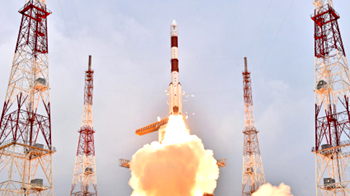
ISRO launches record 20 satellites in one go

June 22, 2016

satellites1

Sriharikota (AP), Jun 22: Setting a record in its space programme, India today successfully launched 20 satellites, including its earth observation Cartosat-2 series, in a single mission on board ISRO's workhorse PSLV-C34 from the spaceport here.

In a precision launch, PSLV-C34 took off from the second launch pad of Satish Dhawan Space Centre here, about 110 km from Chennai at 9.26 AM and placed the Cartosat-2 Series and 19 others in the designated polar Sun Synchronous Orbit (SSO) about 30 minutes later in clear skies.

The 727.5 kg Cartosat-2 series satellite will provide regular remote sensing services with its panchromatic and multispectral cameras and its imagery will be of multiple use.

Of the 19-satellites, 12 are earth imaging "Dove satellites" of USA and another American satellite. The rest are from Canada (two) and one each from Germany and Indonesia.

Two academic satellites are from Sathyabama University (Sathyabamasat) in Chennai and from College of Engineering (Swayam) at Pune.

Use of Cartosat 2 includes cartographic, urban and rural applications, coastal land use and regulation, utility management like road network monitoring and water distribution.

Also, creation of land use maps, precision study,change detection to bring out geographical and man-made features and various other Land Information System and Geographical Information System applications can be done. It is similar to the earlier Cartosat-2, 2A and 2B.

Prime Minister Narendra Modi congratulated ISRO and described today's launch as a "monumental" accomplishment.

"20 satellites in a go! @ isro continues to break new barriers. hearty congratulations to our scientists on the monumental accomplishment', he said on Twitter.

ISRO Chairman A S Kiran Kumar congratulated his team for the successful launch 'in a record time' and said "PSLV C-34 has done its job."

"We have the current generation of earth observation satellite of Cartosat 2 series," he said, adding ISRO had done a "wonderful job".

P Kunhikrishnan, Director, SDSC-SHAR, said that it was a major accomplishment by PSLV in its 35th consecutive successful mission.

"PSLV has become a success symbol for ISRO and India. ISRO is adopting more and more professionalism," he said.

D Jayakumar, Mission Director,described today's launch as a major landmark and said that the vehicle performance was "exceedingly well."

With today's launch of 20 satellites, PSLV beat its 2008 record when it placed in orbit 10 satellites in a single launch into various Low Earth Orbits.

This is the 14th flight of PSLV in "XL" configuration known for its capacity to carry more load which uses 'solid strap-on motors'.

The total weight of all the 20 satellites carried onboard PSLV-C34 is about 1288 kg.

India has 11 operational earth observation satellites, including RESOURCESAT-1 and 2, CARTOSAT-1, 2, 2A, 2B, RISAT-1 and 2, OCEANSAT-2 are in orbit.

Beginning in 1988, ISRO had launched many remote sensing satellites (for earth observation) and the data are for varied use including agriculture, water and ocean resources besides disaster management.

Comments

Add new comment

  • Coastaldigest.com reserves the right to delete or block any comments.
  • Coastaldigset.com is not responsible for its readers’ comments.
  • Comments that are abusive, incendiary or irrelevant are strictly prohibited.
  • Please use a genuine email ID and provide your name to avoid reject.
News Network
February 14,2020

Feb 14: India will never forget the martyrdom of the security personnel killed in last year's Pulwama attack, Prime Minister Narendra Modi said on Friday.

He termed the slain security personnel were "exceptional individuals" who devoted their lives to serving and protecting the nation.

On February 14 last year, a convoy of vehicles carrying security personnel on the Jammu-Srinagar National Highway was attacked by a vehicle-borne suicide bomber at Lethpora in Pulwama district of Jammu and Kashmir. Forty Central Reserve Police Force (CRPF) personnel were killed in the attack.

"Tributes to the brave martyrs who lost their lives in the gruesome Pulwama Attack last year. They were exceptional individuals who devoted their lives to serving and protecting our nation. India will never forget their martyrdom," tweets PM Modi one year since the Pulwama attack.

"I pay homage to the martyrs of Pulwama Attack. India will forever be grateful of our bravehearts and their families who made supreme sacrifice for the sovereignty and integrity of our motherland," tweets Union Home Minister Amit Shah.

Comments

Add new comment

  • Coastaldigest.com reserves the right to delete or block any comments.
  • Coastaldigset.com is not responsible for its readers’ comments.
  • Comments that are abusive, incendiary or irrelevant are strictly prohibited.
  • Please use a genuine email ID and provide your name to avoid reject.
Agencies
January 9,2020

The World Bank says that a lack of credit and drop in private consumption have led to a gloomy growth outlook for India with a steep cut in growth rate for the current fiscal year and only a modest gain projected for the next year.

India's growth rate is forecast to be only 5 per cent for the current fiscal year, weighed down by a growth of only 4.5 per cent in the July-September quarter, according to the 2020 Global Economic Prospects report released on Wednesday.

"In India, [economic] activity was constrained by insufficient credit availability, as well as by subdued private consumption," the Bank said.

The growth rate is forecast by the Bank to pick up to 5.8 per cent in the next fiscal year and to 6.1 per cent in 2021-22.

India's growth rate was 6.8 per cent in 2018-19.

The 5 per cent growth rate projection for the current financial year is a sharp cut of 2.5 per cent from the 7.5 per cent forecast made by the Bank in January last year, toppling it from the rank of the world's fastest growing economy.

India's performance follows a global trend of lowered growth weighed down by developed economies.

The report estimated world economic growth rate to be only 2.4 per cent last year and forecast it to edge up 0.1 per cent to 2.5 per cent in the current year.

Even with the lower growth rate of 5 per cent in the current fiscal year and 5.8 per cent forecast for the next, India holds the second rank among large economies, behind only China with an estimated growth rate of 6.1 per cent for 2019 and 5.9 per cent this year.

The report blamed "weak confidence, liquidity issues in the financial sector" and "weakness in credit from non-bank financial companies" for India's slowdown.

The Bank predicated India's recovery to 5.8 per cent in the coming financial year for India but "on the monetary policy stance remaining accommodative" and the assumption that "the stimulative fiscal and structural measures already taken will begin to pay off."

It also warned that sharper-than-expected slowdown in major external markets such as United States and Europe, would affect South Asia through trade, financial, and confidence channels, especially for countries with strong trade links to these economies."

The Bank said that the growth of advanced economies was 1.6 per cent last year and "is anticipated to slip to 1.4 per cent in 2020 in part due to continued softness in manufacturing."

In contrast the growth of emerging market and developing countries is expected to accelerate from 3.5 per cent last year to 4.1 per cent this year, the report said.

In South Asia, Bangladesh is estimated to have the highest growth rate of 7.2 per cent in the current fiscal year, although down from 8.1 per cent last fiscal year.

But its higher regional growth rates are coming off a lower base with a per capital gross domestic product of $1,698 compared to $2,010 for India.

Bangladesh is expected to grow by 7.3 per cent in the next financial year.

Pakistan's growth rate is estimated at only 2.4 per cent in the current fiscal year and is projected to rise to 3 per cent in the next, according to the Bank.

The Bank blamed monetary tightening in Pakistan for a sharp deceleration in fixed investment and a considerable softening in private consumption for the fall in growth rate from 3.3 per cent in the 2018-19 fiscal year.

Sri Lanka's growth rate was estimated to be 2.7 per cent last year and forecast to grow to 3.3 per cent this year.

Nepal grew by an estimated 6.4 per cent in the current fiscal year and will rise to 6.5 per cent in the next.

Comments

Add new comment

  • Coastaldigest.com reserves the right to delete or block any comments.
  • Coastaldigset.com is not responsible for its readers’ comments.
  • Comments that are abusive, incendiary or irrelevant are strictly prohibited.
  • Please use a genuine email ID and provide your name to avoid reject.
News Network
May 25,2020

New Delhi, May 25: Mahindra Group Chairman Anand Mahindra on Monday said lockdown extensions are not just economically disastrous but also create another medical crisis.

While acknowledging that choices are not easy for policymakers, he said a lockdown extension will not help.

"Lockdown extensions aren't just economically disastrous, as I had tweeted earlier, but also create another medical crisis," Mahindra said in a tweet.

He was referring to an article that highlighted "the dangerous psychological effects of lockdowns & the huge risk of neglecting non-COVID patients".

Mahindra, who had earlier proposed a comprehensive lifting after 49 days of lockdown, further said, "The choices aren't easy for policy makers but a lockdown extension won't help".

He said, "The numbers (coronavirus cases) will continue to rise & the focus must be on rapid expansion of field hospital beds with oxygen lines".

He further said, "The army has enormous expertise in this".

On March 22, before the government announced nationwide lockdown, Mahindra had proposed such a move expressing concerns over reports that India was likely to have already reached stage 3 of coronavirus transmission.

Comments

Add new comment

  • Coastaldigest.com reserves the right to delete or block any comments.
  • Coastaldigset.com is not responsible for its readers’ comments.
  • Comments that are abusive, incendiary or irrelevant are strictly prohibited.
  • Please use a genuine email ID and provide your name to avoid reject.