


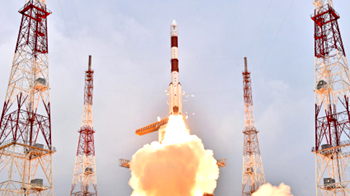
ISRO launches record 20 satellites in one go

June 22, 2016

satellites1

Sriharikota (AP), Jun 22: Setting a record in its space programme, India today successfully launched 20 satellites, including its earth observation Cartosat-2 series, in a single mission on board ISRO's workhorse PSLV-C34 from the spaceport here.

In a precision launch, PSLV-C34 took off from the second launch pad of Satish Dhawan Space Centre here, about 110 km from Chennai at 9.26 AM and placed the Cartosat-2 Series and 19 others in the designated polar Sun Synchronous Orbit (SSO) about 30 minutes later in clear skies.

The 727.5 kg Cartosat-2 series satellite will provide regular remote sensing services with its panchromatic and multispectral cameras and its imagery will be of multiple use.

Of the 19-satellites, 12 are earth imaging "Dove satellites" of USA and another American satellite. The rest are from Canada (two) and one each from Germany and Indonesia.

Two academic satellites are from Sathyabama University (Sathyabamasat) in Chennai and from College of Engineering (Swayam) at Pune.

Use of Cartosat 2 includes cartographic, urban and rural applications, coastal land use and regulation, utility management like road network monitoring and water distribution.

Also, creation of land use maps, precision study,change detection to bring out geographical and man-made features and various other Land Information System and Geographical Information System applications can be done. It is similar to the earlier Cartosat-2, 2A and 2B.

Prime Minister Narendra Modi congratulated ISRO and described today's launch as a "monumental" accomplishment.

"20 satellites in a go! @ isro continues to break new barriers. hearty congratulations to our scientists on the monumental accomplishment', he said on Twitter.

ISRO Chairman A S Kiran Kumar congratulated his team for the successful launch 'in a record time' and said "PSLV C-34 has done its job."

"We have the current generation of earth observation satellite of Cartosat 2 series," he said, adding ISRO had done a "wonderful job".

P Kunhikrishnan, Director, SDSC-SHAR, said that it was a major accomplishment by PSLV in its 35th consecutive successful mission.

"PSLV has become a success symbol for ISRO and India. ISRO is adopting more and more professionalism," he said.

D Jayakumar, Mission Director,described today's launch as a major landmark and said that the vehicle performance was "exceedingly well."

With today's launch of 20 satellites, PSLV beat its 2008 record when it placed in orbit 10 satellites in a single launch into various Low Earth Orbits.

This is the 14th flight of PSLV in "XL" configuration known for its capacity to carry more load which uses 'solid strap-on motors'.

The total weight of all the 20 satellites carried onboard PSLV-C34 is about 1288 kg.

India has 11 operational earth observation satellites, including RESOURCESAT-1 and 2, CARTOSAT-1, 2, 2A, 2B, RISAT-1 and 2, OCEANSAT-2 are in orbit.

Beginning in 1988, ISRO had launched many remote sensing satellites (for earth observation) and the data are for varied use including agriculture, water and ocean resources besides disaster management.

Comments

Add new comment

  • Coastaldigest.com reserves the right to delete or block any comments.
  • Coastaldigset.com is not responsible for its readers’ comments.
  • Comments that are abusive, incendiary or irrelevant are strictly prohibited.
  • Please use a genuine email ID and provide your name to avoid reject.
News Network
April 23,2020

Washington, Apr 23: Air pollution over northern India has plummeted to a 20-year-low for this time of the year, according to satellite data published by US space agency National Aeronautics and Space Administration (NASA).
The US space agency's satellite sensors observed aerosol levels at a 20-year low post the countrywide lockdown, implemented to slow the spread of the novel coronavirus.

"We knew we would see changes in atmospheric composition in many places during the lockdown," said Pawan Gupta, a Universities Space Research Association (USRA) scientist at NASA''s Marshall Space Flight Center. "But I have never seen aerosol values so low in the Indo-Gangetic Plain at this time of year," added Mr Gupta.

Acting Assistant Secretary of State for South and Central Asia Alice G Wells tweeted, "These images from NASA were taken each spring starting in 2016 and show a 20-year low in airborne particle levels over India. When India and the world are ready to work and travel again, let's not forget that collaborative action can result in cleaner air."

The data published with maps show aerosol optical depth (AOD) in 2020 compared to the average for 2016-2019. Aerosol optical depth is a measure of how light is absorbed or reflected by airborne particles as it travels through the atmosphere.

If aerosols are concentrated near the surface, an optical depth of 1 or above indicates very hazy conditions. An optical depth, or thickness, of less than 0.1 over the entire atmospheric vertical column is considered "clean." The data were retrieved by the Moderate Resolution Imaging Spectroradiometer (MODIS) on NASA's Terra satellite.

In the first few days of the lockdown, it was difficult to observe a change in the pollution signature. "We saw an aerosol decrease in the first week of the shutdown, but that was due to a combination of rain and the lockdown," said Mr Gupta.

Around March 27, heavy rain poured over vast areas of northern India and helped clear the air of aerosols. Aerosol concentrations usually increase again after such heavy precipitation.

"After the rainfall, I was really impressed that aerosol levels did not go up and return to normal. We saw a gradual decrease and things have been staying at the level we might expect without anthropogenic emissions," Mr Gupta said.

On March 25, the Indian government placed its 1.3 billion citizens under a strict lockdown to reduce the spread of COVID-19. The countrywide mandate decreased activity at factories and severely reduced car, bus, truck and airplane traffic. Every year, aerosols from anthropogenic (human-made) sources contribute to unhealthy levels of air pollution in many Indian cities.

Aerosols are tiny solid and liquid particles suspended in the air that reduce visibility and can damage the human lungs and heart.

In southern India though, the story is a little hazier. Satellite data show aerosol levels have not yet decreased to the same extent. In fact, levels seem to be slightly higher than in the past four years. The reasons are unclear but could be related to recent weather patterns, agricultural fires, winds or other factors.

"This a model scientific experiment," Robert Levy, program leader for NASA's MODIS aerosol products, said about the lockdown and its effects on pollution.

"We have a unique opportunity to learn how the atmosphere reacts to sharp and sudden reductions in emissions from certain sectors. This can help us separate how natural and human sources of aerosols affect the atmosphere," Mr Levy added.

Comments

Add new comment

  • Coastaldigest.com reserves the right to delete or block any comments.
  • Coastaldigset.com is not responsible for its readers’ comments.
  • Comments that are abusive, incendiary or irrelevant are strictly prohibited.
  • Please use a genuine email ID and provide your name to avoid reject.
News Network
April 27,2020

New Delhi, Apr 27: Prime Minister Narendra Modi on Monday held a video conference with chief ministers to discuss the situation arising due to the coronavirus pandemic in the country, which has been under a lockdown since March 25 to contain the spread of the virus, amid indications that the interaction would also focus on a graded exit from the ongoing lockdown.

This is Modi's fourth such interaction with state chief ministers since March 22 when he discussed coronavirus situation and steps taken both by the Centre and the states to contain the pandemic.

Two days later on March 24, Modi announced a 21-day nationwide lockdown. He extended the lockdown by 19 days on April 14, the last day of the initial three week shutdown, till May 3.

Sources in the government had on Sunday indicated that besides discussing the way forward in dealing with the pandemic, the prime ministers and chief ministers could also focus on a "graded" exit from the lockdown.

In a tweet on Monday, the Prime Minister's Office said Modi and the chief ministers will be discussing aspects relating to the COVID-19 situation.

In his monthly 'Mann ki Baat' radio address on Sunday, the prime minister said the country is in the middle of a 'yudh' (war) and asserted that people have to continue being careful and take precautions.

His note of caution came amidst gradual exemptions being granted by the Centre and states to revive economic activities.

"I urge you not to get overconfident. You should in your over-enthusiasm not think that if the coronavirus has not yet reached your city, village, street or office, it is not going to reach now. Never make such a mistake. The experience of the world tells us a lot in this regard," Modi said while referring to a popular Hindi idiom 'Sawdhani hati, durghatna ghati' (disaster strikes when you lower your concentration).

The Centre and the state governments have been giving gradual exemptions to boost economic activities as also to provide relief to people as some states want further relaxation in areas which have seen few or no coronavirus cases.

Comments

Add new comment

  • Coastaldigest.com reserves the right to delete or block any comments.
  • Coastaldigset.com is not responsible for its readers’ comments.
  • Comments that are abusive, incendiary or irrelevant are strictly prohibited.
  • Please use a genuine email ID and provide your name to avoid reject.
News Network
May 11,2020

New Delhi, May 11: With an increase of 4,213 cases in the past 24 hours, India's COVID-19 count reached 67,152 on Monday, according to the Union Ministry of Health and Family Welfare.

The number of active cases in the country rose to 44,029, while 20,916 patients have been cured and discharged and one has migrated, according to the Ministry.

The number of deaths in the country due to the infection reached 2,206 on Sunday.

Maharashtra, with 22,171 confirmed cases is the worst-affected due to the infection so far and is followed by Gujarat with 8,194 cases.

However, Tamil Nadu surpassed the national capital in total coronavirus cases numbers. Delhi has 6,923 reported cases while Tamil Nadu has 7,204 confirmed cases.

Maximum deaths due to coronavirus have so far been recorded in Maharashtra (832), followed by Gujarat which has toll of 493.

Comments

Add new comment

  • Coastaldigest.com reserves the right to delete or block any comments.
  • Coastaldigset.com is not responsible for its readers’ comments.
  • Comments that are abusive, incendiary or irrelevant are strictly prohibited.
  • Please use a genuine email ID and provide your name to avoid reject.