


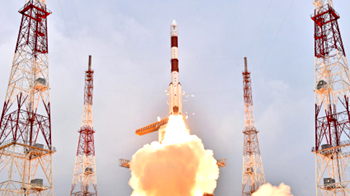
ISRO launches record 20 satellites in one go

June 22, 2016

satellites1

Sriharikota (AP), Jun 22: Setting a record in its space programme, India today successfully launched 20 satellites, including its earth observation Cartosat-2 series, in a single mission on board ISRO's workhorse PSLV-C34 from the spaceport here.

In a precision launch, PSLV-C34 took off from the second launch pad of Satish Dhawan Space Centre here, about 110 km from Chennai at 9.26 AM and placed the Cartosat-2 Series and 19 others in the designated polar Sun Synchronous Orbit (SSO) about 30 minutes later in clear skies.

The 727.5 kg Cartosat-2 series satellite will provide regular remote sensing services with its panchromatic and multispectral cameras and its imagery will be of multiple use.

Of the 19-satellites, 12 are earth imaging "Dove satellites" of USA and another American satellite. The rest are from Canada (two) and one each from Germany and Indonesia.

Two academic satellites are from Sathyabama University (Sathyabamasat) in Chennai and from College of Engineering (Swayam) at Pune.

Use of Cartosat 2 includes cartographic, urban and rural applications, coastal land use and regulation, utility management like road network monitoring and water distribution.

Also, creation of land use maps, precision study,change detection to bring out geographical and man-made features and various other Land Information System and Geographical Information System applications can be done. It is similar to the earlier Cartosat-2, 2A and 2B.

Prime Minister Narendra Modi congratulated ISRO and described today's launch as a "monumental" accomplishment.

"20 satellites in a go! @ isro continues to break new barriers. hearty congratulations to our scientists on the monumental accomplishment', he said on Twitter.

ISRO Chairman A S Kiran Kumar congratulated his team for the successful launch 'in a record time' and said "PSLV C-34 has done its job."

"We have the current generation of earth observation satellite of Cartosat 2 series," he said, adding ISRO had done a "wonderful job".

P Kunhikrishnan, Director, SDSC-SHAR, said that it was a major accomplishment by PSLV in its 35th consecutive successful mission.

"PSLV has become a success symbol for ISRO and India. ISRO is adopting more and more professionalism," he said.

D Jayakumar, Mission Director,described today's launch as a major landmark and said that the vehicle performance was "exceedingly well."

With today's launch of 20 satellites, PSLV beat its 2008 record when it placed in orbit 10 satellites in a single launch into various Low Earth Orbits.

This is the 14th flight of PSLV in "XL" configuration known for its capacity to carry more load which uses 'solid strap-on motors'.

The total weight of all the 20 satellites carried onboard PSLV-C34 is about 1288 kg.

India has 11 operational earth observation satellites, including RESOURCESAT-1 and 2, CARTOSAT-1, 2, 2A, 2B, RISAT-1 and 2, OCEANSAT-2 are in orbit.

Beginning in 1988, ISRO had launched many remote sensing satellites (for earth observation) and the data are for varied use including agriculture, water and ocean resources besides disaster management.


Comments

Add new comment

  • Coastaldigest.com reserves the right to delete or block any comments.
  • Coastaldigset.com is not responsible for its readers’ comments.
  • Comments that are abusive, incendiary or irrelevant are strictly prohibited.
  • Please use a genuine email ID and provide your name to avoid reject.
Agencies
July 30,2020

New Delhi, Jul 30: India's gold demand in 2020 is expected to fall to the lowest level in 26 years with domestic bullion prices hitting a record high and as falling disposable incomes could curtail retail purchases, the World Gold Council (WGC) said on Thursday.

Lower demand by the world's second-biggest bullion consumer could limit a rally in global prices, which hit a record high earlier this month, although it could also reduce India's trade deficit and support the ailing rupee.

"Fast rising gold prices could act as headwinds," said Somasundaram PR, the managing director of WGC's Indian operations.

Local gold futures have jumped 35% so far this year after rising a quarter in 2019.

India's gold consumption in the first half of 2020 plunged 56% on-year to 165.6 tonnes. Meanwhile, the coronavirus-triggered lockdown also slashed demand by 70% in the June quarter to 63.7 tonnes, the lowest in more than a decade, the WGC said in a report published on Thursday.

Millions of Indians have lost their jobs or taken a pay cut after the country imposed a lockdown on its 1.3 billion people to curb the spread of the virus that has infected more than 1.5 million Indians.

Consumption is generally high during the June quarter due to weddings and key festivals such as Akshaya Tritiya, but lockdown restrictions kept shoppers indoors this year.

The weak demand in the first half could drag down India's gold consumption in 2020 to the lowest since 1994, when demand stood at 415 tonnes, Somasundaram said, adding that it is still difficult to provide an estimate for full-year demand as the coronavirus crisis is still unfolding.

"Indian demand has previously jumped as much as 300 tonnes in a quarter. Latent demand could come out in the second half," Somasundaram said.

Comments

Add new comment

  • Coastaldigest.com reserves the right to delete or block any comments.
  • Coastaldigset.com is not responsible for its readers’ comments.
  • Comments that are abusive, incendiary or irrelevant are strictly prohibited.
  • Please use a genuine email ID and provide your name to avoid reject.
News Network
January 1,2020

Jan 1: The ban on the practice of instant triple talaq, making it a penal offence and the increase in the strength of Supreme Court judges were two of the major achievements of the law ministry in 2019.

In July, Parliament gave its nod to The Muslim Women (Protection of Rights on Marriage) Bill, 2019. The new law makes talaq-e-biddat or any other similar form of talaq having the effect of instantaneous and irrevocable divorce pronounced by a Muslim husband void and illegal.

It makes it illegal to pronounce talaq three times in spoken, written or through SMS or WhatsApp or any other electronic chat in one sitting.

According to the new law, any Muslim who pronounces the illegal form of talaq upon his wife shall be punished with imprisonment for a term which may extend to three years, and shall also be liable to fine.

During the year, four new judges were appointed to the Supreme Court in September, taking its strength to 34, the highest-ever.

However, vacancies in high courts and lower courts are on the rise and convincing state governments and the 25 high courts to come on board to create an all-India judicial service to recruit judges for the subordinate courts tops the agenda of the Law Ministry in 2020.

Besides creating a consensus on setting up the All-India Judicial Services, the ministry will also have to focus on filling up vacancies in the high court. On an average, the vacancies stood at 400 throughout this year.

With more than 5,000 positions of judicial officers in district and subordinate courts lying vacant, the Law Ministry has pitched for setting up all-India judicial services.

The sanctioned strength of the judicial officers in district and subordinate courts was 22,644. The number of judicial officers in position and vacant posts is 17,509 and 5,135, respectively.

The government has proposed that while states and high courts can recruit judicial officers, the Union Public Service Commission (UPSC) can hold pan-India entrance tests.

The ministry has made it clear that such services would not encroach on the powers of the states.

As of now, the selection and appointment of judges in subordinate courts is the responsibility of the high courts and state governments concerned.

The Narendra Modi government has given a fresh push to the long-pending proposal to set up the new service to have a separate cadre for the lower judiciary in the country.

But there is a divergence of opinion among state governments and respective high courts on the constitution of the All India Judicial Service (AIJS).

One of the problems cited is that since several states have used powers under Code of Criminal Procedure (CrPC) and Code of Civil Procedure (CPC) to declare that the local language would be used in lower courts even for writing orders, a person say selected from Tamil Nadu may find it difficult to hold proceedings in states like Uttar Pradesh and Bihar.

The other point of opposition is that an all India service may hamper the career progression of state judicial services officers.

Another key issue the ministry has to handle in 2020 is vacancies in the 25 high courts.

Throughout 2019, on an average, the high courts faced a shortage of 400 judges.

According to Law Ministry data, as on September 1, the high courts had 414 vacant positions as compared to the sanctioned strength of 1,079 judges. The figure was 409 in August and 403 in July, as per the data.

A three-member Supreme Court collegium recommends the names of candidates for appointment as high court judges. In case of appointments to the Supreme Court, the collegium consists of five top judges of the top court.

High court collegiums shortlist candidates for their respective high courts and send the names to the law ministry.

The ministry, along with background check reports by the Intelligence Bureau, forwards it to the Supreme Court collegium for a final call.

The government has maintained that appointment of judges in the high courts is a "continuous collaborative process" between the Executive and the Judiciary, as it requires consultation and approval from various Constitutional authorities.

Vacancies keep arising on account of retirement, resignation or elevation of judges and increase in judges' strength. In June last year, the vacancy position stood at 399, while it was 396 in May.

In April, 399 posts of judges were vacant, while the figure was 394 in March. The vacancy position in February stood at 400 and in January, it was 392, according to the data collated by the Department of Justice.

Over 43 lakh cases are pending in the 25 high courts.

Another priority would be the finalisation of the memorandum of the procedure to guide the appointment and transfer of the Supreme Court and high court judges. The issue had now been pending for over two years now with the SC collegium and the government failing to reach a consensus.

Successive governments have also been working on making India a hub of international arbitration. It has taken several steps to change laws dealing with commercial disputes.

Comments

Add new comment

  • Coastaldigest.com reserves the right to delete or block any comments.
  • Coastaldigset.com is not responsible for its readers’ comments.
  • Comments that are abusive, incendiary or irrelevant are strictly prohibited.
  • Please use a genuine email ID and provide your name to avoid reject.
Agencies
June 29,2020

From March through May, around 1 crore migrant workers fled India’s megacities, afraid to be unemployed, hungry and far from family during the world’s biggest anti-Covid-19 lockdown.

Now, as Asia’s third-largest economy slowly reopens, the effects of that massive relocation are rippling across the country. Urban industries don’t have enough workers to get back to capacity, and rural states worry that without the flow of remittances from the city, already poor families will be even worse off -- and a bigger strain on state coffers.

Meanwhile, migrant workers aren’t expected to return to the cities as long as the virus is spreading and work is uncertain. States are rolling out stimulus programs, but India’s economy is hurtling for its first contraction in more than 40 years, and without enough jobs, a volatile political climate gets more so.

“This will be a huge economic shock, especially for households of short-term, cyclical migrants, who tend to come from vulnerable, poor and low-caste and tribal backgrounds,” said Varun Aggarwal, a founder of India Migration Now, a research and advocacy group based in Mumbai.

In the first 15 days of India’s lockdown, domestic remittances dropped by 90%, according to Rishi Gupta, chief executive officer of Mumbai-based Fino Paytech Ltd., which operates the country’s biggest payments bank.

By the end of May, remittances were back to around 1750 rupees ($23), about half the pre-Covid average. Gupta’s not sure how soon it’ll fully recover. “Migrants are in no hurry to come back,” Gupta said. “They’re saying that they’re not thinking of going back at all.”

If workers stay in their home states long term, policymakers will have more than remittances to worry about. If consumption falls and the new surplus of labor drives wages down, Agarwal said, “there will also be a second-order shock to the local economy. Overall, not looking good.”

India announced a $277 billion stimulus package in May and followed it up with a $7 billion program aimed at creating jobs for 125 days for migrants in villages across 116 districts. Separately, local authorities are also looking for solutions.

Officials in Bihar have identified 2,500 acres of land that could be made available to investors, said Sushil Modi, deputy chief minister of Bihar, a state in east India. “We can use this crisis as an opportunity to speed up reforms,” he said.

The investors haven’t materialised yet, and in the meanwhile, state governments are relying on the national cash-for-work program that guarantees 100 days worth of wages per household.

Skilled workers don’t want to do manual labor offered through the program, and even if they did, says Amitabh Kundu of RIS, many think of it as beneath their station. “There will be an increase in social tensions,” he predicts. “Caste may again start playing a role. It’s absolute chaos.”

For skilled workers, initiatives vary:

* Uttar Pradesh, which received 3.2 million people, is compiling lists of skilled workers who need employment and trying to place them with local manufacturing and real estate industry associations. So far, the government says, it’s placed 300,000 people with construction and real estate firms.

* Bihar has placed returners in state-run infrastructure projects and hired others to stitch uniforms and make furniture for government-run schools, even as they waited in quarantine centres, said Pratyay Amrit, head of the state’s disaster management department.

* The eastern state of Odisha announced an urban wage employment program aimed at putting as many as 450,000 day labourers to work through September. Some 25,000 people have been employed, so far, under the scheme, G. Mathivathanan, principal secretary for housing and urban development said.

Attracting Investments

It’s not clear any of this will be enough to make a dent, says Ravi Srivastava, professor at New Delhi-based Institute of Human Development, adding that the states don’t have much of a track record on economic development.

“It was the failure of these states to improve governance and put development plans in place that led to the out-migration in the first place,” he said.

But officials and workers’ rights advocates see opportunity. Uttar Pradesh has established liaisons to encourage companies from the US, Japan and South Korea to establish manufacturing in the state. There and in Madhya Pradesh and Rajasthan, the government has made labour laws more friendly to employers, making it easier to hire and fire workers.

Modi, the minister from Bihar, said the migration may also give workers--historically a disenfranchised group--new power, particularly as urban centres struggle. “The way industries treated workers during the lockdown -- didn’t pay them, the living conditions were poor -- now these industries will realize the value of this force,” Modi said.

“In the days to come, labour will emerge as a force that can’t be ignored anymore,” he added. “That’s the new normal. We will work out how to ensure dignity, rights to our people who are going to work in other states.”

Bihar is due for elections by November, a vote that could be an early test of the mass migration’s political consequences. The state is currently governed by a coalition that includes Prime Minister Narendra Modi’s Bharatiya Janata Party. Amitabh Kundu, a fellow at the Research and Information System for Developing Countries, a New Delhi-based government think-tank, said migrant workers are likely to be angry voters.

“Chief ministers are telling these migrants that they will not have to go back for work,” he said. “But their capacity to do something miraculous in the next four to five months is doubtful. If they can retain even one-fourth of the migrants, I would call it a success.”

Comments

Add new comment

  • Coastaldigest.com reserves the right to delete or block any comments.
  • Coastaldigset.com is not responsible for its readers’ comments.
  • Comments that are abusive, incendiary or irrelevant are strictly prohibited.
  • Please use a genuine email ID and provide your name to avoid reject.