Is Ivan D 'Souza a victim of Catholic politics ' in Congress?

[email protected] (CD Network)
June 18, 2014

IvanLoboFernandis

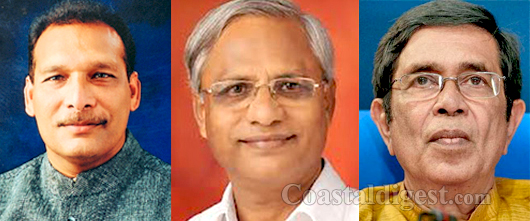
Mangalore, Jun 18: The long-cherished hopes of Congress leader Ivan D 'Souza of being nominated as a Member of Legislative Council seem to have been dashed due to the intense lobbying by delegations led by fellow party leaders against his nomination.

Although Chief Minister Siddaramaiah had reportedly finalised the nomination of Mr D 'Souza, a Catholic leader, as an MLC, the nomination list had to be amended on the recommendation of party supremo Sonia Gandhi after certain local party leaders belonging to same community opposed the nomination.

It is said that delegations led by AICC general secretary Oscar Fernandes and Mangalore South MLA J R Lobo had opposed the nomination of Ivan D 'Souza as an MLC.

Despite assurances by Siddaramaiah, who had approved nominating Mr D 'Souza as an MLC apparently due to their shared connection in the past as members of Janata Parivar, the latter had to forego his dream to be nominated to the legislative council.

Mr D 'Souza had previously contested from Dakshina Kannada in the assembly elections in 2008 and had lost. Having denied the ticket in the next assembly elections in 2013, he had been aspiring to rise to a prominent position in the party by being nominated to the legislative council.

However, no sooner than his name had been doing the rounds to be nominated as an MLC, the faction of party workers led by J R Lobo paid a visit to the state in-charge Digvijay Singh urging him to consider nominating a Congress leader from the Hindu or Jain community.

A disheartened Ivan D 'Souza said that he had been robbed of an opportunity to serve the people of Dakshina Kannada due to inner politics in the party.

Meanwhile, Mr Lobo denied that he and fellow party workers had lobbied against the nomination of Ivan D 'Souza. “Rather, we have urged the state in-charge of party affairs Digvijay Singh and former minister Oscar Fernandes to consider the names of deserving party leaders such as former MLA Vijaykumar Shetty and Suresh Ballal for the legislative council,” he said, indicating that it had nothing to do with communities.

Meanwhile, sources within the Congress party in Mangalore said that few prominent Catholic political leaders in coastal Karnataka were trying to curb alternative political leadership in their community. The Janata Parivar link of Mr D 'Souza is also said to be one of the reasons for other local Congress leaders ' effort to isolate him in the party.

Comments

francis
 - 
Sunday, 12 Jun 2016

Holy Father
You are the tree and cardinal bishops are trunk and we are branches.Then why we lay people rights are not considered by Mumbai church
From last several years I am fighting for transparency in Funds collected by Church .Mumbai Church is full of news about land selling to builders,demanding donations,Not giving records of fund collected
Why Holy Father instead of giving instruction does not come heavily on those who go against Church teachings.Why we are tutored like child that God is merciful and we can go on sinning The first trunk part that will crack is Mumbai archdiocese.
My Church Nativity of Lord kandivali east Mumbai collects building fund of rs two lacks from public every month .The priest refuses to give balance sheet showing where cores from last seven years or more kept .We want to know which banks hold this money .We want expenditure /income details from start of fund.This father has completed five years then why he is not transferred .Should I believe their are God Father?Our Church is closed full day on Monday ,No mass.Why one assistant not given to this church as we have seven hundred families.
The contribution to fund is volantary but they hane made cumpolsary by closing nose saying no minority/baptism /mariage certificate be given unless latest reciept of contribution to fund is shown
Holy father has to act against Arch bishop as my letters fall on deaf ear

Add new comment

  • Coastaldigest.com reserves the right to delete or block any comments.
  • Coastaldigset.com is not responsible for its readers’ comments.
  • Comments that are abusive, incendiary or irrelevant are strictly prohibited.
  • Please use a genuine email ID and provide your name to avoid reject.
News Network
July 31,2020

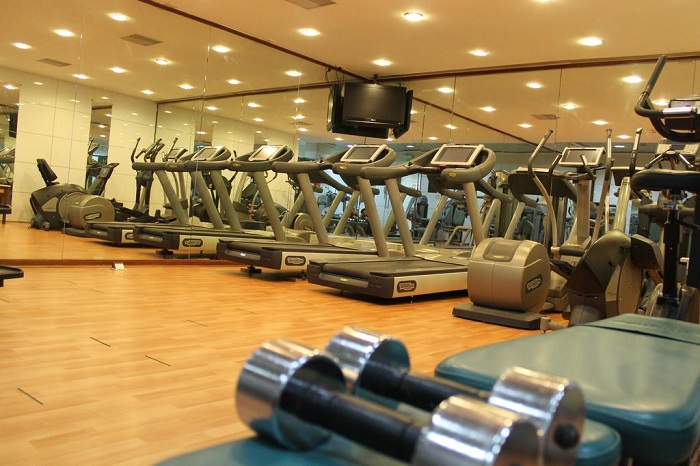
Bengaluru, Jul 31: Gyms in Bengaluru carried out sanitation work on Thursday following the Centre's nod to reopen gyms from August 5, after several weeks of COVID-induced lockdowns.

"We are taking all the precautionary measures prescribed by the government and will follow the guidelines very strictly. A thermal scanner, oximeter and hand sanitizers have been placed at the entrance of the gym. 

We request all other gym owners also to follow the guidelines strictly to keep their members safe and healthy," said Prasad Kumar, a gym owner in Bangalore.

He added, "The last few months have been very difficult for us gym owners and fitness instructors. We are very grateful to the government for allowing us to re-open. 

We are going to be very cautious when we open. Even before this COVID-19 pandemic, we used to sanitise all the equipment before and after every use so hopefully, this won't be too difficult for us. We are getting rid of the air conditioners to allow cross ventilation and open the space a little more."

According to Chandu Gowda, an actor and frequenter of the gym, working out at home was not the same as working out in the gym with the proper equipment.

"I'm very glad that I get to come back and work out as I used to before this lockdown. For an actor, working out is extremely important, not just for my physical health but also mental health. 

Doing exercises at home is never as good as exercising in a space dedicated to one purpose. I hope other members of the gym follow the rules and regulations religiously," Gowda said.

Comments

Add new comment

  • Coastaldigest.com reserves the right to delete or block any comments.
  • Coastaldigset.com is not responsible for its readers’ comments.
  • Comments that are abusive, incendiary or irrelevant are strictly prohibited.
  • Please use a genuine email ID and provide your name to avoid reject.
Ram Puniyani
January 14,2020

In the beginning of January 2020 two very disturbing events were reported from Pakistan. One was the attack on Nankana Sahib, the holy shrine where Sant Guru Nanak was born. While one report said that the place has been desecrated, the other stated that it was a fight between two Muslim groups. Prime Minister of Pakistan Imran Khan condemned the incident and the main accused Imran Chisti was arrested. The matter related to abduction and conversion of a Sikh girl Jagjit Kaur, daughter of Pathi (One who reads Holy Guru Granth Sahib in Gurudwara) of the Gurudwara. In another incident one Sikh youth Ravinder Singh, who was out on shopping for his marriage, was shot dead in Peshawar.

While these condemnable attacks took place on the Sikh minority in Pakistan, BJP was quick enough to jump to state that it is events like this which justify the Citizenship Amendment Act (CAA). Incidentally CAA is the Act which is discriminatory and relates to citizenship with Religion, which is not as per the norms of Indian constitution. There are constant debates and propaganda that population of Hindus has come down drastically in Pakistan and Bangla Desh. Amit Shah, the Home minister stated that in Pakistan the population of Hindus has come down from 23% at the time of partition to 3.7% at present. And in Bangla Desh it has come down from 22% to present 8%.

While not denying the fact that the religious minorities are getting a rough deal in both these countries, the figures which are presented are totally off the mark. These figures don’t take into consideration the painful migrations, which took place at the time of partition and formation of Bangla Desh later. Pakistan census figures tell a different tale. Their first census was held in 1951. As per this census the overall percentage of Non Muslim in Pakistan (East and West together) was 14.2%, of this in West Pakistan (Now Pakistan) it was 3.44 and in Eat Pakistan it was 23.2. In the census held in Pakistan 1998 it became 3.72%. As far as Bangla Desh is concerned the share of Non Muslims has gone down from 23.2 (1951) to 9.6% in 2011.

The largest minority of Pakistan is Ahmadis, (https://minorityrights.org/country/pakistan/) who are close to 4 Million and are not recognised as Muslims in Pakistan. In Bangla Desh the major migrations of Hindus from Bangla Desh took place in the backdrop of Pakistan army’s atrocities in the then East Pakistan.

As far as UN data on refugees in India it went up by 17% between 2016-2019 and largest numbers were from Tibet and Sri Lanka.  (https://www.un.org/en/development/desa/population/migration/publication…)

The state of minorities is in a way the index of strength of democracy. Most South Asian Countries have not been able to sustain democratic values properly. In Pakistan, the Republic began with Jinnah’s classic speech where secularism was to be central credo of Pakistan. This 11th August speech was in a way what the state policy should be, as per which people of all faiths are free to practice their religion. Soon enough the logic of ‘Two Nation theory” and formation of Pakistan, a separate state for Muslim took over. Army stepped in and dictatorship was to reign there intermittently. Democratic elements were suppressed and the worst came when Zia Ul Haq Islamized the state in collusion with Maulanas. The army was already a strong presence in Pakistan. The popular formulation for Pakistan was that it is ruled by three A’s, Army, America and Allah (Mullah).

Bangla Desh had a different trajectory. Its very formation was a nail in the coffin of ‘two nation theory’; that religion can be the basis of a state. Bangla Desh did begin as a secular republic but communal forces and secular forces kept struggling for their dominance and in 1988 it also became Islamic republic. At another level Myanmar, in the grip of military dictatorship, with democratic elements trying to retain their presence is also seeing a hard battle. Democracy or not, the army and Sanghas (Buddhist Sang has) are strong, in Myanmar as well. The most visible result is persecution of Rohingya Muslims.

Similar phenomenon is dominating in Sri Lanka also where Budhhist Sanghas and army have strong say in the political affairs, irrespective of which Government is ruling. Muslim and Christian minorities are a big victim there, while Tamils (Hindus, Christians etc.) suffered the biggest damage as ethnic and religious minorities. India had the best prospect of democracy, pluralism and secularism flourishing here. The secular constitution, the outcome of India’s freedom struggle, the leadership of Gandhi and Nehru did ensure the rooting of democracy and secularism in a strong way.

India so far had best democratic credentials amongst all the south Asian countries. Despite that though the population of minorities rose mainly due to poverty and illiteracy, their overall marginalisation was order of the day, it went on worsening with the rise of communal forces, with communal forces resorting to identity issues, and indulging in propaganda against minorities.

While other South Asian countries should had followed India to focus more on infrastructure and political culture of liberalism, today India is following the footsteps of Pakistan. The retrograde march of India is most visible in the issues which have dominated the political space during last few years. Issues like Ram Temple, Ghar Wapasi, Love Jihad, Beef-Cow are now finding their peak in CAA.

India’s reversal towards a polity with religion’s identity dominating the political scene was nicely presented by the late Pakistani poetess Fahmida Riaz in her poem, Tum bhi Hum Jaise Nikle (You also turned out to be like us). While trying to resist communal forces has been an arduous task, it is becoming more difficult by the day. This phenomenon has been variously called, Fundamentalism, Communalism or religious nationalism among others. Surely it has nothing to do with the religion as practiced by the great Saint and Sufi traditions of India; it resorts mainly to political mobilization by using religion as a tool.


Comments

Ashi
 - 
Tuesday, 14 Jan 2020

If Malaysia implement similar NRC/CAA, India and China are the loser.

Add new comment

  • Coastaldigest.com reserves the right to delete or block any comments.
  • Coastaldigset.com is not responsible for its readers’ comments.
  • Comments that are abusive, incendiary or irrelevant are strictly prohibited.
  • Please use a genuine email ID and provide your name to avoid reject.
News Network
January 17,2020

Bengaluru, Jan 17: Chief minister BS Yediyurappa is likely to induct new ministers into his cabinet only after he returns from Davos, Switzerland, on January 25.

Yediyurappa will leave for Davos on January 19 to participate in the World Economic Forum’s 50th annual meet.

Sources say Yediyurappa is keen on expanding his cabinet before he leaves for Davos and is still trying to secure the green signal from BJP national president Amit Shah. However, Shah has cold-shouldered Yediyurappa’s several requests for a meeting to discuss the issue.

Shah is scheduled to visit Karnataka on January 18 to participate in a pro-Citizenship (Amendment) Act rally in Hubballi and the CM plans to corner him there. But, given the time constraint, Yediyurappa is likely to put off the exercise till he returns from Davos even if Shah extends approval.

“Even if Shah gives the green signal, Yediyurappa will have less than 24 hours to expand his cabinet,” a source said. “It is highly unlikely he will rush through the process of inducting ministers. Also, his presence is required to douse disgruntlement which is bound to arise once the new ministers are sworn in.”

The CM and the party high command are on different pages as far as cabinet expansion is concerned. While Yediyurappa is hell-bent on keeping his promise of inducting all the newly elected MLAs, who switched from Congress and JD(S) to the BJP, Shah is keen on sharing vacant berths equally between loyal MLAs and the new entrants. There are 16 cabinet berths vacant.

Shah, sources said, is of the opinion that giving 12 berths to the turncoats will lead to heartburn among loyalists and it will impact the party’s prospects in the next election. “Moreover, he is of the opinion that none of the turncoats have mass appeal, nor do they have any administrative experience. This, he thinks, will impact governance,” said a source.

This has resulted in a deadlock and the issue has dragged on for a month now.

Comments

Add new comment

  • Coastaldigest.com reserves the right to delete or block any comments.
  • Coastaldigset.com is not responsible for its readers’ comments.
  • Comments that are abusive, incendiary or irrelevant are strictly prohibited.
  • Please use a genuine email ID and provide your name to avoid reject.