


Jamia: The brave new face of Muslim girls

December 23, 2013

Muslim_girls

New Delhi, Dec 23: Asma Naseem began her primary education in 1990 in a small village in Baghpat district of Uttar Pradesh. Six months after she started going to her two-room school, her family decided that she deserved a better education. Her father then shifted, with four-year-old Asma, to Delhi.

The little girl was admitted to the primary school in Jamia Millia Islamia, and her father found work in the city. The girl's mother joined them four years later.

Asma finished school, then graduated in biotechnology from Jamia's Faculty of Natural Sciences, and won the gold medal in the post-graduation class of biosciences at Jamia. She then researched protein conformational diseases at Jamia, and is now pursuing post-doctoral studies at the International Centre for Genetic Engineering and Biotechnology (ICGEB) in Italy.

Just like Asma, Samreen Jahaan joined the mechanical engineering course at Jamia Polytechnic after school. She is the only woman student in the first-year batch of the course. But being the lone girl in her class is not something Samreen makes much of: "If boys can, why can't girls?" she asks.

"Initially I hesitated in sitting in an all-boys' class, but now I don't mind. The boys help me in all the subjects," Asma told IANS, expressing happiness that her parents support her in her career decision.

Zainab Zafar, a first-year student of the Bachelor of Physiotherapy course at Jamia, has joined this paramedical field with the aim of treating patients. In a course where numerous girl students had withdrawn their names in the initial batches because lab work requires physical touch with "models" of the other sex, Zainab and her fellow girl students are confident that they are doing noble work.

"Our parents are today comfortable with what we are learning. After all, it's a noble job. I will be treating someone," says Zainab.

Nor does she feel that the burqa that she wears could prove a hindrance at the time of recruitment. "Recruiters will see my potential," Zainab said, exuding confidence.

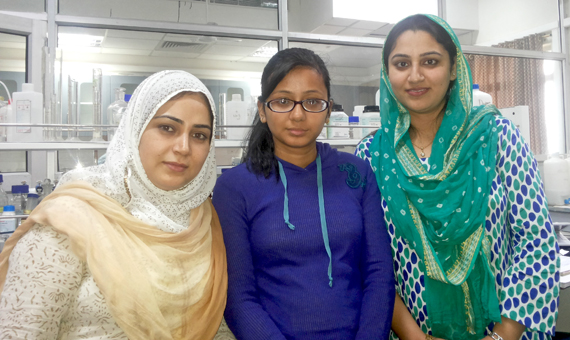
Asma, Samreen and Zainab represent the brave new face of Muslim girls, confident of their skills, competitive in spirit and hungry for success. Irrespective of their geographical distance or social situation, Muslim girls are converging at Jamia Millia Islamia, the 92-year-old central university in New Delhi, because of its stimulating academic environment, the safety if offers women, and the religious and cultural ethos at this central university.

Shaila Naaz, a student of architecture from Daltonganj in Jharkhand, says: "Getting admission in a central university is an achievement. And Jamia provides an ideal atmosphere for studies. It's safe too, there's abundant security." Polytechnic student Ayesha Ghayas says she chose Jamia for a degree in computer engineering because it's a Muslim university, with no ragging.

Jamia, on its part, follows a proactive policy to promote girls' education. The 10 percent reservation for women at the university is showing results. In Jamia Polytechnic, for example, of 900 students, 92 are women. While women students traditionally chose courses in humanities, languages and education, today there is enough competition even in courses like physiotherapy.

Ejaz Hussain, director of the Centre for Physiotherapy and Rehabilitation Sciences at Jamia, says that in the first two years of its existence since 2007, the centre had to counsel parents to admit their daughters to the course. These days, the men:women ratio is 70:30.

Jamia is also building more women's hostels. A new hostel for women was recently inaugurated by Lok Sabha Speaker Meira Kumar, taking the capacity to have women living on campus from 500 to 750. With the University Grants Commission grant of Rs.26 crore at the behest of United Progressive Alliance chairperson Sonia Gandhi, the university is set to add 400 more hostel seats for girls.

A zero-tolerance policy on sexual harassment helps too. The earlier University Complaints Committee has been replaced with an Internal Committee to Deal with Sexual Harassment of Women at Workplace. While women staff and the administration are covered under the Sexual Harassment of Women at Workplace (Prevention, Prohibition and Redressal) Act, 2013, for students the university has its own ordinance.

There are complaint boxes at different points on campus, and any complaint dropped into the box is taken up for action. Bulbul Dhar James, director of Sarojini Naidu Centre for Women's Studies at Jamia, is a member of the committee and says women are now picking up courage to lodge complaints.

Sarojini Naidu Centre also teaches men students the right conduct in a multi-cultural milieu. This is especially important because students come from villages, where codes of conduct may be vastly different, and their backgrounds may also create inhibitions and diffidence.

Sabiha Hussain, faculty member at the Centre for Dalit and Minorities Studies in the university, says a sea change has occurred in the attitude of students in the last few years.

"Parents are now open to sending their daughter to Delhi for courses like computer science, biotechnology, physiotherapy and polytechnic. They have high aspirations for daughters, and hope their daughters will get better exposure here," Hussain said.

Comments

Add new comment

  • Coastaldigest.com reserves the right to delete or block any comments.
  • Coastaldigset.com is not responsible for its readers’ comments.
  • Comments that are abusive, incendiary or irrelevant are strictly prohibited.
  • Please use a genuine email ID and provide your name to avoid reject.
Press Release
January 2,2020

Mangaluru, Jan 2: Shwetha Rasquinha, Assistant Professor and Head of the Department of Social Work, St Aloysius College, Mangaluru, has been awarded Doctor of Philosophy (PhD) degree by the Mangalore University for her thesis titled “Effectiveness of Social work intervention on caretakers of cancer patients- A social work study in Mangalore”.

She did her studies under the guidance of Dr Rameela Shekhar, Professor (Rtd), School of Social work, Roshni Nilaya, Mangaluru.

Ms Shwetha Rasquinha hails from Vittal, D/o Vincent Rasquinha and Late Regina Rasquinha, and is the second person to complete doctoral studies from the Vittal Parish.

Her colleagues and well-wishers have congratulated her for her highest achievement in academics and successful completion of quality research.

Comments

Charles Menezes
 - 
Friday, 3 Jan 2020

Hearty congratulations for your achievements. God bless your mission

Add new comment

  • Coastaldigest.com reserves the right to delete or block any comments.
  • Coastaldigset.com is not responsible for its readers’ comments.
  • Comments that are abusive, incendiary or irrelevant are strictly prohibited.
  • Please use a genuine email ID and provide your name to avoid reject.
Media Release
February 13,2020

St. Agnes College (Autonomous), Mangaluru, which is celebrating its centenary year, celebrated 99th college day and merit programme of the academic year 2019-20 in P.U College Auditorium on February 11.

Ms. Philomina Lobo, Retired Director, Secondary Education department of public instructions, Government of India was the chief guest of the programme. The programme began by evoking the blessings of God. Sr Dr M Jeswina A.C, Principal, St Agnes College, Sr Dr M Maria Roopa A.C, the Joint Secretary, Mr. Ronald Pereira PTA Vice President, Mr Charles Pais the Controller of Examinations ,Dr Subha Rao were  present.

Ms. Seemanthini, Assistant Professor, Department of Computer Applications presented the annual college report digitally, highlighting the achievements of the institution, staff and students for the academic year.

Addressing the students, Ms Philomina Lobo advised, “You have knowledge and intelligence but you need to pray for wisdom. Use your talents in the right way.” She also mentioned that the companies today are looking forward for skilful youngsters and asked the students to “be skilful” in order to achieve success in life.

Students received Principal's role of honour, various scholarships and merit certificates for their excellence in academics. The cabinet members of the current academic year were also awarded on the occasion. The Principal gave a token of gratitude to Ms Philomena Lobo, who is also an alumna of the college. Mrs Meera, HOD, Department of History proposed the vote of thanks.

Comments

Add new comment

  • Coastaldigest.com reserves the right to delete or block any comments.
  • Coastaldigset.com is not responsible for its readers’ comments.
  • Comments that are abusive, incendiary or irrelevant are strictly prohibited.
  • Please use a genuine email ID and provide your name to avoid reject.
Media Release
June 12,2020

Mangaluru: Agnes Towards Community (ATC) is a five-year old project of social responsibility undertaken by St Agnes College (Autonomous), Mangaluru to give their students a taste for community service before they leave the portals of the College.  For this purpose the College has adopted five villages in the vicinity of Mangaluru, namely Harekala, Amblamogaru, Munnuru, Kotekar and Hosabettu.  The ATC programmes are undertaken on saturdays wherein all the final year students as guided by their staff members are given hands on experience of community interaction and service.  The four saturdays in a month are divided to plan, prepare, execute and evaluate the whole service exercise.

The year 2019-20 saw a major change in the format of the project. The Science and Arts faculty came together with projects based on the syllabus of study and apply it for their service learning activity.  This was done with the dual purpose of helping students to learn the topic practically in a real social set up and to identify and render useful scientific based practical solutions to the problems faced by the villagers.  

One such problem is water purity. Since water plays an important role in maintaining the human health and welfare, water quality testing is important because it identifies contaminants and prevents water borne diseases. In this regard, Departments of Chemistry and Microbiology took up a project on water analysis.   The major objectives of the project were: 1. To provide hands on experience on water analysis, a topic learnt by the students in their course of study.  2. To test the potability of water sources of the villages, so that the scientific and practical solutions can be provided, wherever needed.  

The first village chosen for the study was Amblamogaru.  The two batches of students (20 students in each batch) were led by Mrs.Prajwal Rao, Assistant Professor, Department of Microbiology and Ms.Smitha, Assistant Professor, Department of Chemistry. They were assisted by Ms.Hezil Saldanha, Assistant Professor, Department of Chemistry in carrying out the project. 

The water samples from different sources were collected in sterilised glass bottles. The students were enthusiastic in collecting water samples and also interacted with the village folk regarding the availability of drinking water supplies. The students under the guidance of faculty carried out the experiments in water analysis in Chemistry and Microbiology Laboratories at St Agnes College. This included testing for parameters such as pH, conductivity, total hardness and turbidity, presumptive, confirmed and completed Coliform test. From chemical analysis, it is found that all parameters satisfy the standards of potable water. Microbiological analysis showed that the water samples were potable for human consumption (No faecal contamination observed). 

The project has been envisaged to help the villagers to have recourse to the information on the results of the tests conducted. The water samples collected for the analysis were found to be potable for human consumption. If the water samples not been found to be potable, the departments had strategized to guide the villagers on useful scientific and practical solutions wherever needed.

This project of Agnes Towards Community (ATC) helped students to go beyond classroom learning, develop practical skills, disseminate knowledge and render service to the community. This activity also provided direct and relevant experiences to the students that deepened and enriched their learning abilities.

Comments

Add new comment

  • Coastaldigest.com reserves the right to delete or block any comments.
  • Coastaldigset.com is not responsible for its readers’ comments.
  • Comments that are abusive, incendiary or irrelevant are strictly prohibited.
  • Please use a genuine email ID and provide your name to avoid reject.