



Japan PM’s party suffers historic defeat in Tokyo poll, popular governor wins big

Agencies
July 3, 2017

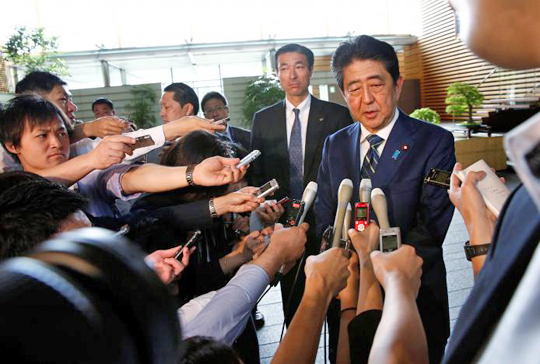
Tokyo, Jul 3: Prime Minister Shinzo Abe’s Liberal Democratic Party suffered an historic defeat in an election in the Japanese capital on Sunday, signalling trouble ahead for the premier, who has suffered from slumping support because of a favouritism scandal.
japan

On the surface, the Tokyo Metropolitan assembly election was a referendum on Governor Yuriko Koike’s year in office, but the dismal showing for Abe’s party is also a stinging rebuke of his 4-1/2-year-old administration.

Koike’s Tokyo Citizens First party and its allies took 79 seats in the 127-seat assembly.

The LDP won a mere 23, its worst-ever results, compared with 57 before the election.

“We must recognise this as an historic defeat,” former defence minister Shigeru Ishiba was quoted as saying by NHK.

“Rather than a victory for Tokyo Citizens First, this is a defeat for the LDP,” said Ishiba, who is widely seen as an Abe rival within the ruling party.

Past Tokyo elections have been bellwethers for national trends. A 2009 Tokyo poll in which the LDP won just 38 seats was followed by its defeat in a general election that year, although this time no lower house poll need be held until late 2018.

Koike, a media-savvy ex-defence minister and former LDP member, took office a year ago as the first female governor in the capital, defying the local LDP chapter to run and promising to reform governance of a megacity with a population of 13.7 million and an economy bigger than the Netherlands’.

Among her allies in the Komeito party, the LDP’s national coalition partner, got 23 seats.

“I am excited but at the same time, I am also keenly aware of the weight of my responsibility,” Koike told NHK, adding the results had exceeded her expectations.

Speculation, coalition cracks, rivals

The strong showing by Koike’s party will fuel speculation that she will make a bid for the nation’s top job, although that may not be until after the 2020 Tokyo Olympics.

It could also widen cracks between the LDP and the Komeito while damaging prospects for the opposition Democratic Party, which won five seats.

Abe’s rivals in his party could be encouraged by the LDP’s dismal performance to challenge him in a leadership race in September 2018, victory in which would set Abe on course to become Japan’s longest-serving leader and bolster his hopes of revising the post-war, pacifist constitution.

The LDP’s thrashing, however, could make it harder for Abe to pursue his cherished goal of revising the U.S.-drafted constitution’s pacifist Article 9 by 2020, a politically divisive agenda, said Sophia University professor Koichi Nakano.

“His prime motive to stay in power is his desire to revise the constitution, but once his popularity really starts to fall, that becomes very difficult to do,” Nakano said.

Abe’s troubles centre on concern he may have intervened to help Kake Gakuen (Kake Educational Institution) win approval for a veterinary school in a special economic zone. Its director, Kotaro Kake, is a friend of Abe’s.

The government has not granted such an approval in decades due to a perceived glut of veterinarians. Abe and his aides have denied doing Kake any favours.

Potentially more devastating is the impression among many voters that Abe and his inner circle have grown arrogant.

“We must accept the results humbly,” said Hakubun Shimomura, a close Abe ally and head of the LDP’s Tokyo chapter. “The voters have handed down an extremely severe verdict.”

Abe is expected to reshuffle his cabinet in coming months in an effort to repair his damaged ratings, a step often taken by beleaguered leaders but one that can backfire if novice ministers become embroiled in scandals or commit gaffes.

Among those many political insiders expected to be replaced is Defence Minister Tomomi Inada. Inada’s remark during the Tokyo campaign seeking voter support in the name of the Self-Defence Forces, as the military is known, came under heavy fire. By law, the military is required to be politically neutral.

Comments

Add new comment

  • Coastaldigest.com reserves the right to delete or block any comments.
  • Coastaldigset.com is not responsible for its readers’ comments.
  • Comments that are abusive, incendiary or irrelevant are strictly prohibited.
  • Please use a genuine email ID and provide your name to avoid reject.
Agencies
July 8,2020

Washington, Jul 7: President Donald Trump on Tuesday formally started the withdrawal of the United States from the World Health Organization, making good on threats to deprive the UN body of its top funding source over its response to the coronavirus.

Public health advocates and Trump's political opponents voiced outrage at the departure from the Geneva-based body, which leads the global fight on maladies from polio to measles to mental health -- as well as Covid-19, at a time when cases have again been rising around the world.

After threatening to suspend the $400 million (Dh1.47 billion) in annual US contributions and then announcing a withdrawal, the Trump administration has formally sent a notice to UN Secretary-General Antonio Guterres, a State Department spokesperson said.

The withdrawal is effective in one year -- July 6, 2021 -- and Joe Biden, Trump's presumptive Democratic opponent, is virtually certain to stop it and stay in the WHO if he wins the November election.

A spokesman for Guterres and the global health body itself confirmed that the United States, a key founding WHO member, gave its notice.

In a speech earlier in the day, WHO chief Tedros Adhanom Ghebreyesus said of Covid-19, "National unity and global solidarity are more important than ever to defeat a common enemy."

In line with conditions set when the WHO was set up in 1948, the United States can leave within one year but must meet its remaining assessed financial obligations, the UN spokesman said.

'Total control'

In late May, Trump said that China exerted "total control" over the WHO and accused the UN body led by Tedros, an Ethiopian doctor and diplomat, of failing to implement reforms.

Blaming China for the coronavirus, Trump, a frequent critic of the UN, said the United States would redirect funding "to other worldwide and deserving, urgent, global public health needs."

Democratic lawmakers have accused Trump of seeking to deflect criticism from his handling of the pandemic in the United States, which has suffered by far the highest death toll of any nation despite the president's stated hope that the virus will disappear.

"To call Trump's response to Covid chaotic and incoherent doesn't do it justice," said Senator Robert Menendez, the top Democrat on the Foreign Relations Committee.

"This won't protect American lives or interests -- it leaves Americans sick and America alone," he wrote on Twitter.

Representative Ami Bera, himself a physician, said that the United States and World Health Organization had worked "hand in hand" to eradicate smallpox and nearly defeat polio.

"Our cases are increasing," Bera said of Covid-19. "If the WHO is to blame: why has the US been left behind while many countries from South Korea to New Zealand to Vietnam to Germany return to normal?"

Even some of Trump's Republican allies had voiced hope that he was exerting pressure rather than making a final decision to abandon the World Health Organization.

The investigative news outlet ProPublica reported last month that most of Trump's aides were blindsided by the WHO withdrawal announcement, which he made during an appearance about China. 

The Trump administration has said that the WHO ignored early signs of human-to-human transmission in China, including warnings from Taiwan -- which, due to Beijing's pressure, is not part of the UN body.

While many public health advocates share some criticism of the WHO, they question what other options the world body had other than to work with China, where Covid-19 was first detected late last year in the city of Wuhan.

The anti-poverty campaign ONE said the United States should work to reform, not abandon, the WHO.

"Withdrawing from the World Health Organization amidst an unprecedented global pandemic is an astounding action that puts the safety of all Americans the world at risk," it said.

Comments

Add new comment

  • Coastaldigest.com reserves the right to delete or block any comments.
  • Coastaldigset.com is not responsible for its readers’ comments.
  • Comments that are abusive, incendiary or irrelevant are strictly prohibited.
  • Please use a genuine email ID and provide your name to avoid reject.
News Network
July 25,2020

Madrid, Jul 25: Spain is witnessing a new surge in virus" coronavirus infections with nearly a thousand cases daily, a month after lifting the pandemic lockdown.

The country is reinstating both voluntary guidelines and mandatory restrictions that it had lifted on June 21, The Washington Post reported.

Spain on Wednesday reported over 224 outbreaks and 2,622 virus" coronavirus cases. According to a report in Washington Post, the new surge is attributed primarily to seasonal farmworkers, people attending family get-togethers and nightclub partyers.

On Thursday, the health ministry reported an additional 971 cases.

"The majority are related to fruit collection and also to the spaces where measures to avoid contact are relaxed," Spain Health Minister Salvador Illa told parliament. "We have to call on citizens to not lose respect for the virus not to be afraid of it, but not to lose respect for it either."

The government of Spain lifted all restrictions put in place to combat virus" coronavirus on June 21 and declared 'a new normal'. 

The virus" coronavirus pandemic till then had killed 24,000 people and infected more than 2,70,166.

Countries around the world are witnessing the second surge of virus" coronavirus. The resurgence could threaten the economic bounce Spain was hoping to get from vacationers eager for summer fun.

The surge in cases has been greatest in the northeastern region of Catalonia with more than 7,953 new confirmed cases since July 10.

Spain's National Epidemiological Survey has predicted that the rate of increase more than doubled in the past three weeks.

Meanwhile, the Catalan government reverted to pre-June 21 confinement rules in Barcelona and a dozen other municipalities in the metropolitan area, as well as in Figueras, Vilafant, La Noguera and Lleida.

Authorities have ordered bars and restaurants to limit indoor occupancy to 50 per cent, reduced sports to fewer than 10 people, closed night clubs and gyms and blocked some cultural activities.

The epidemiologist in charge of the region's biggest hospital warned in an interview last week with the Spanish daily El Pais that the situation in the agricultural hub of Lleida, located about 100 miles west of Barcelona, "had clearly gotten out of hand."

"Nobody foresaw that there would be a number of people coming from abroad to pick fruit in unfavourable conditions and that they might be infected," said epidemiologist Magda Campins of Vall d'Hebron in Barcelona. "And when the infections began to be detected, it was hard to keep tabs on the cases and their contacts because some of them, although they should have been in isolation, got away because they needed to earn money."

Catalonia's Department of Labour, Social Affairs and Family is using a hotel in Lleida to quarantine fruit workers who test positive for COVID-19 but are unable to isolate at home.

In the capital of Madrid, which was the epicentre during the pandemic's first wave in the spring, authorities reported 710 new cases in the past week. The use of face masks is widespread, but the region has shied away from making them mandatory in public.

Madrid's regional health secretary, Enrique Ruiz Escudero, defended that position while citing an uptick in infections in the under-40 age group. He told young people not to let down their guard.

"We can't take even one step backwards. Young people have to be aware of the responsibility they have," Ruiz Escudero said in a news conference Thursday. "I ask them to use the face mask and to maintain a safe distance."

Comments

Add new comment

  • Coastaldigest.com reserves the right to delete or block any comments.
  • Coastaldigset.com is not responsible for its readers’ comments.
  • Comments that are abusive, incendiary or irrelevant are strictly prohibited.
  • Please use a genuine email ID and provide your name to avoid reject.
News Network
June 30,2020

Beijing, June 30: China said on Tuesday it was concerned about India’s decision to ban Chinese mobile apps such as Bytedance’s TikTok and Tencent’s WeChat and was making checks to verify the situation.

Chinese foreign ministry spokesman Zhao Lijian told reporters during a daily briefing that (the Prime Minister Narendra Modi-led government of) India has a responsibility to uphold the rights of Chinese businesses.

India on Monday banned 59, mostly Chinese, mobile apps in its strongest move yet targeting China in the online space since a border crisis erupted between the two countries this month.

The apps are “prejudicial to the sovereignty and integrity of India, the defence of India, the security of state and public order", the ministry of information technology said in a statement, which came two weeks after 20 Indian Army personnel were killed in a violent clash on the India-China border in Ladakh.

The companies have been invited to offer clarifications before a government panel, which will decide whether the ban can be removed or will stay.

The move also came ahead of military and diplomatic talks between India and China scheduled this week.

Comments

Add new comment

  • Coastaldigest.com reserves the right to delete or block any comments.
  • Coastaldigset.com is not responsible for its readers’ comments.
  • Comments that are abusive, incendiary or irrelevant are strictly prohibited.
  • Please use a genuine email ID and provide your name to avoid reject.