Jawan says food terrible, BSF says he's alcoholic

January 10, 2017

New Delhi, Jan 10: Hours after a BSF jawan deployed in Jammu and Kashmir alleged that troops are served poor quality food, the BSF released a statement accusing the soldier of being an "alcoholic and a habitual offender".
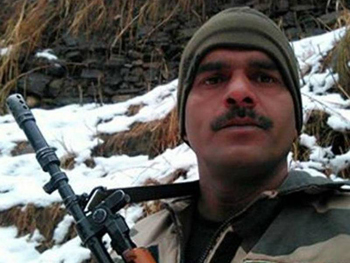
JawanYesterday, in a Facebook post and video, BSF jawan Tej Badur Yadav of the 29 battalion Seema Suraksha Bal - which is posted along the Line of Control - talked at length about what corruption in the force's administration and showed pictures of "poor-quality food". He alleged that the government wasn't to blame. It was the seniors, who sell supplies meant for the soldiers in the open market. He urged the prime Minister to investigate.

A few hours after he released the video, the border force alleged that Yadav has had a difficult past and that right from the start of service, has needed regular counselling.

"The soldier is a habitual offender of absenteeism without permission, chronic alcoholism and misbehaving with superior officers...For such reasons, individual (Tej Bahadur) has served mostly in headquarters under supervision of some dedicated superior officer", the BSF said in a statement.

After the video went viral, Union Home Minister Rajnath Singh also ordered an inquiry into the BSF constable's allegations.

"I have seen a video regarding a BSF jawan's plight. I have asked the HS (Home Secretary) to immediately seek a report from the BSF & take appropriate action," the home minister tweeted late last night.

Meanwhile, Minister of State (Home) Kiren Rijiju too has assured that any lapse in the welfare of defence forces will be addressed on priority.

"Welfare of our Security Forces is our absolute priority. Any anomaly to be dealt with firmly," Rijiju said, according to ANI.

In Yadav's video, filmed at an undisclosed location, Yadav said that the soldiers stand for 11 straight hours every day regardless of the extreme weather, but they are treated in the worst possible way imaginable.

"Neither the media, nor any minister tries to understand what we are going through (harsh weather). We live in the worst-possible conditions. After this, I will share three videos that will show how we are being mistreated by our officials. We don't want to blame any particular government, because they give us everything we need. But it is our seniors who see supplies meant for us to the local market, so it never reaches us," the soldier said in the video.

Yadav then proceeded to show pictures of the food they are served.

"I will show you that we get only one paratha in the breakfast that too without any curry, or pickle. We get it ( paratha ) only with a cup of tea. In the afternoon, I'll show you how we get ' daal ', its only turmeric and salt and nothing else, I will also show you the condition of the chapattis," Yadav said.

Reiterating that he is not blaming the government, Yadav further said that their rations are sold in the market, and called for the situation to be investigated.

"I request honourable Prime Minister also to look into the matter. Friends, I may not live once I upload this video, as my officials are very powerful. Kindly share the video as much as possible so that every media organisation come here and investigate and witness how soldiers are living," he said.

Comments

Rikaz
 - 
Tuesday, 10 Jan 2017

its shocking...top guys are looters...misusing our soldiers...they work day and night for our safety....so that we sleep nicely in night....need to take severe action on guilty officers....

Add new comment

  • Coastaldigest.com reserves the right to delete or block any comments.
  • Coastaldigset.com is not responsible for its readers’ comments.
  • Comments that are abusive, incendiary or irrelevant are strictly prohibited.
  • Please use a genuine email ID and provide your name to avoid reject.
News Network
February 28,2020

Bengaluru, Feb 28: Historian S. Shettar, 85, breathed his last early on February 28 in Bengaluru. He was suffering from respiratory problems and was hospitalised for over a week.

Shettar was known for his multi-disciplinary work, encompassing linguistics, epigraphy, anthropology, the study of religions and art history. He had extensively worked on the Jain practice of ritual death in Karnataka and Asoka edicts. He had studied and compiled early edicts in Kannada and worked extensively on the growth of Kannada language down the ages.

Born in 1935 at Hampasagara, Ballari district, he went on to study at Cambridge University and started his career as a Professor of History at Karnatak University, Dharwad, his alma mater. He later headed the National Museum Institute of the History of Art, Conservation and Museology in 1978 and Indian Council for Historical Research in 1996. He was also a visiting professor at the National Institute of Advanced Studies, Bengaluru.

He was a bilingual historian who wrote in English for most of his career, but started writing in Kannada in later years. In the last two decades, he developed a keen interest in linguistics and wrote multiple books on classical Kannada and Prakrit. His 2007 book “Shangam Tamilagam” is considered a seminal work in the study of the early period of Dravidian languages. It won him Bhasha Samman from Central Sahitya Akademi. He later wrote two works on Halegannada, classical Kannada. His most recent work was “Prakrita Jagadvalaya” in 2018.

Comments

Add new comment

  • Coastaldigest.com reserves the right to delete or block any comments.
  • Coastaldigset.com is not responsible for its readers’ comments.
  • Comments that are abusive, incendiary or irrelevant are strictly prohibited.
  • Please use a genuine email ID and provide your name to avoid reject.
News Network
July 29,2020

Bengaluru, July 29: The Central Crime Branch arrested four international drug peddlers belonging to Kerala and recovered drugs worth Rs 1.25 crore from them, said Karnataka Home Minister Basavaraj Bommai on Wednesday.

"We have started a war on drugs. Our agenda is to curb the drug mafia not only in Bengaluru, but in entire Karnataka. Many people are involved in the drug mafia. They are targeting students, other states, and international students who can spend and afford to become victims," said Bommai.

The recovered items include 2,000 kg LSD strips, 110 grams MDMA Cristol, 10 ecstasy tablets, 5 kg Ganja, five cell phones, weighing machine and pouches.

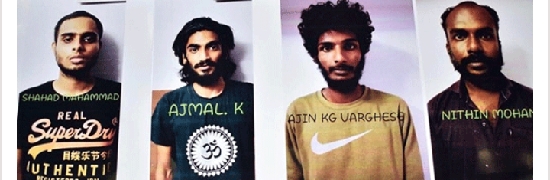
"When we raided a house in Soladevanahally police station area, we arrested Shahad Mohammed, Azmal, Ajin KG Verghese and Nitin Mohan. All are from Kerala and we will arrest their contacts as well. They are involved in the dark web mafia," Bommai said.

He said the peddlers were using post offices and couriers for their business.

"I'll speak to the central government, the home ministry and postal department, and other issues related to this mafia. Canada, Netherlands, and other nations are also involved in this mafia," said the state home minister.

"People from influential backgrounds are also involved in this mafia, but our objective is zero tolerance. We are using our intelligence. Drugs are coming from other states like AP, Goa, and other states," he said.
Bommai said he was personally addressing this case and appealed for support from parents, schools and colleges.

"I'm addressing this issue personally because it's important to curb the drug mafia. I need support from schools and college managements and parents. I'll also call college and hostel managements before colleges start. We will make managements responsible," he said.

Comments

Add new comment

  • Coastaldigest.com reserves the right to delete or block any comments.
  • Coastaldigset.com is not responsible for its readers’ comments.
  • Comments that are abusive, incendiary or irrelevant are strictly prohibited.
  • Please use a genuine email ID and provide your name to avoid reject.
Agencies
July 8,2020

The Central Board of Secondary Education (CBSE) has rationalised by up to 30 per cent the syllabus for classes 9 to 12 for the academic year 2020-21 to reduce course load on students amid the COVID-19 crisis, Union HRD Minister Ramesh Pokhriyal 'Nishank' announced on Tuesday.

The curriculum has been rationalised while retaining the core elements, the Human Resource Development said.

Among the chapters dropped after the rationalisation exercise are lessons on democracy and diversity, demonetisation, nationalism, secularism, India's relations with its neighbours and growth of local governments in India, among others.

"Looking at the extraordinary situation prevailing in the country and the world, CBSE was advised to revise the curriculum and reduce course load for the students of classes 9 to 12.

"To aid the decision, a few weeks back I also invited suggestions from all educationists on the reduction of syllabus for students and I am glad to share that we received more than 1.5K suggestions. Thank you, everyone, for the overwhelming response," Nishank tweeted.

"Considering the importance of learning achievement, it has been decided to rationalise syllabus up to 30 per cent by retaining the core concepts," he added.

The Union minister said the changes made in the syllabi have been finalised by the respective course committees with the approval of the curriculum committee and the Governing Body of the Board.

"The heads of schools and teachers have been advised by the board to ensure that the topics that have been reduced are also explained to the students to the extent required to connect different topics. However, the reduced syllabus will not be part of the topics for internal assessment and year-end board examination.

"Alternative academic calendar and inputs from the NCERT on transacting the curriculum using different strategies shall also be part of the teaching pedagogy in the affiliated schools," a senior official of the HRD ministry said.

For classes 1 to 8, the National Council of Education Research and Training (NCERT) has already notified an alternative calendar and learning outcomes.

According to the updated curriculum, among the chapters deleted from class 10 syllabus are-- democracy and diversity, gender, religion and caste, popular struggles and movement, challenges to democracy

For class 11, the deleted portions included chapters on federalism, citizenship, nationalism, secularism, growth of local governments in India.

Similarly, class 12 students will not be required to study chapters on India's relations with its neighbours, changing nature of India's economic development, social movements in India and demonetisation, among others.

Universities and schools across the country have been closed since March 16 when the central government announced a nationwide classroom shutdown as one of the measures to contain the COVID-19 outbreak.

A nationwide lockdown was announced on March 24, which came into effect the next day. While the government has eased several restrictions, schools and colleges continue to remain closed.

Comments

Add new comment

  • Coastaldigest.com reserves the right to delete or block any comments.
  • Coastaldigset.com is not responsible for its readers’ comments.
  • Comments that are abusive, incendiary or irrelevant are strictly prohibited.
  • Please use a genuine email ID and provide your name to avoid reject.