Jaya's situation 'extremely grave', says London specialist

December 5, 2016

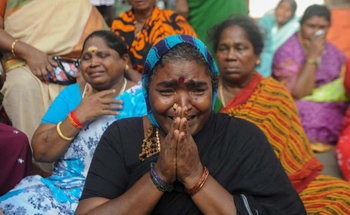
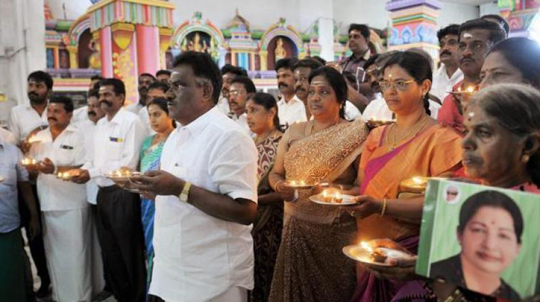
Chennai, Dec 5: The condition of Tamil Nadu Chief Minister J Jayalalithaa is "extremely grave", the London doctor who is being consulted for her treatment said today.

jayagravem"Unfortunately, and in spite of the progress she had made, her underlying health conditions inevitably meant that the risk of further problems always remained," Dr Richard Beale said in a statement.

"The situation is extremely grave, but I can confirm that everything possible is being done to give her the best chance of surviving this shocking event. She is being cared for by a highly multi-disciplinary team and is now on extra corporeal life support.

"This is the most advanced level of support available and is the approach the best centres internationally would take in this situation. That this technology is available in Apollo Chennai reflects the high degree of expertise of this centre and, that at all times, Madam has received exceptional care from Apollo and AIIMS care team, which are equal of any in the world," he said.

He said his prayers and thoughts were with the Chief Minister, her family, her carers and the people of Tamil Nadu "at this very difficult time".

jayagrave

Comments

A. Mangalore
 - 
Monday, 5 Dec 2016

Neera Melana gulle nijawalla hariye......

Sherief
 - 
Monday, 5 Dec 2016

Our thoughts and prayers are with you as we wish for a complete and fast recovery. Get well soon.

Kannadiga
 - 
Monday, 5 Dec 2016

kannadigara sapa thattade erutha!

Add new comment

  • Coastaldigest.com reserves the right to delete or block any comments.
  • Coastaldigset.com is not responsible for its readers’ comments.
  • Comments that are abusive, incendiary or irrelevant are strictly prohibited.
  • Please use a genuine email ID and provide your name to avoid reject.
News Network
July 5,2020

Ahmedabad, Jul 5: A woman police sub-inspector (PSI) with Ahmedabad Police was arrested and sent to three-day police remand, on Saturday, for allegedly accepting a bribe of Rs 20 lakh from an Ahmedabad-based businessman — accused in two rape cases — in exchange for not applying a stringent act against him.

According to police officials, Shweta Jadeja, PSI and incharge of Mahila police station (West) in the city, was arrested by a team of Detection of Crime Branch (DCB) officials in Ahmedabad on Friday after the complainant in the case, the rape accused, approached the Crime Branch and stated that Jadeja had allegedly demanded Rs 35 lakh form him, in exchange for not booking him under the Prevention of Anti-Social Activities (PASA) Act.

The PASA Act in Gujarat gives power to the police to detain an accused and send them to a prison away from their native district. The complainant claimed that he already paid Rs 20 lakh of the total amount to Jadeja on February 3.

On Saturday, a sessions court awarded Jadeja a three-day remand with the Crime Branch, which will end at 11:30 am on July 7. Following this, the PSI will undergo a medical check-up and be presented before the magistrate again.

“We had originally demanded a seven-day remand. The accused officer has been sent to three-day remand for further investigation in the case,” said a senior police official in Ahmedabad.

According to police, complainant Kenal Shah — managing director of GSP Crop Science Private Limited, a crop solution-based company in Ahmedabad — is allegedly facing two separate rape cases under IPC section 376.

PSI Jadeja was first entrusted with the investigation of a rape case against Shah in January this year, lodged at Mahila police station (West).

The rape case complaint is of 2019. Another rape case against Shah was being probed by Assistant Commissioner of Police (Crimes Against Women), Mini Josef, wherein the investigation was reportedly completed.

As per the remand application report filed by the police, Jadeja had allegedly threatened Shah through his brother Bhavesh Shah — a joint managing director at GSP Crop Science Private Limited — and initially demanded Rs 25 lakh for not applying the PASA Act against the accused. The bribe amount was then settled at Rs 20 lakh and in February, the accused allegedly paid the amount via an office accountant to one Jayubha, allegedly a representative of Jadeja, from a finance office in Jamjodhpur area of Ahmedabad.

The report further stated that after the initial amount was paid, a third complaint was allegedly made against Kenal by a security officer at his office, Yograjsinh, for criminal intimidation. After the third complaint, PSI Jadeja had contacted Bhavesh again and demanded an additional sum of Rs 15 lakh for not applying the PASA Act against Kenal. The complaint from the security officer was not converted into an FIR and Shah has not been jailed yet.

However, It was after the demand of Rs 15 lakh that complainant Kenal approached the Crime Branch on June 27. An FIR was lodged against Jadeja at Ahmedabad DCB police station under sections seven and twelve of the Prevention of Corruption Act, charging her for “public servant taking gratification other than legal remuneration in respect of an official act”.

“Now that we have received the remand of the accused officer from the court, we will try to trace and recover the alleged Rs 20 lakh amount she received in this case,” said Deepan Bhadran, Deputy Commissioner of Police, Ahmedabad.

Shweta Jadeja is a PSI of the 2016-’17 batch and a resident of Vastrapur in Ahmedabad, while her native place is in Keshod of Junagadh district. The police have not recovered the bribe amount she allegedly accepted as of late Saturday.

Comments

Add new comment

  • Coastaldigest.com reserves the right to delete or block any comments.
  • Coastaldigset.com is not responsible for its readers’ comments.
  • Comments that are abusive, incendiary or irrelevant are strictly prohibited.
  • Please use a genuine email ID and provide your name to avoid reject.
News Network
July 16,2020

New Delhi, Jul 16: With India's economic growth sputtering, the Reserve Bank of India was expected to maintain a rate-cutting cycle, but an uptick in near-term inflation could give the central bank's Monetary Policy Committee reason to pause for now.

Having cut its key lending rate by an aggressive 115 basis points (bps) in 2020, on top of 135 bps cuts in 2019, the RBI so far has had little success in spurring credit growth amid varying degrees of lockdowns across India.

Some economists and market insiders argue it may be prudent for the MPC, the policy committee, to hold its fire when it meets early next month.

"It's probably too early to administer a demand stimulus. The RBI still has room to cut rates, but we probably want to be more cautious of the timing," said Venkat Pasupuleti, portfolio manager at Dalton Investments.

"Maybe they should wait a quarter to see how things pan out once the lockdown situation is eased further."

Market participants have factored in at least a 25 bps rate cut by the MPC on August 6 while analysts are predicting a total 50-75 bps cuts over the rest of the fiscal year that runs to March 31.

The spike in the retail inflation rate above the RBI's mandated 2%-4% target range is another reason for the central bank to take a breather, analysts say.

Annual retail inflation rose to 6.09% in June, compared to 5.84% in March and sharply above a 5.30% median forecast in a Reuters poll of economists.

Rahul Bajoria, an economist at Barclays, said the spike in both consumer and wholesale prices "could lead to a tempering in enthusiasm for material front-loaded policy support from here on."

Almost all economists however agreed the RBI cannot move away from its accommodative stance or call an end to the rate cutting cycle just yet.

India's economy grew at 3.1% in the March quarter - an eight year low - and some economists have predicted a contraction of more than 20% in the June quarter and a contraction of up to 5% in the fiscal year.

"Even in the event of a pause, we think the RBI and MPC would want to hold out the promise of more cuts," said A. Prasanna, economist with ICICI Securities.

RBI Governor Shaktikanta Das said in a recent speech the need of the hour is to restore confidence, preserve financial stability, revive growth and recover stronger, suggesting inflation concerns are unlikely to deter the downward trajectory for rates too soon.

"The August policy decision would boil down to a judgment call over whether RBI can maintain easy monetary and financial conditions without the aid of a token rate cut," Prasanna said. 

Comments

Add new comment

  • Coastaldigest.com reserves the right to delete or block any comments.
  • Coastaldigset.com is not responsible for its readers’ comments.
  • Comments that are abusive, incendiary or irrelevant are strictly prohibited.
  • Please use a genuine email ID and provide your name to avoid reject.
Agencies
June 6,2020

United Nations, Jun 6: The coronavirus disease has not "exploded" in India, but the risk of that happening remains as the country moves towards unlocking its nationwide lockdown that was imposed in March to contain the Covid-19, according to a top WHO expert.

WHO Health Emergencies Programme Executive Director Michael Ryan on Friday said the doubling time of the coronavirus cases in India is about three weeks at this stage.

“So the direction of travel of the epidemic is not exponential but it is still growing,” he said, adding that the impact of the pandemic is different in different parts of India and varies between urban and rural settings.

“In South Asia, not just in India but in Bangladesh and...in Pakistan, other countries in South Asia, with large dense populations, the disease has not exploded. But there is always the risk of that happening,” Ryan said in Geneva.

He stressed that as the disease generates and creates a foothold in communities, it can accelerate at any time as has been seen in a number of settings.

Ryan noted that measures taken in India such as the nationwide lockdown have had an impact in slowing transmission but the risk of an increase in cases looms as the country opens up.

“The measures taken in India certainly had an impact in dampening transmission and as India, as in other large countries, open up and as people begin to move again, there's always a risk of the disease bouncing back up,” he said.

He added that there are specific issues in India regarding the large amount of migration, the dense populations in the urban environment and the fact that many workers have no choice but to go to work every day.

India went past Italy to become the sixth worst-hit nation by the COVID-19 pandemic.

India saw a record single-day jump of 9,887 coronavirus cases and 294 deaths on Saturday, pushing the nationwide infection tally to 2,36,657 and the death toll to 6,642, according to the health ministry.

The lockdown in India, was first clamped on March 25 and spanned for 21 days, while the second phase of the curbs began on April 15 and stretched for 19 days till May 3. The third phase of the lockdown was in effect for 14 days and ended on May 17. The fourth phase ended on May 31.

The country had registered 512 coronavirus infection cases till March 24.

The nation-wide lockdown in containment zones will continue till June 30 in India but extensive relaxations in a phased manner from June 8 are listed in the Union home ministry's fresh guidelines on tackling the Covid-19 pandemic issued last week.

WHO Chief Scientist Soumya Swaminathan said the over 200,000 current coronavirus cases in India, a country of over 1.3 billion people, "look big but for a country of this size, it's still modest.”

She stressed that it is important for India to keep track of the growth rate, the doubling time of the virus and to make sure that that number doesn't get worse.

She said that India is a “heterogeneous and huge country” with very densely populated cities and much lower density in some rural areas and varying health systems in different states and these offer challenges to the control of Covid-19.

Swaminathan added that as the lockdown and restrictions are lifted, it must be ensured that all precautions are taken by people.

“We've been making this point repeatedly that really if you want behaviour change at a large level, people need to understand the rationale for asking them to do certain things (such as) wearing masks,” she said.

In many urban areas in India, it's impossible to maintain physical distancing, she said adding that it then becomes very important for people to wear appropriate face coverings when they are out, in office settings, in public transport and educational institutions.

“As some states are thinking about opening, every institution, organisation, industry and sector needs to think about what are the measures that need to be put in place before you can allow a functioning and it may never be back to normal.”

She said that in many professions working from home can be encouraged but in several jobs, people have to go to work and in such cases measures must be put in place that allow people to protect themselves and others.

“I think communication and behaviour change is a very large part of this whole exercise,” she added.


Comments

Add new comment

  • Coastaldigest.com reserves the right to delete or block any comments.
  • Coastaldigset.com is not responsible for its readers’ comments.
  • Comments that are abusive, incendiary or irrelevant are strictly prohibited.
  • Please use a genuine email ID and provide your name to avoid reject.