Jaya's situation 'extremely grave', says London specialist

December 5, 2016

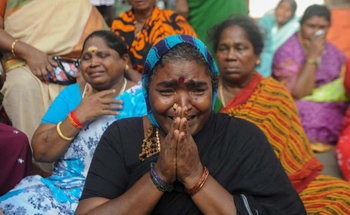
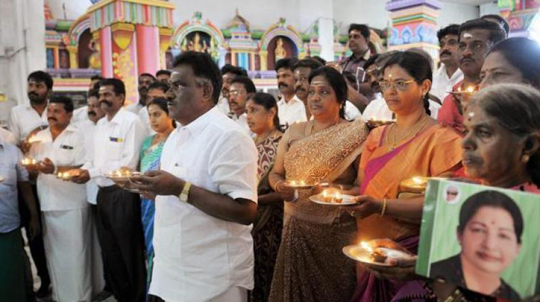
Chennai, Dec 5: The condition of Tamil Nadu Chief Minister J Jayalalithaa is "extremely grave", the London doctor who is being consulted for her treatment said today.

jayagravem"Unfortunately, and in spite of the progress she had made, her underlying health conditions inevitably meant that the risk of further problems always remained," Dr Richard Beale said in a statement.

"The situation is extremely grave, but I can confirm that everything possible is being done to give her the best chance of surviving this shocking event. She is being cared for by a highly multi-disciplinary team and is now on extra corporeal life support.

"This is the most advanced level of support available and is the approach the best centres internationally would take in this situation. That this technology is available in Apollo Chennai reflects the high degree of expertise of this centre and, that at all times, Madam has received exceptional care from Apollo and AIIMS care team, which are equal of any in the world," he said.

He said his prayers and thoughts were with the Chief Minister, her family, her carers and the people of Tamil Nadu "at this very difficult time".

jayagrave

Comments

A. Mangalore
 - 
Monday, 5 Dec 2016

Neera Melana gulle nijawalla hariye......

Sherief
 - 
Monday, 5 Dec 2016

Our thoughts and prayers are with you as we wish for a complete and fast recovery. Get well soon.

Kannadiga
 - 
Monday, 5 Dec 2016

kannadigara sapa thattade erutha!

Add new comment

  • Coastaldigest.com reserves the right to delete or block any comments.
  • Coastaldigset.com is not responsible for its readers’ comments.
  • Comments that are abusive, incendiary or irrelevant are strictly prohibited.
  • Please use a genuine email ID and provide your name to avoid reject.
News Network
March 9,2020

Mumbai, Mar 9: India's Yes Bank will not be merged with State Bank of India, which is set to infuse funds in the beleaguered lender, the newly appointed administrator leading the rescue plan said in a television interview on Monday.

"There is absolutely no question of a merger," Prashant Kumar, the administrator, told the CNBC TV18 channel.

The Reserve Bank of India (RBI) on Thursday took control of Yes Bank, after the lender - which is laden with bad debts - failed to raise the capital it needs to stay above mandated regulatory requirements.

Placing Yes Bank under a 30-day moratorium, the central bank imposed limits on withdrawals to protect depositors and said it would work on a revival plan. The move spooked depositors, who rushed to withdraw funds from the bank.

Kumar, a former finance chief at SBI, assured depositors their money was safe and that the moratorium on Yes Bank might be lifted much before the deadline on April 3 and normal banking operations might resume as early as Friday.

He also mentioned that the withdrawal limit of Yes Bank may be removed by March 15, 2020.

SBI Chairman Rajnish Kumar said on Saturday the state-run bank would need to invest up to 24.5 billion rupees ($331 million) to buy a 49% stake in Yes Bank as part of the initial phase of the rescue deal, adding that the survival of troubled lender was a "must".

Comments

Add new comment

  • Coastaldigest.com reserves the right to delete or block any comments.
  • Coastaldigset.com is not responsible for its readers’ comments.
  • Comments that are abusive, incendiary or irrelevant are strictly prohibited.
  • Please use a genuine email ID and provide your name to avoid reject.
Agencies
January 15,2020

Mumbai, Jan 15: Michael Debabrata Patra took over as Deputy Governor of the Reserve Bank of India (RBI) on Wednesday.

He was an Executive Director of India's central bank before being elevated to the post of Deputy Governor.

An RBI release said that as Deputy Governor, Patra will look after Monetary Policy Department including Forecasting and Modelling Unit (MPD/MU), Financial Markets Operations Department (FMOD), Financial Markets Regulation Department.

He will also look after Market Intelligence (FMRD/MI), International Department (Intl. D), Department of Economic and Policy Research (DEPR), Department of Statistics and Information Management (including Data and Information Management Unit) (DSIM/DIMU), Corporate Strategy and Budget Department (CSBD) and Financial Stability Unit.

Patra, a career central banker since 1985, has worked in various positions in the Reserve Bank of India.

As Executive Director, he was a member of the Monetary Policy Committee (MPC) of RBI, which is invested with the responsibility of monetary policy decision making in India. He will continue to be an ex-officio member of the MPC as Deputy Governor.

Prior to this, he was Principal Adviser of the Monetary Policy Department, Reserve Bank of India between July 2012 and October 2014.

He has worked in the International Monetary Fund (IMF) as Senior Adviser to Executive Director (India) during December 2008 to June 2012, when he actively engaged in the work of the IMF's Executive Board through the period of the global financial crisis and the ongoing Euro area sovereign debt crisis.

The release said that his book "The Global Economic Crisis through an Indian Looking Glass" vividly captures this experience.

He has also published papers in the areas of inflation, monetary policy, international trade and finance, including exchange rates and the balance of payments.

A fellow of the Harvard University where he undertook post-doctoral research in the area of financial stability, he has a PhD in Economics from the Indian Institute of Technology, Mumbai.

He will hold the post for three years or until further orders. The post fell vacant after Viral Acharya resigned on July 23 last year.

Comments

Add new comment

  • Coastaldigest.com reserves the right to delete or block any comments.
  • Coastaldigset.com is not responsible for its readers’ comments.
  • Comments that are abusive, incendiary or irrelevant are strictly prohibited.
  • Please use a genuine email ID and provide your name to avoid reject.
News Network
January 14,2020

New Delhi, Jan 14: The curative petitions of Vinay Sharma and Mukesh, who were sentenced to death in the Nirbhaya gang rape and murder case, was on Tuesday rejected by a five-judge Supreme Court Bench led by Justice N.V. Ramana.

In a three-page order, the Bench concluded, after an in chamber consideration that began about 1.45 p.m., that there was no merit in their pleas to spare them from the gallows.

“We have gone through the curative petitions and relevant documents. In our opinion, no case is made out within the parameters indicated in the decision of this Court in Rupa Ashok Hurra versus Ashok Hurra. Hence, the curative petitions are dismissed,” the court held.

Curative is a rare remedy devised by a Constitution Bench of the Supreme Court in its judgment in the Rupa Ashok Hurra case in 2002. A party can take only two limited grounds in a curative petition - one, he was not heard by the court before the adverse judgment was passed, and two, the judge was biased. A curative plea, which follows the dismissal of review petition, is the last legal avenue open for convicts in the Supreme Court. Sharma was the first among the four convicts to file a curative.

The Bench also rejected their pleas to stay the execution of their death sentence and for oral hearing in open court.

Besides Justice Ramana, the Bench comprised Arun Mishra, Rohinton Nariman, R. Banumathi and Ashok Bhushan.

Curative petitions were filed in the Supreme Court by both convicts on January 9. The petitions had come just days after a Delhi sessions court schedulled the execution of all the four convicts in Tihar jail on January 22.

Sharma and Mukesh, in separate curative petitions, argued that there was a “sea change” in the death penalty jurisprudence since their convictions. Carrying out the death sentence on such changed circumstances would be a “gross miscarriage of justice”.

In his plea, Sharma said the Court had commuted the death penalty in several rape and murder cases since 2017, when it first confirmed the death penalty to the Nirbhaya convicts.

“fter the pronouncement of judgment in 2017, there have been as many as 17 cases involving rape and murder in which various three-judge Benches of the Supreme Court have commuted the sentence of death,” the petition contended.

The Supreme Court recently dismissed a review petition filed by Akshay Singh, another of the four four condemned men, to review its May 5, 2017 judgment confirming the death penalty. It also refused his plea to grant him three weeks' time to file a mercy petition before the President of India.

A Bench led by Justice R. Banumathi had said it was open for the Nirbhaya case convicts to avail whatever time the law prescribes for the purpose of filing a mercy plea.

Akshay (33), Mukesh (30), Pawan Gupta (23) and Sharma (24) had brutally gang-raped a 23-year-old paramedical student in a moving bus on the intervening night of December 16-17, 2012. She died of her injuries a few days later.

The case shocked the nation and led to the tightening of anti-rape laws. Rape, especially gang rape, is now a capital crime.

One of the accused in the case, Ram Singh, allegedly committed suicide in the Tihar jail. A juvenile, who was among the accused, was convicted by a juvenile justice board. He was released from a reformation home after serving a three-year term.


Comments

Add new comment

  • Coastaldigest.com reserves the right to delete or block any comments.
  • Coastaldigset.com is not responsible for its readers’ comments.
  • Comments that are abusive, incendiary or irrelevant are strictly prohibited.
  • Please use a genuine email ID and provide your name to avoid reject.