Jaya's situation 'extremely grave', says London specialist

December 5, 2016

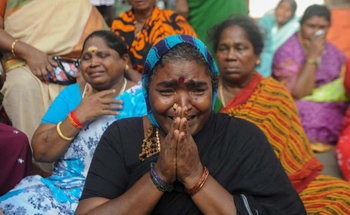
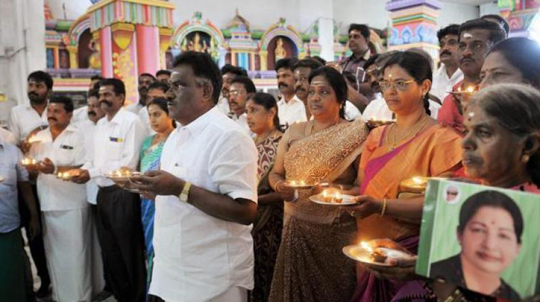
Chennai, Dec 5: The condition of Tamil Nadu Chief Minister J Jayalalithaa is "extremely grave", the London doctor who is being consulted for her treatment said today.

jayagravem"Unfortunately, and in spite of the progress she had made, her underlying health conditions inevitably meant that the risk of further problems always remained," Dr Richard Beale said in a statement.

"The situation is extremely grave, but I can confirm that everything possible is being done to give her the best chance of surviving this shocking event. She is being cared for by a highly multi-disciplinary team and is now on extra corporeal life support.

"This is the most advanced level of support available and is the approach the best centres internationally would take in this situation. That this technology is available in Apollo Chennai reflects the high degree of expertise of this centre and, that at all times, Madam has received exceptional care from Apollo and AIIMS care team, which are equal of any in the world," he said.

He said his prayers and thoughts were with the Chief Minister, her family, her carers and the people of Tamil Nadu "at this very difficult time".

jayagrave

Comments

A. Mangalore
 - 
Monday, 5 Dec 2016

Neera Melana gulle nijawalla hariye......

Sherief
 - 
Monday, 5 Dec 2016

Our thoughts and prayers are with you as we wish for a complete and fast recovery. Get well soon.

Kannadiga
 - 
Monday, 5 Dec 2016

kannadigara sapa thattade erutha!

Add new comment

  • Coastaldigest.com reserves the right to delete or block any comments.
  • Coastaldigset.com is not responsible for its readers’ comments.
  • Comments that are abusive, incendiary or irrelevant are strictly prohibited.
  • Please use a genuine email ID and provide your name to avoid reject.
News Network
March 12,2020

Bhopal, Mar 12: The Madhya Pradesh Congress on Thursday took a dig at Jyotiraditya Scindia, who broke ranks with the party and joined BJP on Wednesday, by pointing out that neither Prime Minister Narendra Modi nor Amit Shah had not even put out as much a tweet to welcome him in the party, and construed it as "humiliation" for the "maharaja".

"Not even a tweet by Narendra Modi-ji or Amit Shah-ji to welcome Scindia-ji! Modi-ji, Shah-ji, at least do not do it so soon. It has not even been 24 hours yet and you guys have already started humiliating him...!" Madya Pradesh Congress tweeted in Hindi.

Taking a jibe at Mr Scindia, a member of the erstwhile royal family of Gwalior who ended his 18-year-long association with the Congress party on a bitter note, the state Congress said: "He is a maharaja, the one whose history is often mentioned by Shivraj-ji (former Madhya Pradesh Chief Minister Shivraj Singh Chouhan)."

On Wednesday, Jyotiraditya  Scindia joined BJP in New Delhi in the presence of party president JP Nadda. He had resigned from Congress a day earlier after meeting Amit Shah and Prime Minister Narendra Modi.

Mr Scindia will file his nomination for the Rajya Sabha elections on March 13. He is expected to go to Bhopal today.

Comments

Add new comment

  • Coastaldigest.com reserves the right to delete or block any comments.
  • Coastaldigset.com is not responsible for its readers’ comments.
  • Comments that are abusive, incendiary or irrelevant are strictly prohibited.
  • Please use a genuine email ID and provide your name to avoid reject.
Agencies
June 29,2020

New Delhi, Jun 29: Fuel prices rose on Monday again after a days pause with oil marketing companies increasing the pump price of petrol by 5 paisa and diesel by 13 paisa per litre in Delhi.

In the national capital, petrol price on Monday stood at Rs 80.43 per litre while that of diesel at Rs 80.53 a litre.

With this increase, fuel prices have moved up on 22 of the last 23 days (with no rise on Sunday). Petrol prices, however, were unchanged for an additional day in between after the daily revision based on dynamic pricing was reinstated by OMCs.

Since the daily price revision resumed on June 7, petrol price has increased Rs 9.17 and diesel rose by Rs 11.14 in the national capital. In the other cities the magnitude of increase was similar.

During the past 23 days, the quantum of price hike gradually declined from around 60 paise raise for a few days, immediately post the resumption of daily price revision, to less than 20 paise during the past few days and now even less than 10 paisa per litre.

In a historic development, the price of diesel surged above that of petrol in the national capital during this period. It continues to remain higher even though on Saturday the quantum of petrol price hike was higher than that of diesel.

Officials in oil marketing companies said that it is hard to predict which of the two fuels will be priced higher in the Capital as the gap between the two is almost negligible. But petrol prices have shown more volatility in international markets that may take it ahead once again in coming days.

Apart from Delhi, the retail prices of petrol and diesel have followed the traditional path in other metros with petrol being priced at a premium of between Rs 5 and 8 per litre. The difference between the auto fuel prices in Delhi and other metros is because of the taxation structure.

While both petrol and diesel are at similar levels of taxes (state and centre) in Delhi, it is higher for petrol in many other Indian cities.

Globally diesel is priced a tad higher than petrol. In India too, the base price of diesel is slightly higher than petrol but taxation at central and state levels changed the complexion of retail prices.

If the price of petroleum products and crude hold their positions in global markets, then petrol and diesel prices rise may stop for a longer period and we may even see marginal fall in prices.

Fuel prices have been increasing since June 7 when oil companies began the daily price revision mechanism after a hiatus of 82 days during the lockdown.

Comments

Add new comment

  • Coastaldigest.com reserves the right to delete or block any comments.
  • Coastaldigset.com is not responsible for its readers’ comments.
  • Comments that are abusive, incendiary or irrelevant are strictly prohibited.
  • Please use a genuine email ID and provide your name to avoid reject.
News Network
January 1,2020

Jan 1: The ban on the practice of instant triple talaq, making it a penal offence and the increase in the strength of Supreme Court judges were two of the major achievements of the law ministry in 2019.

In July, Parliament gave its nod to The Muslim Women (Protection of Rights on Marriage) Bill, 2019. The new law makes talaq-e-biddat or any other similar form of talaq having the effect of instantaneous and irrevocable divorce pronounced by a Muslim husband void and illegal.

It makes it illegal to pronounce talaq three times in spoken, written or through SMS or WhatsApp or any other electronic chat in one sitting.

According to the new law, any Muslim who pronounces the illegal form of talaq upon his wife shall be punished with imprisonment for a term which may extend to three years, and shall also be liable to fine.

During the year, four new judges were appointed to the Supreme Court in September, taking its strength to 34, the highest-ever.

However, vacancies in high courts and lower courts are on the rise and convincing state governments and the 25 high courts to come on board to create an all-India judicial service to recruit judges for the subordinate courts tops the agenda of the Law Ministry in 2020.

Besides creating a consensus on setting up the All-India Judicial Services, the ministry will also have to focus on filling up vacancies in the high court. On an average, the vacancies stood at 400 throughout this year.

With more than 5,000 positions of judicial officers in district and subordinate courts lying vacant, the Law Ministry has pitched for setting up all-India judicial services.

The sanctioned strength of the judicial officers in district and subordinate courts was 22,644. The number of judicial officers in position and vacant posts is 17,509 and 5,135, respectively.

The government has proposed that while states and high courts can recruit judicial officers, the Union Public Service Commission (UPSC) can hold pan-India entrance tests.

The ministry has made it clear that such services would not encroach on the powers of the states.

As of now, the selection and appointment of judges in subordinate courts is the responsibility of the high courts and state governments concerned.

The Narendra Modi government has given a fresh push to the long-pending proposal to set up the new service to have a separate cadre for the lower judiciary in the country.

But there is a divergence of opinion among state governments and respective high courts on the constitution of the All India Judicial Service (AIJS).

One of the problems cited is that since several states have used powers under Code of Criminal Procedure (CrPC) and Code of Civil Procedure (CPC) to declare that the local language would be used in lower courts even for writing orders, a person say selected from Tamil Nadu may find it difficult to hold proceedings in states like Uttar Pradesh and Bihar.

The other point of opposition is that an all India service may hamper the career progression of state judicial services officers.

Another key issue the ministry has to handle in 2020 is vacancies in the 25 high courts.

Throughout 2019, on an average, the high courts faced a shortage of 400 judges.

According to Law Ministry data, as on September 1, the high courts had 414 vacant positions as compared to the sanctioned strength of 1,079 judges. The figure was 409 in August and 403 in July, as per the data.

A three-member Supreme Court collegium recommends the names of candidates for appointment as high court judges. In case of appointments to the Supreme Court, the collegium consists of five top judges of the top court.

High court collegiums shortlist candidates for their respective high courts and send the names to the law ministry.

The ministry, along with background check reports by the Intelligence Bureau, forwards it to the Supreme Court collegium for a final call.

The government has maintained that appointment of judges in the high courts is a "continuous collaborative process" between the Executive and the Judiciary, as it requires consultation and approval from various Constitutional authorities.

Vacancies keep arising on account of retirement, resignation or elevation of judges and increase in judges' strength. In June last year, the vacancy position stood at 399, while it was 396 in May.

In April, 399 posts of judges were vacant, while the figure was 394 in March. The vacancy position in February stood at 400 and in January, it was 392, according to the data collated by the Department of Justice.

Over 43 lakh cases are pending in the 25 high courts.

Another priority would be the finalisation of the memorandum of the procedure to guide the appointment and transfer of the Supreme Court and high court judges. The issue had now been pending for over two years now with the SC collegium and the government failing to reach a consensus.

Successive governments have also been working on making India a hub of international arbitration. It has taken several steps to change laws dealing with commercial disputes.


Comments

Add new comment

  • Coastaldigest.com reserves the right to delete or block any comments.
  • Coastaldigset.com is not responsible for its readers’ comments.
  • Comments that are abusive, incendiary or irrelevant are strictly prohibited.
  • Please use a genuine email ID and provide your name to avoid reject.