Jaya's situation 'extremely grave', says London specialist

December 5, 2016

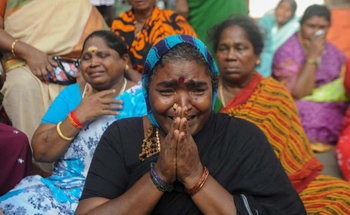
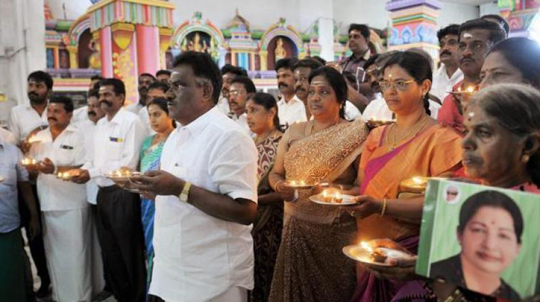
Chennai, Dec 5: The condition of Tamil Nadu Chief Minister J Jayalalithaa is "extremely grave", the London doctor who is being consulted for her treatment said today.

jayagravem"Unfortunately, and in spite of the progress she had made, her underlying health conditions inevitably meant that the risk of further problems always remained," Dr Richard Beale said in a statement.

"The situation is extremely grave, but I can confirm that everything possible is being done to give her the best chance of surviving this shocking event. She is being cared for by a highly multi-disciplinary team and is now on extra corporeal life support.

"This is the most advanced level of support available and is the approach the best centres internationally would take in this situation. That this technology is available in Apollo Chennai reflects the high degree of expertise of this centre and, that at all times, Madam has received exceptional care from Apollo and AIIMS care team, which are equal of any in the world," he said.

He said his prayers and thoughts were with the Chief Minister, her family, her carers and the people of Tamil Nadu "at this very difficult time".

jayagrave

Comments

A. Mangalore
 - 
Monday, 5 Dec 2016

Neera Melana gulle nijawalla hariye......

Sherief
 - 
Monday, 5 Dec 2016

Our thoughts and prayers are with you as we wish for a complete and fast recovery. Get well soon.

Kannadiga
 - 
Monday, 5 Dec 2016

kannadigara sapa thattade erutha!

Add new comment

  • Coastaldigest.com reserves the right to delete or block any comments.
  • Coastaldigset.com is not responsible for its readers’ comments.
  • Comments that are abusive, incendiary or irrelevant are strictly prohibited.
  • Please use a genuine email ID and provide your name to avoid reject.
News Network
June 13,2020

Dehradun, Jun 13: Chief of Army Staff General M M Naravane on Saturday said the country is passing through difficult times and its safety and honour depend on the ability of its young officers as military leaders.

Addressing gentlemen cadets at the Indian Military Academy here as the reviewing officer of a passing out parade, Gen Naravane said they are being commissioned as officers into the army under the most daunting of circumstances and the high standards of their military training will help them overcome the challenges lying in store for them.

The parade saw a total of 423 cadets being commissioned into the army including 333 from the country and 90 from friendly foreign countries.

"These are difficult times for the country. Its safety, honour and respect depend on your abilities as military leaders. You have to live up to the expectations of your countrymen. You have to ensure that whatever you do is for their welfare," he said.

The army chief said there are no good or bad regiments but only good officers.

"Become one with your men. Win their trust and affection and they will win battles for you," Naravane said.          

He asked the gentlemen cadets to throw themselves into their new role as commissioned officers with passion but also be compassionate towards their men.

"When the going gets tough and all seems lost, it is the spirit of your men that helps you win," he said.          

He said the gentlemen cadets who are taking their first step as commissioned officers will have to make decisions in the tactical and operational domain as well as resolve ethical issues and they will have only their conscience to guide them.          

"In such critical moments let the core values enshrined in the preamble of the constitution of India be your guiding light," the Army Chief said.

Asking them to rise above petty considerations of caste, creed and religion, he said the army does not discriminate.

Apart from containing the external threats, you may also have to defang internal forces out to destabilise the country.

He said the precise drill movements of the cadets had convinced him they will do their respective countries proud.

"In the autumn of your careers what will matter is not the position you finally attain but how honourably you have served your nation," he said.              

In a message to the gentlemen cadets' parents, who were not allowed to attend the event due to the coronavirus pandemic, the Army Chief said, "Till yesterday they (gentlemen cadets) were your children but from tomorrow they will be ours."

He promised to be with them through thick and thin.

The parade looked slightly off-colour this time with the enthusiastic crowds of parents and some usual features missing like the showering of the drill square with flower petals by helicopters.

Comments

Add new comment

  • Coastaldigest.com reserves the right to delete or block any comments.
  • Coastaldigset.com is not responsible for its readers’ comments.
  • Comments that are abusive, incendiary or irrelevant are strictly prohibited.
  • Please use a genuine email ID and provide your name to avoid reject.
News Network
February 18,2020

New Delhi, Feb 18: Election strategist-turned-politician Prashant Kishor on Tuesday questioned the Nitish Kumar government's development model, even as he sneered at the chief minister for making ideological compromises to stay in an alliance with the BJP.

Kishor, who has been vocal about his opposition to the Citizenship (Amendment) Act (CAA), said Kumar needs to spell out whether he is with the ideals of Mahatma Gandhi or those who support Nathu Ram Godse.

"Nitish ji has always said that he cannot leave the ideals of Gandhi, JP and Lohiya... At the same time, how can he be with the people who support the ideology of Godse? Both cannot go together. If you want to stay with the BJP, I don't have any problem with it but you cannot be on both sides," he said.

"There has been a lot of discussion between me and Nitish-ji on this. He has his thought process and I have mine. There have been differences between him and me that the ideologies of Godse and Gandhi cannot stand together. As the leader of the party you have to say which side you are on," he added.

In a direct assault on Kumar's model of governance, Kishor said Bihar was the poorest state in 2005 and continues to be so.

"There has been development in Bihar during the last 15 years, but the pace has not been as it should have," he added.

Comments

Add new comment

  • Coastaldigest.com reserves the right to delete or block any comments.
  • Coastaldigset.com is not responsible for its readers’ comments.
  • Comments that are abusive, incendiary or irrelevant are strictly prohibited.
  • Please use a genuine email ID and provide your name to avoid reject.
News Network
February 19,2020

New Delhi, Feb 19: India will switch to the world's cleanest petrol and diesel from April 1 as it leapfrogs straight to Euro-VI emission compliant fuels from Euro-IV grades now - a feat achieved in just three years and not seen in any of the large economies around the globe.

India will join the select league of nations using petrol and diesel containing just 10 parts per million of sulphur as it looks to cut vehicular emissions that are said to be one of the reasons for the choking pollution in major cities.

Sanjiv Singh, Chairman of Indian Oil Corp (IOC) - the firm that controls roughly half of the country's fuel market, said almost all refineries began producing ultra-low sulphur BS-VI (equivalent to Euro-VI grade) petrol and diesel by the end of 2019 and oil companies have now undertaken the tedious task of replacing every drop of fuel in the country with the new one.

"We are absolutely on track for supplying BS-VI fuel from April 1. Almost all refineries have begun supplying BS-VI fuel and the same has reached storage depots across the country," he said.

From storage depots, the fuel has started travelling to petrol pumps and in the next few weeks all of them will only have BS-VI grade petrol and diesel, he said. "We are 100 per cent confident that fuel that will flow from nozzles at all the petrol pumps in the country on April 1 will be BS-VI emission compliant fuel."

India adopted Euro-III equivalent (or Bharat Stage-III) fuel with a sulphur content of 350 ppm in 2010 and then took seven years to move to BS-IV that had a sulphur content of 50 ppm. From BS-IV to BS-VI it took just three years.

"It was a conscious decision to leapfrog to BS-VI as first upgrading to BS-V and then shifting to BS-VI would have prolonged the journey to 4 to 6 years. Besides, oil refineries, as well as automobile manufacturers, would have had to make investments twice - first to producing BS-V grade fuel and engines and then BS-VI ones," he said.

State-owned oil refineries spent about Rs 35,000 crore to upgrade plants that could produce ultra-low sulphur fuel. This investment is on top of Rs 60,000 crore they spent on refinery upgrades in the previous switchovers.

BS-VI has a sulphur content of just 10 ppm and emission standards are as good as CNG.

Originally, Delhi and its adjoining towns were to have BS-VI fuel supplies by April 2019 and the rest of the country was to get same supplies from April 2020.

But oil marketing companies switched over to supply of BS-VI grade fuels in the national capital territory of Delhi on April 1, 2018.

The supply of BS-VI fuels was further extended to four contiguous districts of Rajasthan and eight of Uttar Pradesh in the National Capital Region (NCR) on April 1, 2019, together with the city of Agra.

BS-VI grade fuels were made available in 7 districts of Haryana from October 1, 2019.

Singh said the new fuel will result in a reduction in NOx in BS-VI compliant vehicles by 25 per cent in petrol cars and by 70 per cent in diesel cars.

The switchover, he said, is a tedious task as every drop of old, higher-sulphur content fuel has to be flushed out in depots, pipelines and tanks before being replaced by BS-VI.

"We are confident of disruption-free switchover to BS-VI supplies across the country," he said. "What we will be supplying is the best quality available anywhere in the world. You don't have any better fuel that is supplied in any part of the world. Perhaps our BS-VI fuel will be better than equivalent fuel in some parts of the US and Europe."

India adopted a fuel upgradation programme in the early 1990s. Low lead gasoline (petrol) was introduced in 1994 in Delhi, Mumbai, Kolkata and Chennai. On February 1, 2000, unleaded gasoline was mandated nationwide.

Similarly, BS-2000 (Euro-I equivalent, BS-1) vehicle emission norms were introduced for new vehicles from April 2000. BS-II (Euro-II equivalent) emission norms for new cars were introduced in Delhi from 2000 and extended to the other metro cities in 2001.

Benzene limits have been reduced progressively from 5 per cent in 2000 to 1 per cent nationwide. Lead content in gasoline was removed in phases and only unleaded gasoline is being produced and sold from February 1, 2000.

The octane number of gasoline signifies the improved performance of the engine. Loss in octane number due to phasing out of lead was made up by installing new facilities in the refinery and changes in refinery operation. RON (Research Octane Number) of gasoline for BS-2000 spec was increased to 88. This has over time been increased to 91.

Singh said sulphur reduction will reduce Particulate Matter (PM) emissions even in the in-use older generation diesel vehicles.


Comments

Add new comment

  • Coastaldigest.com reserves the right to delete or block any comments.
  • Coastaldigset.com is not responsible for its readers’ comments.
  • Comments that are abusive, incendiary or irrelevant are strictly prohibited.
  • Please use a genuine email ID and provide your name to avoid reject.