Jaya's situation 'extremely grave', says London specialist

December 5, 2016

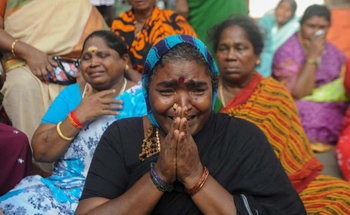
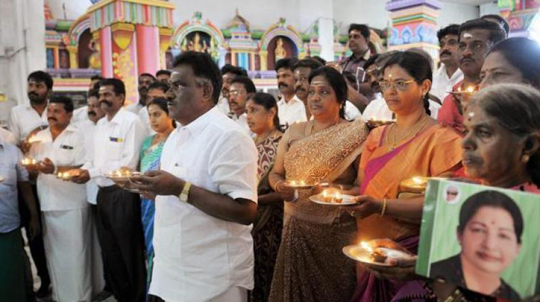
Chennai, Dec 5: The condition of Tamil Nadu Chief Minister J Jayalalithaa is "extremely grave", the London doctor who is being consulted for her treatment said today.

jayagravem"Unfortunately, and in spite of the progress she had made, her underlying health conditions inevitably meant that the risk of further problems always remained," Dr Richard Beale said in a statement.

"The situation is extremely grave, but I can confirm that everything possible is being done to give her the best chance of surviving this shocking event. She is being cared for by a highly multi-disciplinary team and is now on extra corporeal life support.

"This is the most advanced level of support available and is the approach the best centres internationally would take in this situation. That this technology is available in Apollo Chennai reflects the high degree of expertise of this centre and, that at all times, Madam has received exceptional care from Apollo and AIIMS care team, which are equal of any in the world," he said.

He said his prayers and thoughts were with the Chief Minister, her family, her carers and the people of Tamil Nadu "at this very difficult time".

jayagrave

Comments

A. Mangalore
 - 
Monday, 5 Dec 2016

Neera Melana gulle nijawalla hariye......

Sherief
 - 
Monday, 5 Dec 2016

Our thoughts and prayers are with you as we wish for a complete and fast recovery. Get well soon.

Kannadiga
 - 
Monday, 5 Dec 2016

kannadigara sapa thattade erutha!

Add new comment

  • Coastaldigest.com reserves the right to delete or block any comments.
  • Coastaldigset.com is not responsible for its readers’ comments.
  • Comments that are abusive, incendiary or irrelevant are strictly prohibited.
  • Please use a genuine email ID and provide your name to avoid reject.
News Network
March 6,2020

New Delhi, Mar 6: Shares of YES Bank and State Bank of India came under huge selling pressure on Friday as developments unfolded regarding SBI picking stake in the private lender. Shares of the lender hit record low of Rs 5.55, plunging 85 per cent, and were trading below its previous low of Rs 8.16 hit on March 9, 2009.

SBI, on the other hand, slumped 11 per cent to Rs 257.35 on the BSE. The benchmark S&P BSE Sensex was trading with a cut of over 3 per cent at 37,251.37 level.

In the past three months, share price of the private lender has plunged 41 per cent, while the state-owned lender has slipped 14 per cent. In comparison, the S&P BSE Sensex has dipped 5.6 per cent till Thursday.

On Thursday, the Reserve Bank of India superseded the board of troubled private sector lender YES Bank and imposed a 30-day moratorium on it “in the absence of a credible revival plan” amid a “serious deterioration” in its financial health.

During the moratorium, which came into effect from 6 pm on Thursday, YES Bank will not be allowed to grant or renew any loans, and “incur any liability”, except for payment towards employees’ salaries, rent, taxes and legal expenses, among others.

This is the first time that a bank of this size will be put under a moratorium by the RBI.

“The financial position of YES Bank had undergone a steady decline “largely due to inability of the bank to raise capital to address potential loan losses and resultant downgrades, triggering invocation of bond covenants by investors, and withdrawal of deposits,” RBI said in a statement.

“After the moratorium, the next step will be to infuse to money and keep the bank afloat. So from shareholders’ point of view, the future is certainly hazy as the capital requirement is huge. The good part, however, is that the RBI has stepped in and depositors don't have to worry,” says Siddharth Purohit, a research analyst at SMC Securities.

Meanwhile, analysts at Nomura believe that placing the Bank under moratorium implies that equity value in the bank would be negligible, and that the chances of private capital participating in future capital raising plan are near zero.

"Any resolution for Yes Bank is more proposed from the perspective of deposit holders and systemic stability, and not from the perspective of Yes Bank equity investors or even perpetual bond holders," they wrote in a note dated March 6.

In another development, SBI’s Board Thursday gave in-principle approval to consider an “investment opportunity” in YES Bank, even as it said “no decision had yet been taken to pick up stake in the bank”.

According to a  report, highly-placed sources indicated a rescue plan involving SBI and Life Insurance Corporation of India (LIC) was being discussed and an announcement in this regard might be made soon.

“While the finer details of the deal are being worked out, it is anticipated that both SBI and LIC together will take a 51 per cent stake in the bank, with a one-year lock-in period,” the report said.

Most analysts believe it is a positive step for the Indian financial sector as the government has tried to avoid a repeat of IL&FS-like crisis.

“The move is a positive step for the financial sector as a whole. By this, the government has tried to avoid a repeat of IL&FS-like crisis and has saved the depositors,” said AK Prabhakar, Head of Research at IDBI Capital. While we know that YES Bank has a huge pile of bad loans, SBI is the only bank that has the capacity to absorb it, he added.

However, the valuation at which YES bank would be taken over remains a cause of concern.

Global brokerage firm JP Morgan Thursday cut its target price for YES Bank on Thursday to Rs 1 per share, taking into account the potential fall in the lender’s net worth due to stressed assets.

“We believe forced bailout investors will likely want the bank to be acquired at near-zero value to account for risks associated with the stress book and likely loss of deposits. We think the bank will need to be recapitalised at nominal equity value and could test dilution of additional tier 1 (AT1) capital. We remain underweight and cut our target price to Rs 1 as we believe net worth is largely impaired,” JP Morgan said in a note.

Global brokerage firm Nomura estimates a need of Rs 25,000-44,000 crore and adjusted for Rs 7,400 crore of current coverage, if the current stress of Rs 65,000-70,000 crore faces 70 per cent loss given default (LGD).

"It implies Rs 18,000-37,000 crore needed for provisioning against the current net worth of Rs 25,700 crore Also, to run as going concern, the bank would require over Rs 20,000 crore of CET-1 capital as well," the note said.

YES Bank has registered slippages of Rs 12,000 crore so far in FY20, while it has placed Rs 30,000 crore of loan assets under the watch list. Its deposits stood at Rs 2.09 trillion on September 30, 2019, while its advances totalled Rs 2.24 trillion. The bank has delayed publishing its December quarter results by a month to March 14.


Comments

Add new comment

  • Coastaldigest.com reserves the right to delete or block any comments.
  • Coastaldigset.com is not responsible for its readers’ comments.
  • Comments that are abusive, incendiary or irrelevant are strictly prohibited.
  • Please use a genuine email ID and provide your name to avoid reject.
News Network
June 11,2020

Washington, Jun 11: Observing that historically India has been a tolerant, respectful country for all religions, a top Trump administration official has said the US is "very concerned" about what is happening in India over religious freedom.

The comments by Samuel Brownback, Ambassador-At-Large for International Religious Freedom, came hours after the release of the "2019 International Religious Freedom Report" on Wednesday.

Mandated by the US Congress, the report documenting major instances of violation of religious freedom across the world was released by Secretary of State Mike Pompeo at the State Department.

India has previously rejected the US religious freedom report, saying it sees no locus standi for a foreign government to pronounce on the state of its citizens' constitutionally protected rights.

"We do remain very concerned about what's taking place in India. It's historically just been a very tolerant, respectful country of religions, of all religions," Mr Brownback said during a phone call with foreign journalists on Wednesday.

The trend lines have been troubling in India because it is such a religious subcontinent and seeing a lot more communal violence, Mr Brownback said. "We're seeing a lot more difficulty. I think really they need to have a - I would hope they would have an - interfaith dialogue starting to get developed at a very high level in India, and then also deal with the specific issues that we identified as well," he said.

"It really needs a lot more effort on this topic in India, and my concern is, too, that if those efforts are not put forward, you're going to see a growth in violence and increased difficulty within the society writ large," said the top American diplomat.

Responding to a question, Mr Brownback said he hoped minority faiths are not blamed for the COVID-19 spread and that they would have access to healthcare amid the crisis.

Prime Minister Narendra Modi has criticised any form of discrimination, saying the COVID-19 pandemic affects everyone equally. "COVID-19 does not see race, religion, colour, caste, creed, language or border before striking. Our response and conduct thereafter should attach primacy to unity and brotherhood," PM Modi said in a post on LinkedIn in February.

The government, while previously rejecting the US religious freedom report, had said: "India is proud of its secular credentials, its status as the largest democracy and a pluralistic society with a longstanding commitment to tolerance and inclusion".

"The Indian Constitution guarantees fundamental rights to all its citizens, including its minority communities… We see no locus standi for a foreign entity/government to pronounce on the state of our citizens' constitutionally protected rights," the Foreign Ministry said in June last year.

According to the Home Ministry, 7,484 incidents of communal violence took place between 2008 and 2017, in which more than 1,100 people were killed.

Comments

Add new comment

  • Coastaldigest.com reserves the right to delete or block any comments.
  • Coastaldigset.com is not responsible for its readers’ comments.
  • Comments that are abusive, incendiary or irrelevant are strictly prohibited.
  • Please use a genuine email ID and provide your name to avoid reject.
News Network
July 18,2020

Washington, Jul 18: The Foreign Direct Investment (FDI) from the US to India has crossed the $40 billion mark so far this year, reflecting the growing confidence of American companies in the country, the head of an India-centric business advocacy group has said.

The American companies, during the Covid-19 pandemic, which has battered the world economy, have shown great confidence in India and its leadership, said Mukesh Aghi, president of the US-India Strategic and Partnership Forum (USISPF), which keeps a track of the major US FDIs in India.

“Year to date investment from the US, including the recent ones, is over $40 billion,” Aghi said.

In recent weeks alone, the announcement of the FDI into India has been over $20 billion, he said, referring to the announcements made by some of the top companies like Google, Facebook and Walmart.

“Investors’ confidence in India is high. India still remains a very promising market for global investors. If you look at the $20 billion… not just the US, but (investment) has also come from other geographies such as the Middle East and the Far East.

“So, India still remains a very, very bullish market for the investor community,” Aghi said in response to a question.

The USISPF has been working with New Delhi to bring in FDI into India… playing a key role in encouraging American companies planning to move their bases out of China, he said, adding that the move was going on in the last three years of the Trump administration, but gained momentum during the coronavirus pandemic.

“We feel that Prime Minister (Narendra Modi’s) intention is very high. The challenges lie on the execution side. Efforts are being made to encourage manufacturing… I've never seen it so better. The policy framework is moving in the right direction,” he said.

Early this week, Larry Kudlow, the White House Economic Advisor, told reporters that the US tech giants like Google and Facebook announcing big investments in India shows that people are losing trust in China and India is emerging as a big competitor.

At the same time, he rued that India continues to be a protectionist country.

“The question is how do you define protectionism... the administration here is saying America first and India is saying vocal for local…,” Aghi added.

Comments

Add new comment

  • Coastaldigest.com reserves the right to delete or block any comments.
  • Coastaldigset.com is not responsible for its readers’ comments.
  • Comments that are abusive, incendiary or irrelevant are strictly prohibited.
  • Please use a genuine email ID and provide your name to avoid reject.