


JNU enquiry finds ABVP member guilty of assaulting Najeeb Ahmed

November 20, 2016

New Delhi, Nov 20: A proctorial enquiry by JNU has found ABVP member Vikrant Kumar guilty of assaulting Najeeb Ahmed during a brawl following which the latter went missing over a month ago.najeeb copy
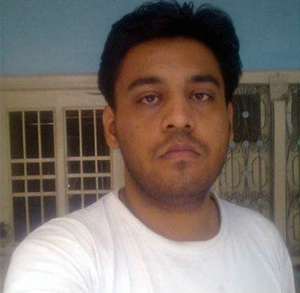
Najeeb (27), a student of School of Biotechnology and a native of Badaun in Uttar Pradesh, went missing on October 15 following an on-campus scuffle allegedly with the members of ABVP, including Vikrant, the night before.

JNU had ordered a proctorial enquiry into the incident.

"In the proctorial enquiry, Vikrant Kumar has been found to be involved in hitting Najeeb Ahmed and using derogatory language with provocative behaviour on October 14. This is an act of indiscipline and misconduct," an official order read.

Vikrant has been asked to explain why disciplinary action should not be initiated against him.

ABVP has, meanwhile, come out in Vikrant's support and accused the university administration of being "biased" in conducting the enquiry.

"The proctor has taken deposition of those students into account who were not even present there. Not only the enquiry is biased but even the administration is siding with the left-dominated students union," Saurabh Sharma, ABVP member and former JNUSU member said.

JNU students and teachers have been agitating against the university administration and Delhi Police for their failure to locate the missing student.

The protesting students had even confined the Vice Chancellor and other senior officials in the administrative building for over 20 hours.

Last month, an SIT was formed to trace the missing student on the directive of Union Home Minister Rajnath Singh to Delhi Police Commissioner Alok Kumar Verma.

The SIT, headed by Additional DCP-II(South) Manishi Chandra, failed to get any actionable clues in the matter. The case was later transferred to Delhi Police's Crime Branch.

Comments

A. Mangalore
 - 
Monday, 21 Nov 2016

Not asking his explanation. Put him inside the bar and question him where is Najeeb. He knows better where is Najeeb.
What type of Government is this ????? fully supporting it's Sangha Pariwar activist and goondas.

Ansari
 - 
Monday, 21 Nov 2016

ABVP....no wonder ...attack and become victims itself ...he hehe he

Subash
 - 
Sunday, 20 Nov 2016

Wow ..ABVP is hurt when a administration is one sided .....ha ha ha remember how much you are hurting people all over the country

Add new comment

  • Coastaldigest.com reserves the right to delete or block any comments.
  • Coastaldigset.com is not responsible for its readers’ comments.
  • Comments that are abusive, incendiary or irrelevant are strictly prohibited.
  • Please use a genuine email ID and provide your name to avoid reject.
News Network
January 10,2020

Bengaluru, Jan 10: Education technology company Byju’s is learnt to have raised $200 million in a funding round from Tiger Global Management, which has valued the Bengaluru-based start-up at around $8 billion, making it the third-largest unicorn (start-up valued over $1 billion) in the country.

With this, the Byju Raveendran-founded company has seen over 50 per cent jump in its valuation in just around nine months. In March 2019, Byju’s was valued $5.4 billion, when it raised around $31 million from General Atlantic, and Chinese investment giant Tencent.

At the current valuation, Byju’s has now replaced home-grown cab-hailing major Ola as the third-largest unicorn, next only to Paytm and OYO, which are valued around $16 billion and $10 billion, respectively.

Byju’s confirmed the transaction through a press statement, though the company declined to share any specific details of the deal. Tiger Global could not be immediately reached for its comments.

“We are happy to partner with a strong investor like Tiger Global Management. They share our sense of purpose and this partnership will advance our long-term vision of creating an impact by changing the way students learn,” said Raveendran. “This partnership is both a validation of the impact created by us so far and a vote of confidence for our long-term vision.”

This is Tiger Global’s first investment in the edutech space in India after Vendantu, an online tutoring platform, where it, along with WestBridge Capital, led a $42-million round in August.

An early backer of India’s internet growth story, the New York-headquartered Tiger Global has been a prolific investor in the Indian start-up space. Its portfolio in the country ranges from consumer focused e-commerce companies that are vital for the growth of the sector, such as Flipkart, Delhivery, Grofers, Quikr and PolicyBazaar, to mention a few.

After tasting success with Flipkart, one of its earliest investments, where it had pumped in around $1 billion, the PE major is now doubling down its focus on the Indian start-up space, under its new investment head Scott Shleifer.

Shleifer, who set up international private equity practice for Tiger Global, is said to be as aggressive deal maker like his predecessor Lee Fixel, who left the investment firm in March. Since then, Tiger has also invested in a host of technology-focused companies in diverse sectors including Ninjacart, CRED, NoBroker and Facilio to mention a few.

“Byju’s has emerged as the leader in the Indian education-tech sector. They are pioneering technology shaping the future of learning for millions of school students in India,” Shleifer was quoted in the press statement issued by the edutech firm.

Comments

Add new comment

  • Coastaldigest.com reserves the right to delete or block any comments.
  • Coastaldigset.com is not responsible for its readers’ comments.
  • Comments that are abusive, incendiary or irrelevant are strictly prohibited.
  • Please use a genuine email ID and provide your name to avoid reject.
News Network
June 12,2020

Bengaluru, June 12: The Karnataka government has withdrawn its notification that allowed factories to extend working hours up to 10 hours a day and 60 hours a week, with immediate effect.

The extension of work hours was from eight hours a day and 48 hours a week. On May 22, the government had exempted all the factories registered under the Factories Act, from the provisions of Section 51 (weekly hours) and Section 54 (daily hours), till August 21 subject to certain conditions.

"Whereas, having examined the provisions further, the Government of Karnataka now intends to withdraw the said notification," the state government in a fresh notification dated June 11 said.

It said, "Therefore, in exercise of the powers conferred under Section 5 of Factories Act, 1948 (Act No. 63 of 1948), the Government of Karnataka hereby withdraws the Notification dated 22-05-2020 with immediate effect."

According to the Karnataka Employers' Association, a petition was filed in the High Cour challenging the May 22 notification as "illegal, arbitrary and in violation" of Section 5 of the Factories Act which permits exemption from any of the provisions of the Factories Act only in case of Public Emergencies'.

During the course of hearing on June 11 an observation was made by the High Court, that it may have to quash the notification unless the government clarifies as to what is the 'Public Emergency' involved to enhance the working hours by exempting some provisions of the Factories Act, it said.

The court further observed that the government should make a submission on June 12 in this behalf. However, the government withdrew the notification on June 11 itself. Recently states like Rajasthan and Uttar Pradesh too had retracted after permitting extending work hours.

Comments

Add new comment

  • Coastaldigest.com reserves the right to delete or block any comments.
  • Coastaldigset.com is not responsible for its readers’ comments.
  • Comments that are abusive, incendiary or irrelevant are strictly prohibited.
  • Please use a genuine email ID and provide your name to avoid reject.
News Network
April 2,2020

The current physical distancing guidelines provided by the World Health Organisation (WHO) and by the US Centers for Disease Control and Prevention (CDC) may not be adequate to curb the coronavirus spread, according to a research which says the gas cloud from a cough or sneeze may help virus particles travel up to 8 metres. The research, published in the Journal of the American Medical Association, noted that the the current guidelines issued by the WHO and CDC are based on outdated models from the 1930s of how gas clouds from a cough, sneeze, or exhalation spread.

Study author, MIT associate professor Lydia Bourouiba, warned that droplets of all sizes can travel 23 to 27 feet, or 7-8 metres, carrying the pathogen.

According to Bourouiba, the current guidelines are based on "arbitrary" assumptions of droplet size, "overly simplified", and "may limit the effectiveness of the proposed interventions" against the deadly pandemic.

 She explained that the old guidelines assume droplets to be one of two categories, small or large, taking short-range semi-ballistic trajectories when a person exhales, coughs, or sneezes.

However based on more recent discoveries, the MIT scientist said, sneezes and coughs are made of a puff cloud that carries ambient air, transporting within it clusters of droplets of a wide range of sizes.

Bourouiba warned that this puff cloud, with ambient air entrapped in it, can offer the droplets moisture and warmth that can prevent it from evaporation in the outer environment.

"The locally moist and warm atmosphere within the turbulent gas cloud allows the contained droplets to evade evaporation for much longer than occurs with isolated droplets," she said.

"Under these conditions, the lifetime of a droplet could be considerably extended by a factor of up to 1000, from a fraction of a second to minutes," the researcher explained in the study.

The MIT scientist, who has researched the dynamics of coughs and sneezes for years, added that these droplets settle along the trajectory of a cough or sneeze contaminating surfaces, with their residues staying suspended in the air for hours.

"Even when maximum containment policies were enforced, the rapid international spread of COVID-19 suggests that using arbitrary droplet size cutoffs may not accurately reflect what actually occurs with respiratory emissions, possibly contributing to the ineffectiveness of some procedures used to limit the spread of respiratory disease," Bourouiba wrote in the study

Comments

Add new comment

  • Coastaldigest.com reserves the right to delete or block any comments.
  • Coastaldigset.com is not responsible for its readers’ comments.
  • Comments that are abusive, incendiary or irrelevant are strictly prohibited.
  • Please use a genuine email ID and provide your name to avoid reject.