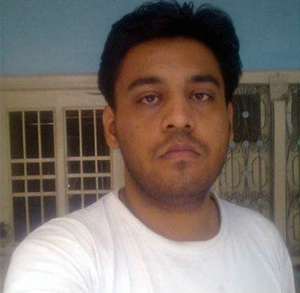
JNU enquiry finds ABVP member guilty of assaulting Najeeb Ahmed

November 20, 2016

New Delhi, Nov 20: A proctorial enquiry by JNU has found ABVP member Vikrant Kumar guilty of assaulting Najeeb Ahmed during a brawl following which the latter went missing over a month ago.najeeb copy

Najeeb (27), a student of School of Biotechnology and a native of Badaun in Uttar Pradesh, went missing on October 15 following an on-campus scuffle allegedly with the members of ABVP, including Vikrant, the night before.

JNU had ordered a proctorial enquiry into the incident.

"In the proctorial enquiry, Vikrant Kumar has been found to be involved in hitting Najeeb Ahmed and using derogatory language with provocative behaviour on October 14. This is an act of indiscipline and misconduct," an official order read.

Vikrant has been asked to explain why disciplinary action should not be initiated against him.

ABVP has, meanwhile, come out in Vikrant's support and accused the university administration of being "biased" in conducting the enquiry.

"The proctor has taken deposition of those students into account who were not even present there. Not only the enquiry is biased but even the administration is siding with the left-dominated students union," Saurabh Sharma, ABVP member and former JNUSU member said.

JNU students and teachers have been agitating against the university administration and Delhi Police for their failure to locate the missing student.

The protesting students had even confined the Vice Chancellor and other senior officials in the administrative building for over 20 hours.

Last month, an SIT was formed to trace the missing student on the directive of Union Home Minister Rajnath Singh to Delhi Police Commissioner Alok Kumar Verma.

The SIT, headed by Additional DCP-II(South) Manishi Chandra, failed to get any actionable clues in the matter. The case was later transferred to Delhi Police's Crime Branch.

Comments

A. Mangalore
 - 
Monday, 21 Nov 2016

Not asking his explanation. Put him inside the bar and question him where is Najeeb. He knows better where is Najeeb.
What type of Government is this ????? fully supporting it's Sangha Pariwar activist and goondas.

Ansari
 - 
Monday, 21 Nov 2016

ABVP....no wonder ...attack and become victims itself ...he hehe he

Subash
 - 
Sunday, 20 Nov 2016

Wow ..ABVP is hurt when a administration is one sided .....ha ha ha remember how much you are hurting people all over the country

Add new comment

  • Coastaldigest.com reserves the right to delete or block any comments.
  • Coastaldigset.com is not responsible for its readers’ comments.
  • Comments that are abusive, incendiary or irrelevant are strictly prohibited.
  • Please use a genuine email ID and provide your name to avoid reject.
News Network
April 4,2020

Mangaluru, Apr 4: The chemistry department of National Institute of Technology-Karnataka (NIT-K) here has started producing hand sanitizers in view of its shortage in the market after the coronavirus outbreak.

The social initiative led by Arun Isloor, professor and head of the department, was launched by NIT-K director K Uma Maheshwar Rao.

The raw materials needed for this product were provided by the institute.

Comments

Add new comment

  • Coastaldigest.com reserves the right to delete or block any comments.
  • Coastaldigset.com is not responsible for its readers’ comments.
  • Comments that are abusive, incendiary or irrelevant are strictly prohibited.
  • Please use a genuine email ID and provide your name to avoid reject.
Agencies
May 8,2020

Washington D.C., May 8: The prime time for brain development in a child's life is the first year, where the infant spends most of the time asleep. It is the time when neural connections form and sensory memories are encoded.

However, when sleep is disrupted, as occurs more often among children with autism, brain development may be affected, too.

New research led by the University of Washington finds that sleep problems in a baby's first 12 months may not only precede an autism diagnosis but also may be associated with altered growth trajectory in a key part of the brain, the hippocampus.

The study, which was published in the American Journal of Psychiatry, researchers report that in a sample of more than 400 taken of 6- to 12-month-old infants, those who were later diagnosed with autism were more likely to have had difficulty falling asleep.

It also states that this sleep difficulty was associated with altered growth trajectories in the hippocampus.

"The hippocampus is critical for learning and memory, and changes in the size of the hippocampus have been associated with poor sleep in adults and older children.

As many as 80 per cent of the children with autism spectrum disorder have sleep problems," said Annette Estes, director of the UW Autism Center and senior author of the study.

"In our clinical experience, parents have a lot of concerns about their children's sleep, and in our work on early autism intervention, we observed that sleep problems were holding children and families back," added Estes, who is also a UW professor of speech and hearing sciences.

"It could be that altered sleep is part-and-parcel of autism for some children. One clue is that behavioural interventions to improve sleep don't work for all children with autism, even when their parents are doing everything just right. This suggests that there may be a biological component to sleep problems for some children with autism," said Estes.

To consider links among sleep, brain development, and autism, researchers at the IBIS Network looked at MRI scans of 432 infants, surveyed parents about sleep patterns, and measured cognitive functioning using a standardized assessment.

At the outset of the study, infants were classified according to their risk for developing autism: Those who were at higher risk of developing autism -- about two-thirds of the study sample -- had an older sibling who had already been diagnosed.

Infant siblings of children with autism have a 20 per cent chance of developing autism spectrum disorder -- a much higher risk than children in the general population.

In the current study, 127 of the 432 infants were identified as "low risk" at the time the MRI scans were taken because they had no family history of autism.

They later evaluated all the participants at 24 months of age to determine whether they had developed autism. Of the roughly 300 children originally considered "high familial risk," 71 were diagnosed with autism spectrum disorder at that age.

Problems with sleep were more common among the infants later diagnosed with an autism spectrum disorder, as were larger hippocampi. No other subcortical brain structures were affected, including the amygdala, which is responsible for certain emotions and aspects of memory, or the thalamus, a signal transmitter from the spinal cord to the cerebral cortex.

The authors note that while parents reported more sleep difficulties among infants who developed autism compared to those who did not, the differences were very subtle and only observed when looking at group averages across hundreds of infants.

Sleep patterns in the first years of life change rapidly as infants transition from sleeping around the clock to a more adult-like sleep/wake cycle. Until further research is completed, Estes said, it is not possible to interpret challenges with sleep as an early sign of increased risk for autism.


Comments

Add new comment

  • Coastaldigest.com reserves the right to delete or block any comments.
  • Coastaldigset.com is not responsible for its readers’ comments.
  • Comments that are abusive, incendiary or irrelevant are strictly prohibited.
  • Please use a genuine email ID and provide your name to avoid reject.
News Network
August 8,2020

Bengaluru, Aug 8: Anticipating a huge number of pilgrims from Karnataka to start visiting Ayodhya following the foundation stone laying ceremony of the Ram temple, Chief Minister B.S. Yediyurappa on Friday requested his Uttar Pradesh counterpart Yogi Adityanath for two acres of land to build a 'yatri nivas' (guest house).

"A large number of pilgrims from Karnataka would be visiting Ayodhya. The government of Karnataka wishes to construct a yatri nivas for the pilgrims visiting Ayodhya," Yediyurappa wrote to Yogi.

"I request you to grant two acres of land in Ayodhya for this purpose," he said.

The Chief Minister said the yatri nivas will be constructed for the benefit of pilgrims from the southern state.

He also congratulated the Uttar Pradesh Chief Minister for successfully laying the foundation stone for the Ram temple on Wednesday.

Comments

M SHARIEF SULTAN
 - 
Sunday, 9 Aug 2020

Use our money for corona patients. Dont waste tax payers money.

For Ayodhya pilgrims, Spend from your BJP looted money.

Ahmed A.K.
 - 
Sunday, 9 Aug 2020

Our ruling govt is only interested in RAM Mandir and spending crores of rupees for the temple. Why the other community is not demanding fund from the GOVT?

Not bothered about the development of the country as currently we have no idea how to tackle the corona viurs. Ministers are keen on builing Guest house for pilgrims, Statue of RAM etc etc.

Please concentrate on how to minimise the Virus issue in KARNAKATA like other Gulf countries.

Add new comment

  • Coastaldigest.com reserves the right to delete or block any comments.
  • Coastaldigset.com is not responsible for its readers’ comments.
  • Comments that are abusive, incendiary or irrelevant are strictly prohibited.
  • Please use a genuine email ID and provide your name to avoid reject.