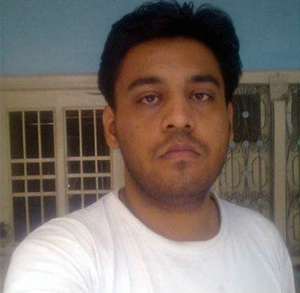
JNU enquiry finds ABVP member guilty of assaulting Najeeb Ahmed

November 20, 2016

New Delhi, Nov 20: A proctorial enquiry by JNU has found ABVP member Vikrant Kumar guilty of assaulting Najeeb Ahmed during a brawl following which the latter went missing over a month ago.najeeb copy

Najeeb (27), a student of School of Biotechnology and a native of Badaun in Uttar Pradesh, went missing on October 15 following an on-campus scuffle allegedly with the members of ABVP, including Vikrant, the night before.

JNU had ordered a proctorial enquiry into the incident.

"In the proctorial enquiry, Vikrant Kumar has been found to be involved in hitting Najeeb Ahmed and using derogatory language with provocative behaviour on October 14. This is an act of indiscipline and misconduct," an official order read.

Vikrant has been asked to explain why disciplinary action should not be initiated against him.

ABVP has, meanwhile, come out in Vikrant's support and accused the university administration of being "biased" in conducting the enquiry.

"The proctor has taken deposition of those students into account who were not even present there. Not only the enquiry is biased but even the administration is siding with the left-dominated students union," Saurabh Sharma, ABVP member and former JNUSU member said.

JNU students and teachers have been agitating against the university administration and Delhi Police for their failure to locate the missing student.

The protesting students had even confined the Vice Chancellor and other senior officials in the administrative building for over 20 hours.

Last month, an SIT was formed to trace the missing student on the directive of Union Home Minister Rajnath Singh to Delhi Police Commissioner Alok Kumar Verma.

The SIT, headed by Additional DCP-II(South) Manishi Chandra, failed to get any actionable clues in the matter. The case was later transferred to Delhi Police's Crime Branch.

Comments

A. Mangalore
 - 
Monday, 21 Nov 2016

Not asking his explanation. Put him inside the bar and question him where is Najeeb. He knows better where is Najeeb.
What type of Government is this ????? fully supporting it's Sangha Pariwar activist and goondas.

Ansari
 - 
Monday, 21 Nov 2016

ABVP....no wonder ...attack and become victims itself ...he hehe he

Subash
 - 
Sunday, 20 Nov 2016

Wow ..ABVP is hurt when a administration is one sided .....ha ha ha remember how much you are hurting people all over the country

Add new comment

  • Coastaldigest.com reserves the right to delete or block any comments.
  • Coastaldigset.com is not responsible for its readers’ comments.
  • Comments that are abusive, incendiary or irrelevant are strictly prohibited.
  • Please use a genuine email ID and provide your name to avoid reject.
News Network
March 13,2020

Bengaluru, Mar 13: Senior IPS officer KSR Charan Reddy, who was the Additional Director General of Police in Criminal Investigation Department, Karnataka passed away in Bengaluru on Friday after prolonged illness. 

He was reportedly battling cancer for at least three years now and had suffered multiple recurs after treatment. 

"Shri Charan Reddy, IPS, ADGP, Karnataka State, passed away this morning, after a prolonged illness. He was one of our finest officers. Always stood tall and held his head high!! May his soul rest in peace," Retired IPS officer and former Director General of Police (Fire Services) MN Reddi tweeted. 

IPS officer Charan Reddy was heading the Special Investigation Team of the Lokayukta when he arrested Vijayanagara MLA Anand Singh in 2015 for illegally transporting iron ore out of Ballari. The illegal mining scam had rocked the former BJP government in 2011.

Karnataka Chief Minister BS Yediyurappa condoled his death and said that he was an honest officer in the state. "Charan Reddy was a dedicated and honest officer. I pray that his soul rests in peace. I pray that god gives his family the strength to go through such a turbulent time after his departure," BS Yediyurappa tweeted. 

A 1993-batch IPS officer, Charan Reddy KSR is originally from Chittoor and has served under various departments of the state's police force. He was serving as the Inspector General of Police in Belagavi division in 2013, when he was transferred to Bengaluru as the IGP (Training). In 2014, he was posted as the IGP of the SIT probing the illegal mining scam in which former Tourism Minister Gali Janardhana Reddy is also allegedly involved.

He was transferred out of the SIT in Lokayukta in 2016 and posted as Additional Commissioner of Police (law and order) in Bengaluru. He served as the ADGP of Crime in Mangaluru in 2018 and was later appointed as the Additional Director General of Police (training) the same year. In 2019, he was transferred and appointed as the ADGP of CID.

Comments

Add new comment

  • Coastaldigest.com reserves the right to delete or block any comments.
  • Coastaldigset.com is not responsible for its readers’ comments.
  • Comments that are abusive, incendiary or irrelevant are strictly prohibited.
  • Please use a genuine email ID and provide your name to avoid reject.
News Network
January 30,2020

Bengaluru, Jan 30: Karnataka Chief Minister B S Yediyurappa, who reached the national capital on Thursday, said he will discuss the much-awaited Ministry expansion with the BJP high command.

"It's been long that I visited Delhi. I will meet the party national president J P Nadda and Home Minister Amit Shah and take their suggestions on the cabinet expansion," Yediyurappa told reporters.

The chief minister said he will also call on Finance Minister Nirmala Sitharaman and Petroleum Minister Dharmendra Pradhan and discuss about development issues related to Karnataka.

Yediyurappa has been anxiously waiting for the high command's nod to expand his ministry amid intense lobbying by the aspirants.

Opposition parties have been critical of the BJP and Yediyurappa over the delay in cabinet expansion, alleging that he was weak and that the administration had collapsed.

As the chief minister has already made it clear that 11 of the disqualified JDS-Congress MLAs who got re-elected in the bypolls on BJP tickets will be made ministers, lobbying has been on in the party for the remaining ministerial berths.

Currently, there are 18 Ministers, including the chief minister in the cabinet that has a sanctioned strength of 34. Sixteen berths are vacant.

Comments

Add new comment

  • Coastaldigest.com reserves the right to delete or block any comments.
  • Coastaldigset.com is not responsible for its readers’ comments.
  • Comments that are abusive, incendiary or irrelevant are strictly prohibited.
  • Please use a genuine email ID and provide your name to avoid reject.
News Network
July 28,2020

Hounde, Jul 28: Coronavirus and its restrictions are pushing already hungry communities over the edge, killing an estimated 10,000 more young children a month as meager farms are cut off from markets and villages are isolated from food and medical aid, the United Nations warned Monday.

In the call to action shared with The Associated Press ahead of publication, four UN agencies warned that growing malnutrition would have long-term consequences, transforming individual tragedies into a generational catastrophe.

Hunger is already stalking Haboue Solange Boue, an infant from Burkina Faso who lost half her former body weight of 5.5 pounds (2.5 kilograms) in just a month. Coronavirus restrictions closed the markets, and her family sold fewer vegetables. Her mother was too malnourished to nurse.

“My child,” Danssanin Lanizou whispered, choking back tears as she unwrapped a blanket to reveal her baby's protruding ribs.

More than 550,000 additional children each month are being struck by what is called wasting, according to the UN — malnutrition that manifests in spindly limbs and distended bellies. Over a year, that's up 6.7 million from last year's total of 47 million. Wasting and stunting can permanently damage children physically and mentally.

“The food security effects of the COVID crisis are going to reflect many years from now,” said Dr. Francesco Branca, the WHO head of nutrition. “There is going to be a societal effect.”

From Latin America to South Asia to sub-Saharan Africa, more poor families than ever are staring down a future without enough food.

In April, World Food Program head David Beasley warned that the coronavirus economy would cause global famines “of biblical proportions” this year. There are different stages of what is known as food insecurity; famine is officially declared when, along with other measures, 30% of the population suffers from wasting.

The World Food Program estimated in February that one Venezuelan in three was already going hungry, as inflation rendered salaries nearly worthless and forced millions to flee abroad. Then the virus arrived.

“Every day we receive a malnourished child,” said Dr. Francisco Nieto, who works in a hospital in the border state of Tachira.

In May, Nieto recalled, after two months of quarantine, 18-month-old twins arrived with bodies bloated from malnutrition. The children's mother was jobless and living with her own mother. She told the doctor she fed them only a simple drink made with boiled bananas.

“Not even a cracker? Some chicken?” he asked.

“Nothing,” the children's grandmother responded. By the time the doctor saw them, it was too late: One boy died eight days later.

The leaders of four international agencies — the World Health Organization, UNICEF, the World Food Program and the Food and Agriculture Organization — have called for at least dollar 2.4 billion immediately to address global hunger.

But even more than lack of money, restrictions on movement have prevented families from seeking treatment, said Victor Aguayo, the head of UNICEF's nutrition program.

“By having schools closed, by having primary health care services disrupted, by having nutritional programs dysfunctional, we are also creating harm,” Aguayo said. He cited as an example the near-global suspension of Vitamin A supplements, which are a crucial way to bolster developing immune systems.

In Afghanistan, movement restrictions prevent families from bringing their malnourished children to hospitals for food and aid just when they need it most. The Indira Gandhi hospital in the capital, Kabul, has seen only three or four malnourished children, said specialist Nematullah Amiri. Last year, there were 10 times as many.

Because the children don't come in, there's no way to know for certain the scale of the problem, but a recent study by Johns Hopkins University indicated an additional 13,000 Afghans younger than 5 could die.

Afghanistan is now in a red zone of hunger, with severe childhood malnutrition spiking from 690,000 in January to 780,000 — a 13% increase, according to UNICEF.

In Yemen, restrictions on movement have blocked aid distribution, along with the stalling of salaries and price hikes. The Arab world's poorest country is suffering further from a fall in remittances and a drop in funding from humanitarian agencies.

Yemen is now on the brink of famine, according to the Famine Early Warning Systems Network, which uses surveys, satellite data and weather mapping to pinpoint places most in need.

Some of the worst hunger still occurs in sub-Saharan Africa. In Sudan, 9.6 million people live from one meal to the next — a 65% increase from the same time last year.

Lockdowns across Sudanese provinces, as around the world, have dried up work and incomes for millions. With inflation hitting 136%, prices for basic goods have more than tripled.

“It has never been easy but now we are starving, eating grass, weeds, just plants from the earth,” said Ibrahim Youssef, director of the Kalma camp for internally displaced people in war-ravaged south Darfur.

Adam Haroun, an official in the Krinding camp in west Darfur, recorded nine deaths linked with malnutrition, otherwise a rare occurrence, over the past two months — five newborns and four older adults, he said.

Before the pandemic and lockdown, the Abdullah family ate three meals a day, sometimes with bread, or they'd add butter to porridge. Now they are down to just one meal of “millet porridge” — water mixed with grain. Zakaria Yehia Abdullah, a farmer now at Krinding, said the hunger is showing “in my children's faces.”

“I don't have the basics I need to survive,” said the 67-year-old, who who hasn't worked the fields since April. “That means the 10 people counting on me can't survive either.”


Comments

Add new comment

  • Coastaldigest.com reserves the right to delete or block any comments.
  • Coastaldigset.com is not responsible for its readers’ comments.
  • Comments that are abusive, incendiary or irrelevant are strictly prohibited.
  • Please use a genuine email ID and provide your name to avoid reject.