


Journalists take to streets to protest assault

February 16, 2016

New Delhi, Feb 16: Top editors of national media and hundreds of journalists today hit the streets demanding action against those involved in beating up members of their fraternity in a court complex in police presence and sought Supreme Court's intervention in protecting freedom of speech.JNUmedia
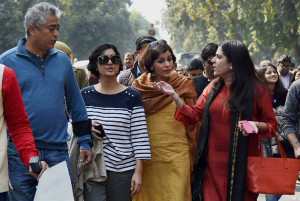
The journalists, shouting slogans against the Modi Government and Delhi Police, marched from Press Club of India to the Supreme Court and submitted a memorandum to its, Registrar, seeking cancellation of licences of lawyers involved in the assualt.

The protesters also demanded Police Commissioner B S Bassi's sacking due to alleged inaction by the security personnel at the Patiala House Courts yesterday when journalists, students and teachers of JNU where attacked by people wearing lawyers' black robes.

A separate delegation of journalists met Home Minister Rajnath Singh demanding his intervention in ensuring "accountability of the Delhi Police who watched silently as the assault happened".

The memorandum by the journalists was submitted to Supreme Court even as it agreed to hear a petition tomorrow on a plea seeking action against those involved in the violence at Patiala House court complex.

"We demand the intervention of the highest court of the land to take appropriate action against the advocates involved in the assault," the memorandum said, urging the court to direct the bar council to cancel the licences of the errant advocates.

No arrest has been made even 24 hours after the assault where Delhi BJP MLA OP Sharma was also seen beating up a CPI activist.

The journalists also said the CCTV footage of yesterday's incident should be called for and police directed to ensure protection to journalists and other media persons.

Yesterday, groups of lawyers had beaten up journalists and JNU students and teachers ahead of the hearing of the sedition case registered against JNUSU president Kanhaiya Kumar in connection with an event at the university last week to protest the hanging of Parliament attack convict Afzal Guru. Anti-India slogans were also allegedly raised at the event.

Nadeem Ahmad Kazmi, Secretary General of Press Club of India, said the Supreme Court registrar told them Chief Justice of India T S Thakur will meet a delegation of journalists in a few days.

"We hope that the Supreme Court will surely protect freedom of speech because it is constitutionally mandated to do so," he said.

Senior journalist Siddharth Varadarajan slammed the Delhi Police for remaining "mute spectators" when the assault was going on.

"The manner in which the police allowed the goons to beat up jourmnalists and no action has been taken against them even after 24 hours tells you that the terrain is likely to get more and more hostile for journalism.

"There is not even a video of Kanhaiya Kumar saying anything and he has been booked for sedition and here you have a video recording of an MLA kicking and beating somebody and not even a case has been registered," he said.

In the memorandum to the Home Minister, the journalists demanded that the perpetrators of the assault be brought to book at the earliest.

"As Union Home Minister, we urge your intervention in the matter on two counts. There should be some accountability of the Delhi Police who watched silently as the assault happened.

"And secondly, as there were CCTV cameras where the incident of assault must have been recorded, we demand that the perpetrators of the assault be brought to book at the earliest," they said.

In the memorandum, the journalists also criticised Bassi for describing the incident as a "minor scuffle".

"It is a matter of concern that the Delhi Police Commissioner has dismissed the incident describing it as a scuffle. Such observations will encourage only those elements who already believe that they are above the law of the land," it said.

In the memorandum to the Supreme Court, the journalists said Delhi Police did nothing even as "brutal assault" was unleashed by lawyers on mediapersons including, on women scribes, in and outside the court room.

More than a dozen journalists were set upon by lawyers who prevented them in the discharge of their duties. The journalists had gone to cover the hearing of the sedition case against arrested JNU students union president Kanhaiya Kumar.

Comments

Curious
 - 
Wednesday, 17 Feb 2016

Silence during violence - this is Modi's tactics, same tactics was used during gujarath riots which killed thousands of muslims .

Add new comment

  • Coastaldigest.com reserves the right to delete or block any comments.
  • Coastaldigset.com is not responsible for its readers’ comments.
  • Comments that are abusive, incendiary or irrelevant are strictly prohibited.
  • Please use a genuine email ID and provide your name to avoid reject.
Wafa Sultana
April 4,2020

Over the last couple of days when the world was occupied with unifying efforts to fight the deadly Covid19 pandemic, sections of Indian media provided viewers a familiar scapegoat – the Indian Muslims – who are often stereotyped as a community being constantly at loggerheads with the citizenry and the State. Biased media channels were quick to resort to blaming the entire Muslim community for the spread of the disease in the country, thanks to an ill-timed Tablighi Jamaat gathering at its international headquarters in Delhi’s Nizamuddin. Unsurprisingly, the opprobrium was also marked by a sudden spike in WhatsApp forwards of videos with people wearing skullcaps licking spoons and performing Sufi breathing rituals, suggesting some sort of wild conspiracy on the part of the community to spread the virus.  Some media channels were quick to formulate, hypothesize and provide loose definitions of a newly discovered form of Jihad i.e. ‘Corona Jihad ’ thereby vilifying the Islamic faith and its followers.

While the investigation on the culpability of the organizers of the Nizamuddin event is still ongoing, there is enough information to suggest that the meeting was held before any lockdown was in force, and the problem began when there was no way of getting people out once the curfew was announced. Be that as it may, there is little doubt that organizing a meet of such a scale when there is a global pandemic smacks of gross misjudgment, and definitely the organizers should be held accountable if laws or public orders were defied. Attendees who attempt to defy quarantine measures must be dealt with strictly. However, what is alarming is that the focus and narrative have now shifted from the unfortunate event at Nizamuddin to the Tablighi Jamaat itself.

For those not familiar with the Tablighi Jamaat, the organization was founded in 1926 in Mewat by scholar Maulana Mohammad Ilyas. The Jamaat’s main objective was to get Muslim youth to learn and practice pristine Islam shorn of external influences. This is achieved through individuals dedicating time for moral and spiritual upliftment secluded from the rest of the world for a brief period of time. There is no formal membership process. More senior and experienced participants typically travel from one mosque to other delivering talks on religious topics, inviting local youth to attend and then volunteer for a spiritual retreat for a fixed number of days to a mosque in a nearby town or village to present the message to their co-religionists. Contrary to ongoing Islamophobic rhetoric, the movement does not actively proselytize. The focus is rather on getting Muslims to learn the teachings and practices of Islam.  This grassroots India-based movement has now grown to almost all countries with substantial Muslim populations. Its annual meets, or ‘ijtemas’ are among the largest Islamic congregations in the world after the annual Haj. One of the reasons for its popularity and wide network in the subcontinent and wordwide is the fact that it has eschewed the need for scholarly intervention, focusing on peer learning of fundamental beliefs and practice rather than high-falutin ideological debates. The Tablighi Jamaat also distinguishes itself from other Islamic movements through its strictly apolitical nature, with a focus on individual self-improvement rather than political mobilization. Hardships and difficulty in the world are expected to be face through ‘sabr’ (patience) and ‘dua’ (supplication),  than through quest for political power or influence. In terms of ideology, it is very much based on mainstream Sunni Islamic principles derived from the Deobandi school.

So, why is all this background important in the current context? While biased media entities have expectedly brought out their Islamophobic paraphernalia out for full display, more neutral commentators have tried to paint the Tablighi Jamaat as a fringe group and have tried to distance it from 'mainstream Muslims'. While the intent is no doubt innocent, this is a trap we must not fall into. This narrative, unfortunately, is also gaining ground due to apathy some Muslims have for the group, accusing it of being “disconnected from the realities of the world”. Unlike other Muslim organizations and movements, the Tablighi Jamat, by virtue of its political indifference, does not boast of high-profile advocates and savvy spokespersons who can defend it in mainstream or social media.  The use of adjectives such as 'outdated' and 'orthodox' by liberal columnists to describe the Jamaat feeds into the malignant attempt to change the narrative from the control of the spread of the pandemic due to the Nizamuddin gathering to 'raison d'etre' of the organization itself.

A large mainstream religious group like the Tablighi Jamaat with nearly a hundred-year history, normally considered to be peaceful, apolitical and minding its own business is now suddenly being villainized owing to unfortunate circumstances. Biased media reactions filled with disgust and hate seem to feed the Indian public conscience with a danngerous misconception - to be a nominal Muslim is okay but being a practicing one is not.  For those committed to the truth and fighting the spread of Islamophobia, the temptation to throw the entire Tablighi Jamaat under the bus must be resisted.

The writer is a lawyer and research scholar at Qatar University. Her research interests include Islamic law and politics.

Comments

zahoorahmed
 - 
Saturday, 4 Apr 2020

great article! provides a great perspective on tableeg jamat

Add new comment

  • Coastaldigest.com reserves the right to delete or block any comments.
  • Coastaldigset.com is not responsible for its readers’ comments.
  • Comments that are abusive, incendiary or irrelevant are strictly prohibited.
  • Please use a genuine email ID and provide your name to avoid reject.
News Network
June 2,2020

Mangaluru, Jun 2: Karnataka-Kerala border at Talapady is yet to be opened for traffic despite lifting lockdown. Only those, who have registered on ‘Seva Sindhu’ portal, are given one-time permission to enter the district.

With the relaxation of the lock-down many, especially the labour class, were anticipating free movement. However, both the States have not allowed free movement of vehicles. Hundreds of people from bordering villages of Kerala arrive in Mangaluru for work and likewise many from bordering villages of Mangaluru too work in Kasargod district.

It has become a routine for the labourers of both the States living in border villages to daily assemble at the check post in the morning and return after the authorities refuse free movement.

Comments

Add new comment

  • Coastaldigest.com reserves the right to delete or block any comments.
  • Coastaldigset.com is not responsible for its readers’ comments.
  • Comments that are abusive, incendiary or irrelevant are strictly prohibited.
  • Please use a genuine email ID and provide your name to avoid reject.
News Network
June 4,2020

Bengaluru, Jun 4: The Special Investment Promotion Task Force, constituted by the Karnataka government, held its first meeting in Vidhana Soudha, Bengaluru on Wednesday, June 3.

The first meeting of the task force was held under the chairmanship of Chief Secretary, Karnataka government.

The body is seeking to find ways to attract the disenchanted multi-national corporations (MNCs) which are looking to shift their manufacturing base away from China in the back-drop of the COVID-19 outbreak.

Comments

Add new comment

  • Coastaldigest.com reserves the right to delete or block any comments.
  • Coastaldigset.com is not responsible for its readers’ comments.
  • Comments that are abusive, incendiary or irrelevant are strictly prohibited.
  • Please use a genuine email ID and provide your name to avoid reject.