


Journalists take to streets to protest assault

February 16, 2016

New Delhi, Feb 16: Top editors of national media and hundreds of journalists today hit the streets demanding action against those involved in beating up members of their fraternity in a court complex in police presence and sought Supreme Court's intervention in protecting freedom of speech.JNUmedia
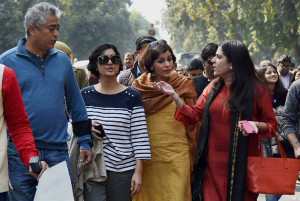
The journalists, shouting slogans against the Modi Government and Delhi Police, marched from Press Club of India to the Supreme Court and submitted a memorandum to its, Registrar, seeking cancellation of licences of lawyers involved in the assualt.

The protesters also demanded Police Commissioner B S Bassi's sacking due to alleged inaction by the security personnel at the Patiala House Courts yesterday when journalists, students and teachers of JNU where attacked by people wearing lawyers' black robes.

A separate delegation of journalists met Home Minister Rajnath Singh demanding his intervention in ensuring "accountability of the Delhi Police who watched silently as the assault happened".

The memorandum by the journalists was submitted to Supreme Court even as it agreed to hear a petition tomorrow on a plea seeking action against those involved in the violence at Patiala House court complex.

"We demand the intervention of the highest court of the land to take appropriate action against the advocates involved in the assault," the memorandum said, urging the court to direct the bar council to cancel the licences of the errant advocates.

No arrest has been made even 24 hours after the assault where Delhi BJP MLA OP Sharma was also seen beating up a CPI activist.

The journalists also said the CCTV footage of yesterday's incident should be called for and police directed to ensure protection to journalists and other media persons.

Yesterday, groups of lawyers had beaten up journalists and JNU students and teachers ahead of the hearing of the sedition case registered against JNUSU president Kanhaiya Kumar in connection with an event at the university last week to protest the hanging of Parliament attack convict Afzal Guru. Anti-India slogans were also allegedly raised at the event.

Nadeem Ahmad Kazmi, Secretary General of Press Club of India, said the Supreme Court registrar told them Chief Justice of India T S Thakur will meet a delegation of journalists in a few days.

"We hope that the Supreme Court will surely protect freedom of speech because it is constitutionally mandated to do so," he said.

Senior journalist Siddharth Varadarajan slammed the Delhi Police for remaining "mute spectators" when the assault was going on.

"The manner in which the police allowed the goons to beat up jourmnalists and no action has been taken against them even after 24 hours tells you that the terrain is likely to get more and more hostile for journalism.

"There is not even a video of Kanhaiya Kumar saying anything and he has been booked for sedition and here you have a video recording of an MLA kicking and beating somebody and not even a case has been registered," he said.

In the memorandum to the Home Minister, the journalists demanded that the perpetrators of the assault be brought to book at the earliest.

"As Union Home Minister, we urge your intervention in the matter on two counts. There should be some accountability of the Delhi Police who watched silently as the assault happened.

"And secondly, as there were CCTV cameras where the incident of assault must have been recorded, we demand that the perpetrators of the assault be brought to book at the earliest," they said.

In the memorandum, the journalists also criticised Bassi for describing the incident as a "minor scuffle".

"It is a matter of concern that the Delhi Police Commissioner has dismissed the incident describing it as a scuffle. Such observations will encourage only those elements who already believe that they are above the law of the land," it said.

In the memorandum to the Supreme Court, the journalists said Delhi Police did nothing even as "brutal assault" was unleashed by lawyers on mediapersons including, on women scribes, in and outside the court room.

More than a dozen journalists were set upon by lawyers who prevented them in the discharge of their duties. The journalists had gone to cover the hearing of the sedition case against arrested JNU students union president Kanhaiya Kumar.

Comments

Curious
 - 
Wednesday, 17 Feb 2016

Silence during violence - this is Modi's tactics, same tactics was used during gujarath riots which killed thousands of muslims .

Add new comment

  • Coastaldigest.com reserves the right to delete or block any comments.
  • Coastaldigset.com is not responsible for its readers’ comments.
  • Comments that are abusive, incendiary or irrelevant are strictly prohibited.
  • Please use a genuine email ID and provide your name to avoid reject.
News Network
July 28,2020

Hounde, Jul 28: Coronavirus and its restrictions are pushing already hungry communities over the edge, killing an estimated 10,000 more young children a month as meager farms are cut off from markets and villages are isolated from food and medical aid, the United Nations warned Monday.

In the call to action shared with The Associated Press ahead of publication, four UN agencies warned that growing malnutrition would have long-term consequences, transforming individual tragedies into a generational catastrophe.

Hunger is already stalking Haboue Solange Boue, an infant from Burkina Faso who lost half her former body weight of 5.5 pounds (2.5 kilograms) in just a month. Coronavirus restrictions closed the markets, and her family sold fewer vegetables. Her mother was too malnourished to nurse.

“My child,” Danssanin Lanizou whispered, choking back tears as she unwrapped a blanket to reveal her baby's protruding ribs.

More than 550,000 additional children each month are being struck by what is called wasting, according to the UN — malnutrition that manifests in spindly limbs and distended bellies. Over a year, that's up 6.7 million from last year's total of 47 million. Wasting and stunting can permanently damage children physically and mentally.

“The food security effects of the COVID crisis are going to reflect many years from now,” said Dr. Francesco Branca, the WHO head of nutrition. “There is going to be a societal effect.”

From Latin America to South Asia to sub-Saharan Africa, more poor families than ever are staring down a future without enough food.

In April, World Food Program head David Beasley warned that the coronavirus economy would cause global famines “of biblical proportions” this year. There are different stages of what is known as food insecurity; famine is officially declared when, along with other measures, 30% of the population suffers from wasting.

The World Food Program estimated in February that one Venezuelan in three was already going hungry, as inflation rendered salaries nearly worthless and forced millions to flee abroad. Then the virus arrived.

“Every day we receive a malnourished child,” said Dr. Francisco Nieto, who works in a hospital in the border state of Tachira.

In May, Nieto recalled, after two months of quarantine, 18-month-old twins arrived with bodies bloated from malnutrition. The children's mother was jobless and living with her own mother. She told the doctor she fed them only a simple drink made with boiled bananas.

“Not even a cracker? Some chicken?” he asked.

“Nothing,” the children's grandmother responded. By the time the doctor saw them, it was too late: One boy died eight days later.

The leaders of four international agencies — the World Health Organization, UNICEF, the World Food Program and the Food and Agriculture Organization — have called for at least dollar 2.4 billion immediately to address global hunger.

But even more than lack of money, restrictions on movement have prevented families from seeking treatment, said Victor Aguayo, the head of UNICEF's nutrition program.

“By having schools closed, by having primary health care services disrupted, by having nutritional programs dysfunctional, we are also creating harm,” Aguayo said. He cited as an example the near-global suspension of Vitamin A supplements, which are a crucial way to bolster developing immune systems.

In Afghanistan, movement restrictions prevent families from bringing their malnourished children to hospitals for food and aid just when they need it most. The Indira Gandhi hospital in the capital, Kabul, has seen only three or four malnourished children, said specialist Nematullah Amiri. Last year, there were 10 times as many.

Because the children don't come in, there's no way to know for certain the scale of the problem, but a recent study by Johns Hopkins University indicated an additional 13,000 Afghans younger than 5 could die.

Afghanistan is now in a red zone of hunger, with severe childhood malnutrition spiking from 690,000 in January to 780,000 — a 13% increase, according to UNICEF.

In Yemen, restrictions on movement have blocked aid distribution, along with the stalling of salaries and price hikes. The Arab world's poorest country is suffering further from a fall in remittances and a drop in funding from humanitarian agencies.

Yemen is now on the brink of famine, according to the Famine Early Warning Systems Network, which uses surveys, satellite data and weather mapping to pinpoint places most in need.

Some of the worst hunger still occurs in sub-Saharan Africa. In Sudan, 9.6 million people live from one meal to the next — a 65% increase from the same time last year.

Lockdowns across Sudanese provinces, as around the world, have dried up work and incomes for millions. With inflation hitting 136%, prices for basic goods have more than tripled.

“It has never been easy but now we are starving, eating grass, weeds, just plants from the earth,” said Ibrahim Youssef, director of the Kalma camp for internally displaced people in war-ravaged south Darfur.

Adam Haroun, an official in the Krinding camp in west Darfur, recorded nine deaths linked with malnutrition, otherwise a rare occurrence, over the past two months — five newborns and four older adults, he said.

Before the pandemic and lockdown, the Abdullah family ate three meals a day, sometimes with bread, or they'd add butter to porridge. Now they are down to just one meal of “millet porridge” — water mixed with grain. Zakaria Yehia Abdullah, a farmer now at Krinding, said the hunger is showing “in my children's faces.”

“I don't have the basics I need to survive,” said the 67-year-old, who who hasn't worked the fields since April. “That means the 10 people counting on me can't survive either.”

Comments

Add new comment

  • Coastaldigest.com reserves the right to delete or block any comments.
  • Coastaldigset.com is not responsible for its readers’ comments.
  • Comments that are abusive, incendiary or irrelevant are strictly prohibited.
  • Please use a genuine email ID and provide your name to avoid reject.
News Network
March 12,2020

Mangaluru, Mar 12: Deputy Commissioner Sindhu B Rupesh on Thursday said that the test reports of the 35-year-old passenger from Dubai have shown no signs of either Coronavirus (COVID-19) or H1N1.

In statement issued here Ms Rupesh said that the passenger has now been discharged from the Bantwal hospital. He has been asked to stay at home quarantined for the next 14 days.

The passenger, who had been diagnosed with fever after he arrived at the airport from Dubai on March 8, had left the Government Wenlock Hospital in the early hours of March 9 refusing to undergo tests.

Later, he was traced and admitted to the hospital in Bantwal and his throat swab samples had been sent to Viral Research Diagnostic Laboratory (VRDL) in Hassan Institute of Medical Sciences.

Meanwhile, throat swab samples of six patients were also found negative for COVID-19.

As many asf 49 people were under quarantine in the district of which five have completed the 28-day cycle.

All passengers arriving by international flights and those in contact with them should voluntarily report to the district health team and undergo self-quarantine for 14 days. If there were symptoms of cough, cold and fever, they should undergo tests for COVID-19. If the reports were positive for COVID-19, then they have to stay in the isolation ward of the Government Wenlock Hospital or in the seven select private hospitals for 28 days.

Screening facility at the airport has been strengthened by posting doctors from seven private medical colleges on rotation basis. These doctors would be in addition to the medical officer at the airport. An ambulance has been placed at the airport exclusively to shift people to the hospitals, she added.

The State government has issued a notification on Wednesday authorising Deputy Commissioners to get the affected admitted by force, if necessary.

Comments

Add new comment

  • Coastaldigest.com reserves the right to delete or block any comments.
  • Coastaldigset.com is not responsible for its readers’ comments.
  • Comments that are abusive, incendiary or irrelevant are strictly prohibited.
  • Please use a genuine email ID and provide your name to avoid reject.
News Network
January 6,2020

Bengaluru, Jan 6: Chief minister BS Yediyurappa has plenty on his plate ahead of the 2020-21 state budget to be presented on March 5 what with the economic slowdown and a sizeable shortfall in revenue, but the biggest worry is the uncertainty surrounding Goods and Services Tax (GST) compensation from the Centre.

There is also uncertainty over the state’s share under devolution of funds as per the 14th Finance Commission recommendation.

Finance department officials say that while Rs 3,500 crore is expected as GST compensation for every two months, the devolution of funds would have yielded about Rs 7,000 crore for the current fiscal. But the economic slowdown appears to have hit the Centre’s finances and is likely to impact the state’s share of funds.

“The GST payment for August-September came only in December and we are unsure how much we will get for October-November and December-January,” an official said. Estimates suggest the state’s share under devolution of funds could be reduced by half.

At a meeting of finance department officials last week, Yediyurappa is said to have admitted that unlike those states where non-BJP parties are in power — they have threatened agitations and court cases — the government cannot go “against” Prime Minister Narendra Modi’s regime.

Instead, Yediyurappa has urged senior IAS finance department officials to lobby for funds with their counterparts in New Delhi. On his part, Yediyurappa is said to have already written to Modi and finance minister Nirmala Sitharaman to at least release the state’s share of GST compensation for the current calendar year of 2019. He is planning to personally meet the PM in Delhi to push the state’s case.

Comments

Add new comment

  • Coastaldigest.com reserves the right to delete or block any comments.
  • Coastaldigset.com is not responsible for its readers’ comments.
  • Comments that are abusive, incendiary or irrelevant are strictly prohibited.
  • Please use a genuine email ID and provide your name to avoid reject.