


Journalists take to streets to protest assault

February 16, 2016

New Delhi, Feb 16: Top editors of national media and hundreds of journalists today hit the streets demanding action against those involved in beating up members of their fraternity in a court complex in police presence and sought Supreme Court's intervention in protecting freedom of speech.JNUmedia
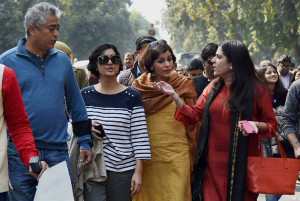
The journalists, shouting slogans against the Modi Government and Delhi Police, marched from Press Club of India to the Supreme Court and submitted a memorandum to its, Registrar, seeking cancellation of licences of lawyers involved in the assualt.

The protesters also demanded Police Commissioner B S Bassi's sacking due to alleged inaction by the security personnel at the Patiala House Courts yesterday when journalists, students and teachers of JNU where attacked by people wearing lawyers' black robes.

A separate delegation of journalists met Home Minister Rajnath Singh demanding his intervention in ensuring "accountability of the Delhi Police who watched silently as the assault happened".

The memorandum by the journalists was submitted to Supreme Court even as it agreed to hear a petition tomorrow on a plea seeking action against those involved in the violence at Patiala House court complex.

"We demand the intervention of the highest court of the land to take appropriate action against the advocates involved in the assault," the memorandum said, urging the court to direct the bar council to cancel the licences of the errant advocates.

No arrest has been made even 24 hours after the assault where Delhi BJP MLA OP Sharma was also seen beating up a CPI activist.

The journalists also said the CCTV footage of yesterday's incident should be called for and police directed to ensure protection to journalists and other media persons.

Yesterday, groups of lawyers had beaten up journalists and JNU students and teachers ahead of the hearing of the sedition case registered against JNUSU president Kanhaiya Kumar in connection with an event at the university last week to protest the hanging of Parliament attack convict Afzal Guru. Anti-India slogans were also allegedly raised at the event.

Nadeem Ahmad Kazmi, Secretary General of Press Club of India, said the Supreme Court registrar told them Chief Justice of India T S Thakur will meet a delegation of journalists in a few days.

"We hope that the Supreme Court will surely protect freedom of speech because it is constitutionally mandated to do so," he said.

Senior journalist Siddharth Varadarajan slammed the Delhi Police for remaining "mute spectators" when the assault was going on.

"The manner in which the police allowed the goons to beat up jourmnalists and no action has been taken against them even after 24 hours tells you that the terrain is likely to get more and more hostile for journalism.

"There is not even a video of Kanhaiya Kumar saying anything and he has been booked for sedition and here you have a video recording of an MLA kicking and beating somebody and not even a case has been registered," he said.

In the memorandum to the Home Minister, the journalists demanded that the perpetrators of the assault be brought to book at the earliest.

"As Union Home Minister, we urge your intervention in the matter on two counts. There should be some accountability of the Delhi Police who watched silently as the assault happened.

"And secondly, as there were CCTV cameras where the incident of assault must have been recorded, we demand that the perpetrators of the assault be brought to book at the earliest," they said.

In the memorandum, the journalists also criticised Bassi for describing the incident as a "minor scuffle".

"It is a matter of concern that the Delhi Police Commissioner has dismissed the incident describing it as a scuffle. Such observations will encourage only those elements who already believe that they are above the law of the land," it said.

In the memorandum to the Supreme Court, the journalists said Delhi Police did nothing even as "brutal assault" was unleashed by lawyers on mediapersons including, on women scribes, in and outside the court room.

More than a dozen journalists were set upon by lawyers who prevented them in the discharge of their duties. The journalists had gone to cover the hearing of the sedition case against arrested JNU students union president Kanhaiya Kumar.

Comments

Curious
 - 
Wednesday, 17 Feb 2016

Silence during violence - this is Modi's tactics, same tactics was used during gujarath riots which killed thousands of muslims .

Add new comment

  • Coastaldigest.com reserves the right to delete or block any comments.
  • Coastaldigset.com is not responsible for its readers’ comments.
  • Comments that are abusive, incendiary or irrelevant are strictly prohibited.
  • Please use a genuine email ID and provide your name to avoid reject.
Ram Puniyani
February 4,2020

As democracy is seeping in slowly all over the world, there is an organization which is monitoring the degree of democracy in the individual countries, The Economist Intelligence Unit. As such in each country there are diverse factors which on one hand work to deepen it, while others weaken it. Overall there is a march from theoretical democracy to substantive one. The substantive democracy will herald not just the formal equality, freedom and community feeling in the country but will be founded on the substantive quality of these values. In India while the introduction of modern education, transport, communication laid the backdrop of beginning of the process, the direction towards deepening of the process begins with Mahatma Gandhi when he led the non-cooperation movement in 1920, in which average people participated. The movement of freedom for India went on to become the ‘greatest ever mass movement’ in the World.

The approval and standards for democracy were enshrined in Indian Constitution, which begins ‘We the people of India’, and was adopted on 26th January 1950. With this Constitution and the policies adopted by Nehru the process of democratization started seeping further, the dreaded Emergency in 1975, which was lifted later restored democratic freedoms in some degree. This process of democratisation is facing an opposition since the decade of 1990s after the launch of Ram Temple agitation, and has seen the further erosion with BJP led Government coming to power in 2014. The state has been proactively attacking civil liberties, pluralism and participative political culture with democracy becoming flawed in a serious way. And this is what got reflected in the slipping of India by ten places, to 51st, in 2019. On the index of democracy India slipped down from the score of 7.23 to 6.90. The impact of sectarian BJP politics is writ on the state of the nation, country.

Ironically this lowering of score has come at a time when the popular protests, the deepening of democracy has been given a boost and is picking up with the Shaheen Bagh protests. The protest which began in Shaheen Bagh, Delhi in the backdrop of this Government getting the Citizenship amendment Bill getting converted into an act and mercilessly attacking the students of Jamia Milia Islamia, Aligarh Muslim University along with high handed approach in Jamia Nagar and neighbouring areas.  From 15th December 2019, the laudable protest is on.

It is interesting to note that the lead in this protest has been taken by the Muslim women, from the Burqa-Hijab clad to ‘not looking Muslim’ women and was joined by students and youth from all the communities, and later by the people from all the communities. Interestingly this time around this Muslim women initiated protest has contrast from all the protests which earlier had begun by Muslims. The protests opposing Shah Bano Judgment, the protests opposing entry of women in Haji Ali, the protests opposing the Government move to abolish triple Talaq. So far the maulanas from top were initiating the protests, with beard and skull cap dominating the marches and protests. The protests were by and large for protecting Sharia, Islam and were restricted to Muslim community participating.

This time around while Narendra Modi pronounced that ‘protesters can be identified by their clothes’, those who can be identified by their external appearance are greatly outnumbered by all those identified or not identified by their appearance.

The protests are not to save Islam or any other religion but to protect Indian Constitution. The slogans are structured around ‘Defence of democracy and Indian Constitution’. The theme slogans are not Allahu Akbar’ or Nara-E-Tadbeer’ but around preamble of Indian Constitution. The lead songs have come to be Faiz Ahmad Faiz’s ‘Hum Dekhenge’, a protest against Zia Ul Haq’s attempts to crush democracy in the name of religion. Another leading protest song is from Varun Grover, ‘Tanashah Aayenge…Hum Kagaz nahin Dikhayenge’, a call to civil disobedience against the CAA-NRC exercise and characterising the dictatorial nature of the current ruling regime.

While BJP was telling us that primary problem of Muslim women is Triple talaq, the Muslim women led movements has articulated that primary problem is the very threat to Muslim community. All other communities, cutting across religious lines, those below poverty line, those landless and shelter less people also see that if the citizenship of Muslims can be threatened because of lack of some papers, they will be not far behind in the victimization process being unleashed by this Government.

While CAA-NRC has acted as the precipitating factor, the policies of Modi regime, starting from failure to fulfil the tall promises of bringing back black money, the cruel impact of demonetisation, the rising process of commodities, the rising unemployment, the divisive policies of the ruling dispensation are the base on which these protest movements are standing. The spread of the protest movement, spontaneous but having similar message is remarkable. Shaheen Bagh is no more just a physical space; it’s a symbol of resistance against the divisive policies, against the policies which are increasing the sufferings of poor workers, the farmers and the average sections of society.

What is clear is that as identity issues, emotive issues like Ram Temple, Cow Beef, Love Jihad and Ghar Wapasi aimed to divide the society, Shaheen Bagh is uniting the society like never before. The democratisation process which faced erosion is getting a boost through people coming together around the Preamble of Indian Constitution, singing of Jan Gan Man, waving of tricolour and upholding the national icons like Gandhi, Bhagat Singh, Ambedkar and Maulana Azad. One can feel the sentiments which built India; one can see the courage of people to protect what India’s freedom movement and Indian Constitution gave them.

Surely the communal forces are spreading canards and falsehood against the protests. As such these protests which is a solid foundation of our democracy. The spontaneity of the movement is a strength which needs to be channelized to uphold Indian Constitution and democratic ethos of our beloved country.

Comments

Add new comment

  • Coastaldigest.com reserves the right to delete or block any comments.
  • Coastaldigset.com is not responsible for its readers’ comments.
  • Comments that are abusive, incendiary or irrelevant are strictly prohibited.
  • Please use a genuine email ID and provide your name to avoid reject.
News Network
January 19,2020

Chikkamagaluru, Jan 19: A Chikkamagaluru court on Saturday were sentenced to death two persons convicted of rape and murder 18-year-old girl in 2016.

Pradeep M, 32, and Santhosh, 24, of Vykuntapura in Sringeri taluk raped a 18-year-old girl while she was returning home from college on Februrary 16, 2016.

The crime in which a first year B.Com student who was walking towards her home in a footway was stopped, raped and murdered by the duo. The killers then had dumped her body in a discarded well.

Comments

Add new comment

  • Coastaldigest.com reserves the right to delete or block any comments.
  • Coastaldigset.com is not responsible for its readers’ comments.
  • Comments that are abusive, incendiary or irrelevant are strictly prohibited.
  • Please use a genuine email ID and provide your name to avoid reject.
News Network
February 14,2020

Bengaluru, Feb 14: A 31 -year-old Bhojpuri dancer and another girl were rescued from human traffickers after the former alerted city police on landing at Kempegowda International Airport (KIA) on Tuesday. They were to be received by a woman named Preethi at the airport.

The dancer had been told she was supposed to perform a few stage shows in the city, which has a significant Bhojpuri-speaking population. But when she realised she is likely to be pushed into flesh trade, she raised an alarm.

The woman, Radha (name changed), is a mother of four children and the lone breadwinner of the family. A few months ago, Radha came in contact with a woman named Soniya in New Delhi during a dance performance. Last month, Soniya got in touch with Radha and offered to pay Rs 40,000 per month if she performed in Bengaluru.

Radha agreed and was sent to Bengaluru from Chandigarh along with the other girl. During the journey, she learnt she was supposed to do more than just perform on stage. A shocked Radha informed the Central Industrial Security Force personnel manning KIA that she feared being pushed into prostitution. KIA police were informed and the women were rescued. Preethi was arrested.

Comments

Add new comment

  • Coastaldigest.com reserves the right to delete or block any comments.
  • Coastaldigset.com is not responsible for its readers’ comments.
  • Comments that are abusive, incendiary or irrelevant are strictly prohibited.
  • Please use a genuine email ID and provide your name to avoid reject.