


Journalists take to streets to protest assault

February 16, 2016

New Delhi, Feb 16: Top editors of national media and hundreds of journalists today hit the streets demanding action against those involved in beating up members of their fraternity in a court complex in police presence and sought Supreme Court's intervention in protecting freedom of speech.JNUmedia
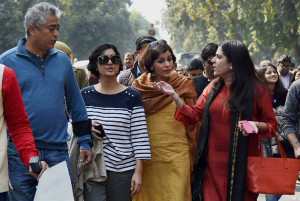
The journalists, shouting slogans against the Modi Government and Delhi Police, marched from Press Club of India to the Supreme Court and submitted a memorandum to its, Registrar, seeking cancellation of licences of lawyers involved in the assualt.

The protesters also demanded Police Commissioner B S Bassi's sacking due to alleged inaction by the security personnel at the Patiala House Courts yesterday when journalists, students and teachers of JNU where attacked by people wearing lawyers' black robes.

A separate delegation of journalists met Home Minister Rajnath Singh demanding his intervention in ensuring "accountability of the Delhi Police who watched silently as the assault happened".

The memorandum by the journalists was submitted to Supreme Court even as it agreed to hear a petition tomorrow on a plea seeking action against those involved in the violence at Patiala House court complex.

"We demand the intervention of the highest court of the land to take appropriate action against the advocates involved in the assault," the memorandum said, urging the court to direct the bar council to cancel the licences of the errant advocates.

No arrest has been made even 24 hours after the assault where Delhi BJP MLA OP Sharma was also seen beating up a CPI activist.

The journalists also said the CCTV footage of yesterday's incident should be called for and police directed to ensure protection to journalists and other media persons.

Yesterday, groups of lawyers had beaten up journalists and JNU students and teachers ahead of the hearing of the sedition case registered against JNUSU president Kanhaiya Kumar in connection with an event at the university last week to protest the hanging of Parliament attack convict Afzal Guru. Anti-India slogans were also allegedly raised at the event.

Nadeem Ahmad Kazmi, Secretary General of Press Club of India, said the Supreme Court registrar told them Chief Justice of India T S Thakur will meet a delegation of journalists in a few days.

"We hope that the Supreme Court will surely protect freedom of speech because it is constitutionally mandated to do so," he said.

Senior journalist Siddharth Varadarajan slammed the Delhi Police for remaining "mute spectators" when the assault was going on.

"The manner in which the police allowed the goons to beat up jourmnalists and no action has been taken against them even after 24 hours tells you that the terrain is likely to get more and more hostile for journalism.

"There is not even a video of Kanhaiya Kumar saying anything and he has been booked for sedition and here you have a video recording of an MLA kicking and beating somebody and not even a case has been registered," he said.

In the memorandum to the Home Minister, the journalists demanded that the perpetrators of the assault be brought to book at the earliest.

"As Union Home Minister, we urge your intervention in the matter on two counts. There should be some accountability of the Delhi Police who watched silently as the assault happened.

"And secondly, as there were CCTV cameras where the incident of assault must have been recorded, we demand that the perpetrators of the assault be brought to book at the earliest," they said.

In the memorandum, the journalists also criticised Bassi for describing the incident as a "minor scuffle".

"It is a matter of concern that the Delhi Police Commissioner has dismissed the incident describing it as a scuffle. Such observations will encourage only those elements who already believe that they are above the law of the land," it said.

In the memorandum to the Supreme Court, the journalists said Delhi Police did nothing even as "brutal assault" was unleashed by lawyers on mediapersons including, on women scribes, in and outside the court room.

More than a dozen journalists were set upon by lawyers who prevented them in the discharge of their duties. The journalists had gone to cover the hearing of the sedition case against arrested JNU students union president Kanhaiya Kumar.

Comments

Curious
 - 
Wednesday, 17 Feb 2016

Silence during violence - this is Modi's tactics, same tactics was used during gujarath riots which killed thousands of muslims .

Add new comment

  • Coastaldigest.com reserves the right to delete or block any comments.
  • Coastaldigset.com is not responsible for its readers’ comments.
  • Comments that are abusive, incendiary or irrelevant are strictly prohibited.
  • Please use a genuine email ID and provide your name to avoid reject.
Media Release
February 14,2020

Veteran journalist P. Sainath has said that the nation is in a crisis. And this crisis is not limited to just the rural area. It has become a national crisis at various areas such as agriculture, education, economy, job creation etc.

He was delivering the endowment lecture on the topic ‘Indian democracy at the post-liberalization and post-truth era’ at Media Manthan 2020 organized by the PG department of journalism and mass communication at St Aloysius College (Autonomous). 

Mr Sainath said that the many policies adopted in the 90s led to India becoming unusually unequal. Referring to the speech Ambedkar had made at the Constituent Assembly while handing over the draft of the Constitution, Mr Sainath said, “Ambedkar had warned about the weakness of Indian democracy that liberty without equality allows the supremacy of a few over the multitude. Liberty, equality and fraternity must be kept together as we cannot have one without the other.” 

Mr Sainath stated that the agrarian crisis was no longer about the loss of productivity, employment or about farmer suicide; it was a societal, civilizational crisis. Commenting on the lopsided policies such as cow-slaughter ban, he explained how cow slaughter ban had adversely affected many industries due to their interdependency. While Muslims who slaughtered cows were rendered helpless, the cattle traders who were mostly OBCs lost their earnings as the cattle prices crashed. An important industry like Kolhapur sandals industry in Maharashtra went bankrupt as a result of the cow slaughter ban in Maharashtra. He said the policymakers had no idea how the rural industries were interconnected. Demonetisation too devastated the rural economy as 98 percent of rural transactions happen through cash. 

Mr Sainath also spoke about the crisis of inequality which affects the Dalits and the Adivasis far more than anyone else as 90 percent of the rural households take home less than Rs 10,000/- per month. “Women are yet another group whose labour is never counted in the gross domestic product. Women and girls globally do unpaid work which amounts to about 12.5 billion working hours per year. Monetarily speaking, this is worth 10.8 trillion dollars,” Mr Sainath added. 

Speaking about the crisis of jobs Mr Sainath said that major companies were laying off employees just to create more profits for the investors and the adoption of artificial intelligence in the industry would further destroy millions of jobs.

Rector of St Aloysius College Institutions Fr Dionysius Vaz SJ, Principal Dr (Fr) Praveen Martis SJ, HOD of Journalism and Mass Communication department Dr (Fr) Melwyn Pinto SJ were present.

‘Veerappan and Vijay Mallya’s business models are interesting!’

Addressing the gathering during his endowment lecture on Friday, Mr Sainath made an interesting comment on the so called ‘revenue model’. “Whenever I visit IIMs and IITs for lectures on my PARI project, the students there ask me what my revenue model for my project is. I tell them that I do not have a revenue model. In fact, journalism does not begin with a revenue model. Gandhiji, Ambedkar, Bhagat Singh were all great journalists. But they did not have a revenue model,” Mr Sainath said.

On a lighter note, he said that the best revenue model that he liked was that of forest brigand Veerappan and liquor baron Vijay Mallya. “Veerappan ruled the forest for forty years and from the top ministers to the villagers he could dictate terms and liver royally. Similarly, Mallya’s revenue model was to steal the banks and run away abroad and live like a king,” Mr Sainath added.

Journalism is not and can never be a business. It is a calling, he opined. While newspaper can be a business, television can be a business, journalism per se cannot be reduced to a business. “Unfortunately today, journalists are recruited on a contract basis and they have no bargaining power; and there are no unions to fight for their cause. Hence, they are at the mercy of the corporate media houses for their survival and are made to write stories that cannot be called journalism,” Mr Sainath said.

Answering a question as to the pressures he faced as a journalist, he said that external pressures from the government or others could be very well handled. It is the internal pressures from once own media house that journalists find it difficult to manage.


Comments

Add new comment

  • Coastaldigest.com reserves the right to delete or block any comments.
  • Coastaldigset.com is not responsible for its readers’ comments.
  • Comments that are abusive, incendiary or irrelevant are strictly prohibited.
  • Please use a genuine email ID and provide your name to avoid reject.
News Network
March 21,2020

Bengaluru, Mar 21: Central Crime Branch (CCB) sleuths have nabbed a three-member Irani gang, including a woman and recovered from them 1 kg 33 gram stolen gold chains worth about Rs 40 lakh.

City Police Commissioner Bhaskar Rao told newsmen here on Saturday that the arrested were identified as Abujar, Abdul Hussain and Ms. Jenia, all hailed from Bhopal in Madhya Pradesh.

He said that the culprits, who had been arrested on similar theft cases, were out on bail and continued their criminal activities. They were involved in more than 23 cases.

Comments

Add new comment

  • Coastaldigest.com reserves the right to delete or block any comments.
  • Coastaldigset.com is not responsible for its readers’ comments.
  • Comments that are abusive, incendiary or irrelevant are strictly prohibited.
  • Please use a genuine email ID and provide your name to avoid reject.
News Network
April 29,2020

Washington, Apr 29: A US government panel on Tuesday called for India to be put on a religious freedom blacklist over a "drastic" downturn under Prime Minister Narendra Modi, triggering a sharp rebuttal from New Delhi.

The US Commission on International Religious Freedom recommends but does not set policy, and there is virtually no chance the State Department will follow its lead on India, an increasingly close US ally.

In an annual report, the bipartisan panel narrowly agreed that India should join the ranks of "countries of particular concern" that would be subject to sanctions if they do not improve their records.

"In 2019, religious freedom conditions in India experienced a drastic turn downward, with religious minorities under increasing assault," the report said.

It called on the United States to impose punitive measures, including visa bans, on Indian officials believed responsible and grant funding to civil society groups that monitor hate speech.

The commission said that Modi's Hindu nationalist government, which won a convincing election victory last year, "allowed violence against minorities and their houses of worship to continue with impunity, and also engaged in and tolerated hate speech and incitement to violence."

It pointed to comments by Home Minister Amit Shah, who notoriously referred to mostly Muslim migrants as "termites," and to a citizenship law that has triggered nationwide protests.

It also highlighted the revocation of the autonomy of Kashmir, which was India's only Muslim-majority state, and allegations that Delhi police turned a blind eye to mobs who attacked Muslim neighborhoods in February this year.

Coronavirus state-wise India update: Total number of confirmed cases, deaths on April 29

The Indian government, long irritated by the commission's comments, quickly rejected the report.

"Its biased and tendentious comments against India are not new. But on this occasion, its misrepresentation has reached new levels," foreign ministry spokesman Anurag Srivastava said.

"We regard it as an organization of particular concern and will treat it accordingly," he said in a statement.

The State Department designates nine "countries of particular concern" on religious freedom -- China, Eritrea, Iran, Myanmar, North Korea, Pakistan, Saudi Arabia, Tajikistan and Turkmenistan.

The commission asked that all nine countries remain on the list. In addition to India, it sought the inclusion of four more -- Nigeria, Russia, Syria and Vietnam.

Pakistan, India's historic rival, was added by the State Department in 2018 after years of appeals by the commission.

In its latest report, the commission said that Pakistan "continued to trend negatively," voicing alarm at forced conversions of Hindus and other minorities, abuse of blasphemy prosecutions and a ban on the Ahmadi sect calling itself Muslim.

India's citizenship law fast-tracks naturalization for minorities from neighbouring countries -- but not if they are Muslim.

Modi's government says it is not targeting Muslims but rather providing refuge to persecuted people and should be commended.

But critics consider it a watershed move by Modi to define the world's largest democracy as a Hindu nation and chip away at independent India's founding principle of secularism.

Tony Perkins, the commission's chair, called the law a "tipping point" and voiced concern about a registry in the northeastern state of Assam, under which 1.9 million people failed to produce documentation to prove that they were Indian citizens before 1971 when mostly Muslim migrants flowed in during Bangladesh's bloody war of independence.

"The intentions of the national leaders are to bring this about throughout the entire country," Perkins told an online news conference.

"You could potentially have 100 million people, mostly Muslims, left stateless because of their religion. That would be, obviously, an international issue," said Perkins, a Christian activist known for his opposition to gay rights who is close to President Donald Trump's administration.

Three of the nine commissioners dissented -- including another prominent Christian conservative, Gary Bauer, who voiced alarm about India's direction but said the ally could not be likened to non-democracies such as China.

"I am deeply concerned that this public denunciation risks exactly the opposite outcome than the one we all desire," Bauer said.

Trump, who called for a ban on Muslim immigration to the US when he ran for president, hailed Modi on a February visit to New Delhi.

Comments

Add new comment

  • Coastaldigest.com reserves the right to delete or block any comments.
  • Coastaldigset.com is not responsible for its readers’ comments.
  • Comments that are abusive, incendiary or irrelevant are strictly prohibited.
  • Please use a genuine email ID and provide your name to avoid reject.