K Jayaprakash Hegde releases BJP’s manifesto for Udupi constituency

News Network
May 6, 2018

Udupi, May 6: Former Udupi-Chikkamagaluru MP K Jayaprakash Hegde, yesterday released the manifesto of the Bharatiya Janata Party (BJP) for Udupi Assembly constituency here.

K Raghupati Bhat, former MLA and BJP candidate for Udupi Assembly Constituency, giving details about of the manifesto said that the party would give importance to creating Greater Udupi.

Greater Udupi is the proposed extension of Udupi City Municipal Council by merging adjacent villages surrounding Udupi city. The concept was mooted when V Ponnuraj was the deputy commissioner of the district.

Mr Bhat said that instead of the present plan of bringing water from the Varahi to Baje by pipelines, a 10-feet corridor would be constructed from the source to Baje.

The BJP would convert the following two-lane roads: Manipal-Ambagilu, Old Taluk Office-Korangarapady, Beedinagudde-Alevoor, Brahmagiri-Bannanje, Brahmavar-Kalathur, and Manipal-Alevoor-Korangarapady Road into four-lane roads.

Priority would be given to widening the Malpe-Manipal-Parkala stretch on the National Highway 169A here.

The BJP will give importance to creating Greater Udupi. Solid waste would be scientifically disposed at the waste management plant at Alevoor.

A special fisheries industrial area would be created for the sake of fishermen. The fisherwomen selling dry fish would be given the lands, where they sell, on lease. The upkeep of Malpe beach would be given to local bhajan mandalis instead of private agencies. A cricket stadium would be constructed in Beedinagudde. An Information Technology hub would be established in the Constituency.

Efforts would be made to get an ESI Hospital in Udupi. Housing facilities would be provided to poor people. Udyog Melas would be held annually to provide jobs for the youth.

The maintenance of street lamps in the city would be improved. Importance would be given to maintenance of cleanliness in the city.

Comments

zahoor ahmed
 - 
Monday, 7 May 2018

Shameless guy releases seedless manifesto

abdul
 - 
Sunday, 6 May 2018

we have seen you how much they respect while PM came to UDUDPI  , JP hegde 


shameless Guy Still in BJP 

Add new comment

  • Coastaldigest.com reserves the right to delete or block any comments.
  • Coastaldigset.com is not responsible for its readers’ comments.
  • Comments that are abusive, incendiary or irrelevant are strictly prohibited.
  • Please use a genuine email ID and provide your name to avoid reject.
coastaldigest.com news network
July 30,2020

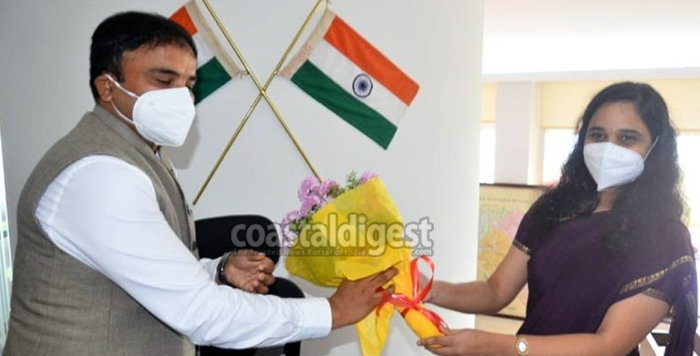
Mangaluru, July 30: Medical doctor turned IAS officer K V Rajendra assumed charge as the 130th deputy commissioner of Dakshina Kannada district here today.

The 2013 batch Karnataka cadre officer succeeds Sindhu B Rupesh, who was transferred as Director of Electronic Delivery of Citizen Services (EDCS), Bengaluru. The outgoing DC welcomed the new DC in the presence of staff. 

Dr Rajendra said that he expects cooperation from all stakeholders in administering the district, amidst the mounting Covid-19 cases.

Rajendra, an alumnus of JJM Medical College, Davanagere, was serving as the CEO of Belagavi zilla panchayat before being posted as DC of this coastal district. 

Having served as assistant commissioner of Puttur sub-division for nearly a year from December 2015, Dr Rajendra, hails from Thirthahalli in Shivamogga district, had his probationary training in Bidar. He posted as CEO of Ballari ZP where he worked for nearly three till 21, 2019.

He also had a brief stint as assistant secretary in the department of fertiliser with the ministry of chemicals and fertilisers.

Sindhu who was the CEO of Udupi zilla panchayat had succeeded Sasikanth Senthil, who resigned from the Indian Administrative Service on September 6, 2019. She had taken charge on September 7, 2019.

Comments

Add new comment

  • Coastaldigest.com reserves the right to delete or block any comments.
  • Coastaldigset.com is not responsible for its readers’ comments.
  • Comments that are abusive, incendiary or irrelevant are strictly prohibited.
  • Please use a genuine email ID and provide your name to avoid reject.
News Network
January 22,2020

Bengaluru, Jan 22: The suspected man in planting of a live bomb at the Mangaluru International Airport surrendered before the DG and IG of Karnataka Police, Neelamani Raju, here on Wednesday, police sources said.

The accused was identified as Aditya Rao, a resident of Udupi.

The accused was taken for questioning by the Halasurugate Police, where he was being interrogated intensively, the sources further said.

According to them, he confessed that he planted an explosive device at Mangaluru Airport on Monday said that it was an act of revenge for denying him an employment by the Kempegowda International Airport Limited (KIAL).

He was arrested by the Bengaluru police in the past for making a hoax call to the police stating that a bomb had been planted at the Bengaluru Airport.

Karnataka Home minister Basavaraj Bommai told the media that 'the Bengaluru police have taken the custody of Aditya Rao, who is being subjected for a thorough interrogation'.

The Mangaluru police was also likely to join the Bengaluru police into the investigation, the sources added.

Also Read: Udupi’s Aditya Rao arrested for issuing bomb threats to Airport, railway station

Comments

sameer
 - 
Wednesday, 22 Jan 2020

This would have been a false flag operation, if he was not caught, they would have been an explosions and Dr.police would have put muslim youths behind bars...or that was the intention/plan but due to unforseen reasons failed......i hope someone comes out with the truth..

Alert
 - 
Wednesday, 22 Jan 2020

if he were to be a muslim, he would have benn branded terrorist. revenge and all these expalnations are just excuses. investigate from where an dhow he got bombs.

Ashi
 - 
Wednesday, 22 Jan 2020

Bomb has weaken once bomber name appears. Now time for fact finding, family emotions, personal attachments etc. If he was Muslim it would have connected to ISIS, Anti-CAA, Pakistan, Kerala..


Add new comment

  • Coastaldigest.com reserves the right to delete or block any comments.
  • Coastaldigset.com is not responsible for its readers’ comments.
  • Comments that are abusive, incendiary or irrelevant are strictly prohibited.
  • Please use a genuine email ID and provide your name to avoid reject.
Media Release
February 14,2020

Veteran journalist P. Sainath has said that the nation is in a crisis. And this crisis is not limited to just the rural area. It has become a national crisis at various areas such as agriculture, education, economy, job creation etc.

He was delivering the endowment lecture on the topic ‘Indian democracy at the post-liberalization and post-truth era’ at Media Manthan 2020 organized by the PG department of journalism and mass communication at St Aloysius College (Autonomous). 

Mr Sainath said that the many policies adopted in the 90s led to India becoming unusually unequal. Referring to the speech Ambedkar had made at the Constituent Assembly while handing over the draft of the Constitution, Mr Sainath said, “Ambedkar had warned about the weakness of Indian democracy that liberty without equality allows the supremacy of a few over the multitude. Liberty, equality and fraternity must be kept together as we cannot have one without the other.” 

Mr Sainath stated that the agrarian crisis was no longer about the loss of productivity, employment or about farmer suicide; it was a societal, civilizational crisis. Commenting on the lopsided policies such as cow-slaughter ban, he explained how cow slaughter ban had adversely affected many industries due to their interdependency. While Muslims who slaughtered cows were rendered helpless, the cattle traders who were mostly OBCs lost their earnings as the cattle prices crashed. An important industry like Kolhapur sandals industry in Maharashtra went bankrupt as a result of the cow slaughter ban in Maharashtra. He said the policymakers had no idea how the rural industries were interconnected. Demonetisation too devastated the rural economy as 98 percent of rural transactions happen through cash. 

Mr Sainath also spoke about the crisis of inequality which affects the Dalits and the Adivasis far more than anyone else as 90 percent of the rural households take home less than Rs 10,000/- per month. “Women are yet another group whose labour is never counted in the gross domestic product. Women and girls globally do unpaid work which amounts to about 12.5 billion working hours per year. Monetarily speaking, this is worth 10.8 trillion dollars,” Mr Sainath added. 

Speaking about the crisis of jobs Mr Sainath said that major companies were laying off employees just to create more profits for the investors and the adoption of artificial intelligence in the industry would further destroy millions of jobs.

Rector of St Aloysius College Institutions Fr Dionysius Vaz SJ, Principal Dr (Fr) Praveen Martis SJ, HOD of Journalism and Mass Communication department Dr (Fr) Melwyn Pinto SJ were present.

‘Veerappan and Vijay Mallya’s business models are interesting!’

Addressing the gathering during his endowment lecture on Friday, Mr Sainath made an interesting comment on the so called ‘revenue model’. “Whenever I visit IIMs and IITs for lectures on my PARI project, the students there ask me what my revenue model for my project is. I tell them that I do not have a revenue model. In fact, journalism does not begin with a revenue model. Gandhiji, Ambedkar, Bhagat Singh were all great journalists. But they did not have a revenue model,” Mr Sainath said.

On a lighter note, he said that the best revenue model that he liked was that of forest brigand Veerappan and liquor baron Vijay Mallya. “Veerappan ruled the forest for forty years and from the top ministers to the villagers he could dictate terms and liver royally. Similarly, Mallya’s revenue model was to steal the banks and run away abroad and live like a king,” Mr Sainath added.

Journalism is not and can never be a business. It is a calling, he opined. While newspaper can be a business, television can be a business, journalism per se cannot be reduced to a business. “Unfortunately today, journalists are recruited on a contract basis and they have no bargaining power; and there are no unions to fight for their cause. Hence, they are at the mercy of the corporate media houses for their survival and are made to write stories that cannot be called journalism,” Mr Sainath said.

Answering a question as to the pressures he faced as a journalist, he said that external pressures from the government or others could be very well handled. It is the internal pressures from once own media house that journalists find it difficult to manage.


 

Comments

Add new comment

  • Coastaldigest.com reserves the right to delete or block any comments.
  • Coastaldigset.com is not responsible for its readers’ comments.
  • Comments that are abusive, incendiary or irrelevant are strictly prohibited.
  • Please use a genuine email ID and provide your name to avoid reject.