Kalladka communal clashes result of Cong-BJP ‘match fixing’, claims HDK

CD Network
June 19, 2017

Mangaluru, Jun 19: The communal clashes that occur in Kalladka and other parts of Dakshina Kannada are a result of “match fixing” between the Congress and BJP to consolidate their voter base, according to former Chief Minister and JD(S) State president H D Kumaraswamy.

iftar koota 4

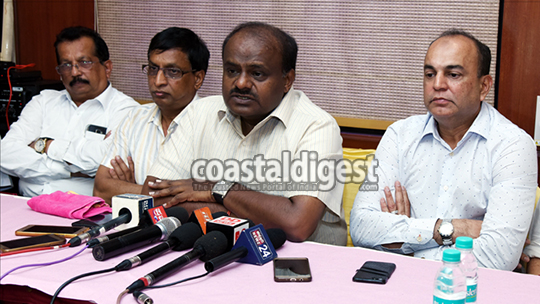
Speaking to media persons in the city on Sunday, Mr Kumaraswamy said that the Kalladka clashes were nothing but attempts by both the parties to make gains through disturbances. He said communal clashes appear to intensify in Dakshina Kannada every time an election is near.

He said the BJP and Congress might succeed in consolidating their voter base, but many innocent families and individuals suffer because of the clashes and the hatred. Instead of focussing on clashes, the national parties should have concentrated on alleviating the plight of farmers, he said.

No alliance

Mr Kumaraswamy, who had forged alliance with the Bharatiya Janata Party several times in the past, said that there was no question of partnering with the BJP or the Congress either before or after next year’s Assembly elections. “JD(S) is not in need of support from the Congress or the BJP, but they do,” he said.

Referring to the recent no-confidence motion passed by the Congress against Legislative Council Chairman D H Shankaramurthy, he said the Congress did not ask for the support of JD(S) in the beginning stage. Chief Minister Siddaramaiah wanted Shankaramurthy to step down from the post of the Chairman of Legislative Council. The Congress had thought they would pass the non-confidence motion with the support of their independent MLAs. But their plan turned upside down, Kumaraswamy said.

He said that may be Yeddyurappa also didn’t want Shankaramurthy to continue as the Chairman of the Council and that was why he did not seek the JD(S)’ support. “We do not need to learn a lesson of secularism from Siddaramaiah. He is always involved in caste-based politics which is evident in his decisions.”

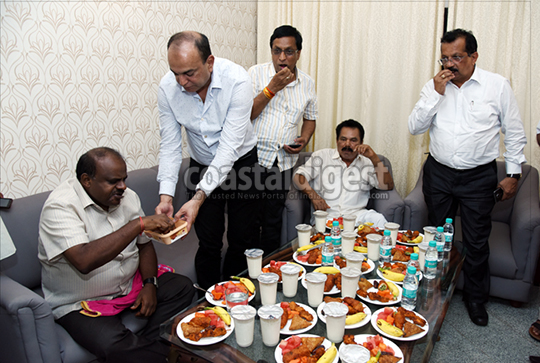
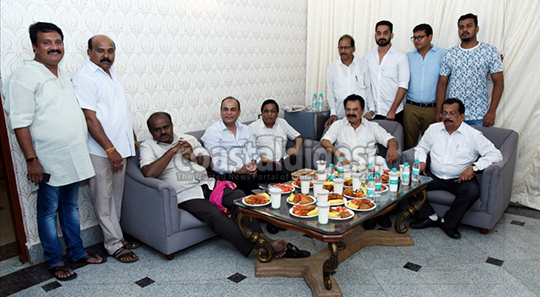
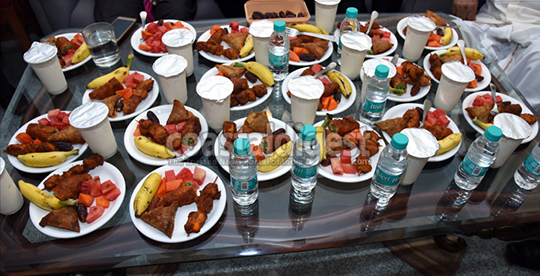
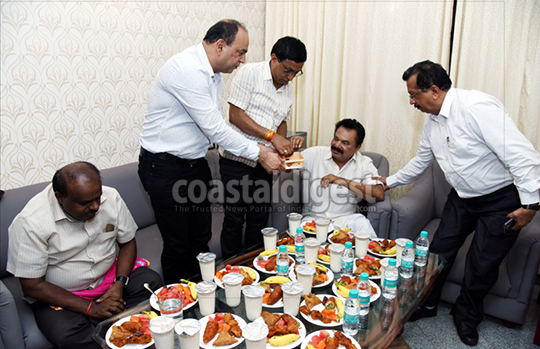
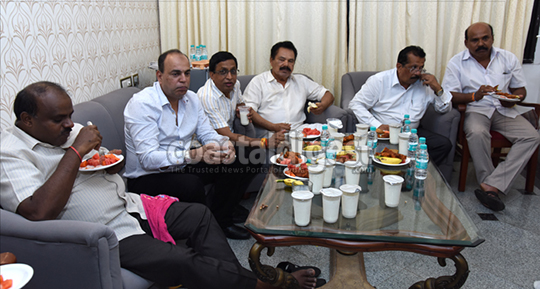
After iftar Mr Kumaraswamy does iftar with other JD(S) leaders incuding B M Farooq, Amarnath Shetty and Akshith Suvarna.

iftar koota 1

jds1

iftar koota 2

iftar koota 3

iftar koota 5

Comments

Beedi Basava
 - 
Monday, 19 Jun 2017

Y all are in sad mood. Farooq is more sad.

May b they invited too much people but there is only a few attended.

Waste of food and energy

Add new comment

  • Coastaldigest.com reserves the right to delete or block any comments.
  • Coastaldigset.com is not responsible for its readers’ comments.
  • Comments that are abusive, incendiary or irrelevant are strictly prohibited.
  • Please use a genuine email ID and provide your name to avoid reject.
News Network
February 17,2020

Varanasi, Feb 17: For the first time, the Indian Railways has reserved a seat for a deity on a train. The national transporter, which launched its third IRCTC operated train named Kashi Mahakal Express from Varanasi to Indore, has reserved a seat for Lord Mahakal (Lord Shiva) on board.

Speaking to media, Northern Railway spokesperson Deepak Kumar said: "It is for the first time that a seat has been left reserved for a deity."

"One seat in Kashi Mahakal Express (seat number 64 in B5 coach) has been left reserved for Lord Shiva," he said.

"Even a temple has been drawn on the seat to make people aware that the seat is reserved for Lord Mahakal," he said.

IRCTC's Director, Tourism, Rajni Hasija said that the practice would continue beyond the inaugural run.

Prime Minister Narendra Modi flagged off the Kashi Mahakal Express via video conferencing from Varanasi, where he is all launched several projects worth Rs 1,250 crore during the day's visit to his parliamentary constituency.

The third IRCTC train, after the two Tejas Express trains on New Delhi-Lucknow and Mumbai-Ahmedabad routes, the Kashi Mahakal Express will connect three places -- Jyotirlinga-Omkareshwar (near Indore), Mahakaleshwar (Ujjain) and Kashi Vishwanath (at Varanasi).

Also connecting the industrial and educational hub of Indore, with Bhopal, the train will begin its commercial run from February 20.

"The Kashi Mahakal Express will operate three days in a week and it will be a bi-weekly service through the Sultanpur-Lucknow route and a weekly service via the Prayagraj route," Kumar said.

Elaborating on the two routes from which the train will pass every week, Hasija said: "Once the new train starts its regular run from this week, it will depart from Varanasi at 2.45 p.m. every Tuesday and Thursday to reach Indore at 9.40 a.m. on Wednesday and Friday.

Similarly, the train will start from Indore at 10.55 a.m. every Wednesday and Friday and will reach Varanasi at 6.00 a.m. the next day. This train will have stoppages at Ujjain, Sant Hirdaram Nagar, Bina, Jhansi, Kanpur and Sultanpur stations in both directions.

Meanwhile, in the weekly service via Prayagraj route, the Kashi Mahakal Express will depart from Varanasi at 3.15 p.m. every Sunday to reach Indore at 9.40 a.m. the next day. On the other way, it will depart from Indore at 10.55 a.m. every Monday and reach Varanasi at 5 a.m. the next day.

"This train will halt at Ujjain, Sant Hirdaram Nagar, Bina, Jhansi, Kanpur and Allahabad stations in both directions," Kumar said.

Explaining the fares of the Kashi Mahakal Express, Hasija said, "Kashi Mahakal Express will follow a dynamic fare structure like the other two Tejas Express trains."

One-way journey from Varnasi to Indore will cost Rs 1,951, inclusive of four meals.

According to the IRCTC officials, the Indore-Varanasi Kashi Mahakal Express will be the first private train that will run overnight and for a comfortable long distance journey, will feature a host of facilities. The IRCTC will serve vegetarian food, and provide housekeeping services, on-board security services and bedrolls.

The IRCTC officials said that passengers will also get complementary insurance of Rs 10 lakh.

The train will have an advance reservation period of 120 days and will only have the general and foreign tourist quotas. The current booking will be available to the passengers on the platform itself after preparation of first chart, four hours to five minutes before the scheduled departure of the train.

To facilitate travel for pilgrims, the IRCTC is also introducing special tour packages for passengers who want to see the pilgrim centres enroute. The tour options are; Mahakal Darshan (Ujjain - Omkareshwar), Bhopal-Sanchi-Bhimbetka, Malwa Jyotrilinga Darshan (Ujjain-Omkareshwar- Maheshwar- Indore) and Bhopal-Sanchi-Bhimbetka-Ujjain. Other tour options include Kashi, Ayodhya and Prayag; Kashi Darshan; Kashi, Prayag, Ayodhya; Kashi and Prayag and only Kashi.

The train has silent features like CCTV cameras, which will be monitored online around the clock from the IRCTC centres, whereas for the first time the IRCTC has brought the marshals in the train for passengers safety and also to make people aware to not smoke inside the train as it has smoke and heat sensors installed in the coaches as well as in the bathroom. For the blind passengers, the train coaches have the seat numbers written in Braille, and the catering staff will be dressed in yellow kurta-pyjamas with a rudraksh malas on their necks to promote the train's theme.


Comments

ASIF
 - 
Tuesday, 18 Feb 2020

waw.. good header with superb news..

good going !!

Althaf
 - 
Tuesday, 18 Feb 2020

If you are truthful then go to china and stay with patients of carona virus. The carona virus should not affect you as you are a vegeterian. Prove this first. 

Add new comment

  • Coastaldigest.com reserves the right to delete or block any comments.
  • Coastaldigset.com is not responsible for its readers’ comments.
  • Comments that are abusive, incendiary or irrelevant are strictly prohibited.
  • Please use a genuine email ID and provide your name to avoid reject.
News Network
June 20,2020

Bengaluru, Jun 20: The Karnataka Health Department has issued guidelines on the admission of COVID-19 patients in private hospitals after clinical assessment, mandating that the district surveillance officer (DSO) should be first informed to initiate further procedures, an official said on Friday.

"A health team sent by the DSO should visit the home or hospital where the patient is staying. The team should conduct a rapid assessment of his or her health condition," said Karnataka's Additional Chief Secretary Jawaid Akhtar.

In the rapid health condition assessment, the team should first check the patient's body temperature, followed by SpO2 (oxygen saturation) level and confirm if there are any comorbidities such as hypertension, diabetes, tuberculosis, HIV, cancer, stroke etc.

Depending on the health condition of patients, Akhtar said, two categories have been made.

"Those who have body temperature greater than 37.5 degrees Celsius, SpO2 level below 94 percent, elderly (above 60 years) and suffering from known comorbid conditions should be taken to a dedicated Covid hospital (DCH)," he said.

"All other patients, even if older but not suffering from co-morbidities, those below 60 and suffering from co-morbidities and asymptomatic cases should be taken to a dedicated Covid health centre (DCHC) or a private hospital as opted by the patient," he added.

Private hospitals have been asked to pitch in due to the rising number of cases in Karnataka. Currently, there are 2943 active cases in the state after 337 cases were reported on Friday.

"The patients are assessed clinically and evaluated at DCHCs or private hospitals with appropriate diagnostic tests. After evaluation, if the patients are asymptomatic, they are shifted to a COVID Care Centre (CCC) for further management," said Akhtar.

CCCs are expected to be equipped with ventilated rooms, pulse oximeters, handheld thermal scanners and blood pressure apparatus.

A nurse has to be present round the clock for every 50 patients and should visit each patient twice a day for assessment whereas the medical officer has to visit the CCC once a day. He should also be available on call in case of an emergency.

Staff serving food and others should wear personal protective equipment and an N-95 mask. Explaining the procedures at DCHCs, Akhtar said general examinations for medical conditions like body temperature, BP, pulse, oxygen saturation and urine output should be in place.

Investigations such as complete blood count, fasting blood sugar, random blood sugar, liver function tests, renal function tests, ECG and chest X-ray facilities should be available.

"DCHCs should ensure that above examinations are over in an orderly timeline of 24 hours and depending on the examination, the patient is continued to be lodged at the DCHC or sent to DCH or CCC," said the senior officer.

Likewise, the discharge policy should be done as per the protocols issued by the Health Department from time to time.

The Karnataka government is yet to fix an upper limit on the cost of treating COVID-19 patients in private hospitals. While reports indicated that this could be capped at Rs 5200 per day, health officials are yet to specify this is the case. Private hospitals in the state have asked the government to take a collaborative approach in deciding the fixed cap on treatment cost.

Comments

Add new comment

  • Coastaldigest.com reserves the right to delete or block any comments.
  • Coastaldigset.com is not responsible for its readers’ comments.
  • Comments that are abusive, incendiary or irrelevant are strictly prohibited.
  • Please use a genuine email ID and provide your name to avoid reject.
News Network
March 4,2020

Bengaluru, Mar 4: CM BS Yediyurappa may reconsider plans to hike taxes and curtail populist schemes in his budget on Thursday as the Centre released part of GST compensation it owes the state. Officials said the Centre released the first instalment of the bimonthly compensation for October-November amounting to Rs 2,013 crore.

"This is welcome relief as the government has been scrambling to mobilise funds," said BT Manohar, member of GST consultative committee, government of Karnataka. The second instalment of Rs 1,523 crore is also expected to be released soon.

The CM, in his seventh budget, is expected keep the focus firmly on farmers and give top priority to irrigation, agriculture and welfare schemes.

The irrigation sector is expected to land the lion's share with an allocation of at least Rs 25,000 crore, followed by agriculture. Former CM Kumaraswamy had allocated over Rs 17,000 crore for water resources.

The bulk of funds is likely to go to the Upper Krishna (UKP) and Upper Bhadra projects, as it will help backward Kalyana Karnataka and central Karnataka regions. The two are also significant political blocs. The government will also seek assistance from the Centre for the UKP project in the erstwhile Hyderabad-Karnataka region, which enjoys special status under the Constitution owing to its backwardness. P4

Yediyurappa is also expected to spell out populist schemes for the poor.

Former CM HD Kumaraswamy had allocated Rs 17,212 crore in the previous budget for water resources and Yediyurappa is likely to go well beyond that figure. "Priority will be given to irrigation and farmers," Yediyurappa had said recently. "I am making efforts to present a budget within the financial constraints."

he amounts are released once every two months, but the Centre had fallen behind on payments. PX

"There are indications that another payment will be made."

The state's optimism stems from the fact that the Centre's GST collection crossed the Rs 1 lakh crore-mark for four successive months till February.

However, the CM could still hike tax rates marginally. At a pre-budget meet on resource mobilisation where Yediyurappa is learnt to have expressed willingness to borrow funds, officials from the finance department advocated raising tax rates instead.

Comments

Add new comment

  • Coastaldigest.com reserves the right to delete or block any comments.
  • Coastaldigset.com is not responsible for its readers’ comments.
  • Comments that are abusive, incendiary or irrelevant are strictly prohibited.
  • Please use a genuine email ID and provide your name to avoid reject.