Kalladka communal clashes result of Cong-BJP ‘match fixing’, claims HDK

CD Network
June 19, 2017

Mangaluru, Jun 19: The communal clashes that occur in Kalladka and other parts of Dakshina Kannada are a result of “match fixing” between the Congress and BJP to consolidate their voter base, according to former Chief Minister and JD(S) State president H D Kumaraswamy.
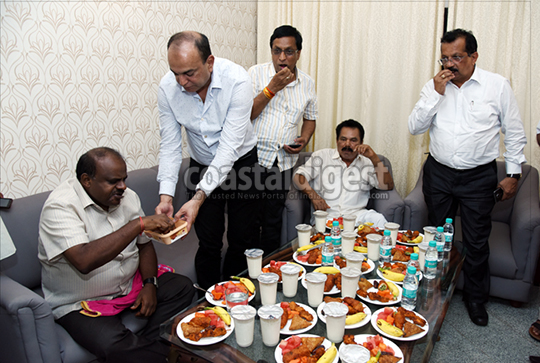
iftar koota 4

Speaking to media persons in the city on Sunday, Mr Kumaraswamy said that the Kalladka clashes were nothing but attempts by both the parties to make gains through disturbances. He said communal clashes appear to intensify in Dakshina Kannada every time an election is near.

He said the BJP and Congress might succeed in consolidating their voter base, but many innocent families and individuals suffer because of the clashes and the hatred. Instead of focussing on clashes, the national parties should have concentrated on alleviating the plight of farmers, he said.

No alliance

Mr Kumaraswamy, who had forged alliance with the Bharatiya Janata Party several times in the past, said that there was no question of partnering with the BJP or the Congress either before or after next year’s Assembly elections. “JD(S) is not in need of support from the Congress or the BJP, but they do,” he said.

Referring to the recent no-confidence motion passed by the Congress against Legislative Council Chairman D H Shankaramurthy, he said the Congress did not ask for the support of JD(S) in the beginning stage. Chief Minister Siddaramaiah wanted Shankaramurthy to step down from the post of the Chairman of Legislative Council. The Congress had thought they would pass the non-confidence motion with the support of their independent MLAs. But their plan turned upside down, Kumaraswamy said.

He said that may be Yeddyurappa also didn’t want Shankaramurthy to continue as the Chairman of the Council and that was why he did not seek the JD(S)’ support. “We do not need to learn a lesson of secularism from Siddaramaiah. He is always involved in caste-based politics which is evident in his decisions.”

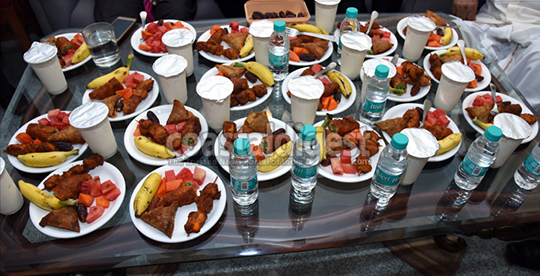
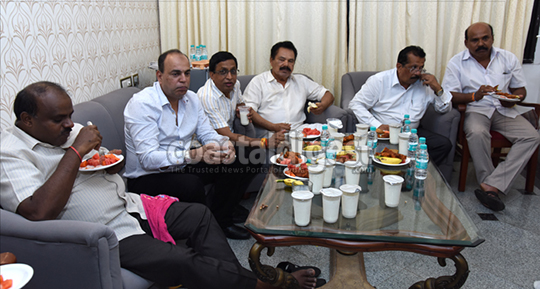
After iftar Mr Kumaraswamy does iftar with other JD(S) leaders incuding B M Farooq, Amarnath Shetty and Akshith Suvarna.

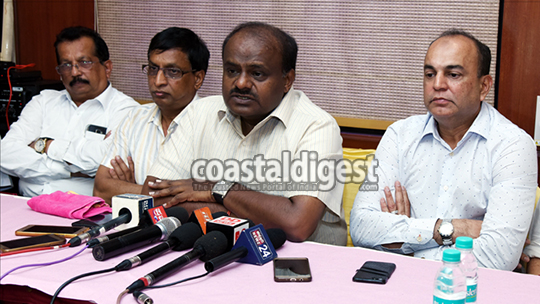
iftar koota 1

jds1

iftar koota 2

iftar koota 3

iftar koota 5

Comments

Beedi Basava
 - 
Monday, 19 Jun 2017

Y all are in sad mood. Farooq is more sad.

May b they invited too much people but there is only a few attended.

Waste of food and energy

Add new comment

  • Coastaldigest.com reserves the right to delete or block any comments.
  • Coastaldigset.com is not responsible for its readers’ comments.
  • Comments that are abusive, incendiary or irrelevant are strictly prohibited.
  • Please use a genuine email ID and provide your name to avoid reject.
News Network
June 14,2020

Kozhikode, Jun 14: A mosque in Kuttichira of Kozhikode has found a unique way to avoid crowding amid the COVID-19 pandemic. The committee that runs the mosque has started issuing smart cards to people for offering prayers and simultaneously encouraging social distancing.

"The committee has given smart cards with numbers to the people in the surroundings of the Masjid. One who enters the mosque premises has to rub their hands with sanitizers. They also have to tell their identity on camera. The automatic system has been put in place to save the address and phone number. Next time onwards they have to say their smart card number only so that other details will be automatically filled," said Muhammad Sajjad, who is part of the Mosque committee.

"The door of the mosque will open automatically after swiping the card. We have fit in a sensor on the doors. We have also made marks inside the mosque area so that people can abide by social distancing norm," he added.

A couple of days back the Kerala government has rolled out an order allowing the opening of places of worship, malls and restaurants from June 9 in strict accordance with guidelines and social distancing norms. As per the guidelines, pregnant women and those with co-morbidities should not visit any places of worship. Those with symptoms should not be allowed.

Comments

Add new comment

  • Coastaldigest.com reserves the right to delete or block any comments.
  • Coastaldigset.com is not responsible for its readers’ comments.
  • Comments that are abusive, incendiary or irrelevant are strictly prohibited.
  • Please use a genuine email ID and provide your name to avoid reject.
coastaldigest.com news network
May 30,2020

Bengaluru, May 31: The coronavirus related fatalities in Karnataka rose to 49 with the death of a 47-year-old woman while 141 new coronavirus cases were confirmed on Saturday taking the infection tally to 2,922, Karnataka minister S Suresh Kumar said.

Among the fresh cases, 90 are inter-state passengers, he told reporters.

The deceased woman from Bidar was admitted on May 24 and died on May 28 at a designated hospital in Bidar, Kumar, minister for primary and secondary education and spokesperson for Covid-19 in the state, said.

The woman was diagnosed with influenza like illness with a history of paralysis and was bed-ridden besides having hypertension and convulsions, Kumar said.

According to him, the total cases include 997 discharges, 1,874 active cases, 49 Covid-19 deaths and two non-Covid related deaths.

Of the total active cases, 15 are in the ICU, he added.

The new cases comprise 33 in Bengaluru, 18 in Yadagir, 14 in Dakshina Kannada, 13 each in Udupi and Hassan, 11 in Vijayapura, 10 in Bidar, six in Shivamogga, four each in Davangere and Haveri, three in Kolar, two each in Kalaburagi, Mysuru, Uttara Kannada, Dharwad, and one each in Belagavi, Chitradurga, Tumakuru and Bengaluru Rural, the health department said in its bulletin.

The minister said the government has issued an order regarding relaxation of curfew on Sundays.

According to the order issued by Chief Secretary T M Vijay Bhaskar, there will not be any curfew on Sundays throughout the day following requests from people.

As per the previous order, curfew was from 7 am to 7 pm on Sundays.

Comments

Add new comment

  • Coastaldigest.com reserves the right to delete or block any comments.
  • Coastaldigset.com is not responsible for its readers’ comments.
  • Comments that are abusive, incendiary or irrelevant are strictly prohibited.
  • Please use a genuine email ID and provide your name to avoid reject.
Agencies
May 8,2020

Washington D.C., May 8: The prime time for brain development in a child's life is the first year, where the infant spends most of the time asleep. It is the time when neural connections form and sensory memories are encoded.

However, when sleep is disrupted, as occurs more often among children with autism, brain development may be affected, too.

New research led by the University of Washington finds that sleep problems in a baby's first 12 months may not only precede an autism diagnosis but also may be associated with altered growth trajectory in a key part of the brain, the hippocampus.

The study, which was published in the American Journal of Psychiatry, researchers report that in a sample of more than 400 taken of 6- to 12-month-old infants, those who were later diagnosed with autism were more likely to have had difficulty falling asleep.

It also states that this sleep difficulty was associated with altered growth trajectories in the hippocampus.

"The hippocampus is critical for learning and memory, and changes in the size of the hippocampus have been associated with poor sleep in adults and older children.

As many as 80 per cent of the children with autism spectrum disorder have sleep problems," said Annette Estes, director of the UW Autism Center and senior author of the study.

"In our clinical experience, parents have a lot of concerns about their children's sleep, and in our work on early autism intervention, we observed that sleep problems were holding children and families back," added Estes, who is also a UW professor of speech and hearing sciences.

"It could be that altered sleep is part-and-parcel of autism for some children. One clue is that behavioural interventions to improve sleep don't work for all children with autism, even when their parents are doing everything just right. This suggests that there may be a biological component to sleep problems for some children with autism," said Estes.

To consider links among sleep, brain development, and autism, researchers at the IBIS Network looked at MRI scans of 432 infants, surveyed parents about sleep patterns, and measured cognitive functioning using a standardized assessment.

At the outset of the study, infants were classified according to their risk for developing autism: Those who were at higher risk of developing autism -- about two-thirds of the study sample -- had an older sibling who had already been diagnosed.

Infant siblings of children with autism have a 20 per cent chance of developing autism spectrum disorder -- a much higher risk than children in the general population.

In the current study, 127 of the 432 infants were identified as "low risk" at the time the MRI scans were taken because they had no family history of autism.

They later evaluated all the participants at 24 months of age to determine whether they had developed autism. Of the roughly 300 children originally considered "high familial risk," 71 were diagnosed with autism spectrum disorder at that age.

Problems with sleep were more common among the infants later diagnosed with an autism spectrum disorder, as were larger hippocampi. No other subcortical brain structures were affected, including the amygdala, which is responsible for certain emotions and aspects of memory, or the thalamus, a signal transmitter from the spinal cord to the cerebral cortex.

The authors note that while parents reported more sleep difficulties among infants who developed autism compared to those who did not, the differences were very subtle and only observed when looking at group averages across hundreds of infants.

Sleep patterns in the first years of life change rapidly as infants transition from sleeping around the clock to a more adult-like sleep/wake cycle. Until further research is completed, Estes said, it is not possible to interpret challenges with sleep as an early sign of increased risk for autism.

Comments

Add new comment

  • Coastaldigest.com reserves the right to delete or block any comments.
  • Coastaldigset.com is not responsible for its readers’ comments.
  • Comments that are abusive, incendiary or irrelevant are strictly prohibited.
  • Please use a genuine email ID and provide your name to avoid reject.