With KaRaVe booking 235 tickets, Sunny’s Bengaluru show likely to be the hottest

News Network
October 22, 2018

Bengaluru, Oct 22: The self-proclaimed saviors of the language, culture and land of Karnataka, who had succeeded in cancelling the New Year’s scheduled show of actress Sunny Leone in Bengaluru, this time have booked as many as 235 tickets for show in the city.

The porn star-turned-Bollywood super star, will perform live for the first time in Karnataka on November 3. The show will be held at a hotel in Manyata Tech Park, near Nagawara on Outer Ring Road of Bengaluru.

According to sources the activists of Karnataka Rakshana Vedike (KaRaVe) have bought 235 tickets for the show. With this, the show is likely to witness chaos and intense protests against Sunny Leone.

Confirming the plan to protest at the venue, Harish, KaRaVe youth wing state president said that as long as Sunny Leone is part of the movie Veeramahadevi, they would protest against her wherever she goes.

“We love seeing Sunny sing and dance to Kannada songs. That is the reason we have blocked 235 tickets online. But we just cannot accept her enacting the role of the greatest queen of Kannada, because of her past roles in blue films. As long as she continues in the movie, wherever she goes, we will protest against her. The protests will not be confined only to Bengaluru, but other parts of Karnataka and Tamil Nadu as well,” Harish said.

At a protest on Monday, in front of the Town Hall, against Sunny enacting the role of Veera Mahadevi, KaRaVe youth wing activists slit their wrists to convey the message: “We will give blood, but not allow Sunny act the role in the film.”

Comments

abdullah
 - 
Tuesday, 23 Oct 2018

Every strike , Harathal, etc are only for money.

Add new comment

  • Coastaldigest.com reserves the right to delete or block any comments.
  • Coastaldigset.com is not responsible for its readers’ comments.
  • Comments that are abusive, incendiary or irrelevant are strictly prohibited.
  • Please use a genuine email ID and provide your name to avoid reject.
coastaldigest.com news network
August 5,2020

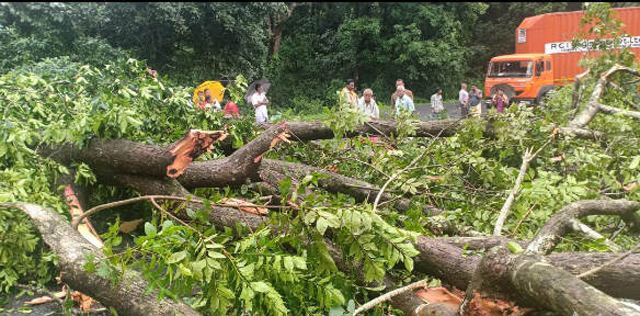
Mangaluru, Aug 5: Normal life was thrown out of gear as heavy rain and gusty winds lashed large parts of coastal and malnad districts of Karnataka in last 48 hours. Widespread power outages due to tree fall and minor landslides were reported in last 24 hours.

Meanwhile, Indian Meteorological Department has sounded a red alert for Uttara Kannada, Udupi and Dakshina Kannada districts 8:30am of August 5.

In Mangaluru city there were several tree falls disrupting power supply in key areas of the city. Four electricity poles were damaged after a tree fell on Boloor Jarandaya road due to rain and heavy winds. In Neermarga too, there were a couple of tree falls in the morning cutting off power supply, which was not restored till this report was sent.

Mescom bore the brunt of the rains in Udupi and Dakshina Kannada District and at the last count as many as 148 electric poles, 23 transformers and 65 kilometer conductor wires were damaged due to poles being damaged in tree fall and landslides.

Traffic was affected on Charmadi Ghat on the Mangaluru-Chikkamagaluru route due to a tree fall on the second hair pin bend. 

On Monday, landslides near Kottigehara, Chikkamagaluru District, left traffic badly affected. Though normalcy has been restored on the route after blocking the road for restoration till Tuesday morning, locals fear more landslides due to continuous downpour.

Kodagu district too received heavy rainfall in past 24 hours which resulted in water logging in low-lying areas.

In the Coast, Uttara Kannada received the highest amount of rainfall at 91mm, followed by Udupi at 75 and DK at 73mm. The highest Rainfall of 241 mm was recorded at Castlerock, Supa Taluk in Uttara Kannada District.

KSNMDC bulletin stated that widespread moderate to heavy rains associated with strong surface winds at times and isolated very heavy to extreme heavy rains was likely over Udupi, Dakshina Kannada and Uttara Kannada districts It also stated that wind speeds ranging between 50kmph to 60 kmph was forecast along the coast of Karnataka from Mangaluru to Karwar, warning fishermen not to venture into the sea.

Comments

Add new comment

  • Coastaldigest.com reserves the right to delete or block any comments.
  • Coastaldigset.com is not responsible for its readers’ comments.
  • Comments that are abusive, incendiary or irrelevant are strictly prohibited.
  • Please use a genuine email ID and provide your name to avoid reject.
News Network
July 28,2020

Hounde, Jul 28: Coronavirus and its restrictions are pushing already hungry communities over the edge, killing an estimated 10,000 more young children a month as meager farms are cut off from markets and villages are isolated from food and medical aid, the United Nations warned Monday.

In the call to action shared with The Associated Press ahead of publication, four UN agencies warned that growing malnutrition would have long-term consequences, transforming individual tragedies into a generational catastrophe.

Hunger is already stalking Haboue Solange Boue, an infant from Burkina Faso who lost half her former body weight of 5.5 pounds (2.5 kilograms) in just a month. Coronavirus restrictions closed the markets, and her family sold fewer vegetables. Her mother was too malnourished to nurse.

“My child,” Danssanin Lanizou whispered, choking back tears as she unwrapped a blanket to reveal her baby's protruding ribs.

More than 550,000 additional children each month are being struck by what is called wasting, according to the UN — malnutrition that manifests in spindly limbs and distended bellies. Over a year, that's up 6.7 million from last year's total of 47 million. Wasting and stunting can permanently damage children physically and mentally.

“The food security effects of the COVID crisis are going to reflect many years from now,” said Dr. Francesco Branca, the WHO head of nutrition. “There is going to be a societal effect.”

From Latin America to South Asia to sub-Saharan Africa, more poor families than ever are staring down a future without enough food.

In April, World Food Program head David Beasley warned that the coronavirus economy would cause global famines “of biblical proportions” this year. There are different stages of what is known as food insecurity; famine is officially declared when, along with other measures, 30% of the population suffers from wasting.

The World Food Program estimated in February that one Venezuelan in three was already going hungry, as inflation rendered salaries nearly worthless and forced millions to flee abroad. Then the virus arrived.

“Every day we receive a malnourished child,” said Dr. Francisco Nieto, who works in a hospital in the border state of Tachira.

In May, Nieto recalled, after two months of quarantine, 18-month-old twins arrived with bodies bloated from malnutrition. The children's mother was jobless and living with her own mother. She told the doctor she fed them only a simple drink made with boiled bananas.

“Not even a cracker? Some chicken?” he asked.

“Nothing,” the children's grandmother responded. By the time the doctor saw them, it was too late: One boy died eight days later.

The leaders of four international agencies — the World Health Organization, UNICEF, the World Food Program and the Food and Agriculture Organization — have called for at least dollar 2.4 billion immediately to address global hunger.

But even more than lack of money, restrictions on movement have prevented families from seeking treatment, said Victor Aguayo, the head of UNICEF's nutrition program.

“By having schools closed, by having primary health care services disrupted, by having nutritional programs dysfunctional, we are also creating harm,” Aguayo said. He cited as an example the near-global suspension of Vitamin A supplements, which are a crucial way to bolster developing immune systems.

In Afghanistan, movement restrictions prevent families from bringing their malnourished children to hospitals for food and aid just when they need it most. The Indira Gandhi hospital in the capital, Kabul, has seen only three or four malnourished children, said specialist Nematullah Amiri. Last year, there were 10 times as many.

Because the children don't come in, there's no way to know for certain the scale of the problem, but a recent study by Johns Hopkins University indicated an additional 13,000 Afghans younger than 5 could die.

Afghanistan is now in a red zone of hunger, with severe childhood malnutrition spiking from 690,000 in January to 780,000 — a 13% increase, according to UNICEF.

In Yemen, restrictions on movement have blocked aid distribution, along with the stalling of salaries and price hikes. The Arab world's poorest country is suffering further from a fall in remittances and a drop in funding from humanitarian agencies.

Yemen is now on the brink of famine, according to the Famine Early Warning Systems Network, which uses surveys, satellite data and weather mapping to pinpoint places most in need.

Some of the worst hunger still occurs in sub-Saharan Africa. In Sudan, 9.6 million people live from one meal to the next — a 65% increase from the same time last year.

Lockdowns across Sudanese provinces, as around the world, have dried up work and incomes for millions. With inflation hitting 136%, prices for basic goods have more than tripled.

“It has never been easy but now we are starving, eating grass, weeds, just plants from the earth,” said Ibrahim Youssef, director of the Kalma camp for internally displaced people in war-ravaged south Darfur.

Adam Haroun, an official in the Krinding camp in west Darfur, recorded nine deaths linked with malnutrition, otherwise a rare occurrence, over the past two months — five newborns and four older adults, he said.

Before the pandemic and lockdown, the Abdullah family ate three meals a day, sometimes with bread, or they'd add butter to porridge. Now they are down to just one meal of “millet porridge” — water mixed with grain. Zakaria Yehia Abdullah, a farmer now at Krinding, said the hunger is showing “in my children's faces.”

“I don't have the basics I need to survive,” said the 67-year-old, who who hasn't worked the fields since April. “That means the 10 people counting on me can't survive either.”


Comments

Add new comment

  • Coastaldigest.com reserves the right to delete or block any comments.
  • Coastaldigset.com is not responsible for its readers’ comments.
  • Comments that are abusive, incendiary or irrelevant are strictly prohibited.
  • Please use a genuine email ID and provide your name to avoid reject.
coastaldigest.com news network
January 20,2020

Mangaluru, Jan 20: A suspicious unattended laptop bag with the suspicion of containing “something harmful” was found abandoned at the Mangaluru International Airport on Monday.

The bag was found kept in the rest area meant for the passengers outside the airport. According to reports, two men came in auto and left the bag near the ticket counter, which is near the VIP vehicles parking area.

The bag, which was lying unattended near the entrance of the airport was removed from the spot by the airport security personnel at 8.45 am.

Bomb detection squad personnel has rushed to the spot and shifted the bag to a safe zone, said Mangaluru Commissioner of Police P S Harsha.

Comments

Add new comment

  • Coastaldigest.com reserves the right to delete or block any comments.
  • Coastaldigset.com is not responsible for its readers’ comments.
  • Comments that are abusive, incendiary or irrelevant are strictly prohibited.
  • Please use a genuine email ID and provide your name to avoid reject.