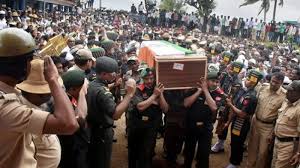
Kargil martyrs Hasan Sab, Basappa Patil laid to rest in Karnataka

August 1, 2016

Bengaluru, Aug 1: The mortal remains of two soldiers from Karnataka who were killed during a landmine blast in Kargil sector along LoC last week were today laid to rest at their native villages.

1braveSubedar Basappa Patil and Sepoy Hasansab Khudavand were killed on July 29 while patrolling when they were caught in a mine blast, the Army had said.

Both their bodies were brought to their native villages via Goa today, where they were laid to rest with full military honors.

Hundreds of villagers from neighboring areas also bid a bid tearful adieu to the martyrs raising patriotic slogans, while their families were inconsolable.

Due to the effect of the blast Subedar Patil, who was the patrol leader and Sepoy Hasansab, the leading scout, suffered injuries which proved to be fatal, officials had said.

Subedar Patil hails from a village in Gokak taluk in Belagavi district and is survived by his wife, a daughter and a son.

Sepoy Hasansab is from a village in Navalagunda taluk in Dharwad district and is survived by his mother, father, a younger sister and brother.

Chief Minister Siddaramaiah has condoled the death of the two soldiers.

"My heartfelt salutes to martyrs Subedar Basappa Patil and Sepoy Hasansab who were killed in a landmine blast in Kargil region of Jammu and Kashmir."

"My deepest condolences to the bereaved families of these two brave soldiers," a post on Chief Minister's official Facebook page said.

Comments

SK
 - 
Tuesday, 2 Aug 2016

Bravo Soldiers .....RIP..... you made your parents proud....
The soldiers have done their duty, now it is the duty of the govt to take care of their Families....

Shuaib
 - 
Tuesday, 2 Aug 2016

Salute to Hasan Sab & Basappa Patil

Shaheed Amar rahe

Add new comment

  • Coastaldigest.com reserves the right to delete or block any comments.
  • Coastaldigset.com is not responsible for its readers’ comments.
  • Comments that are abusive, incendiary or irrelevant are strictly prohibited.
  • Please use a genuine email ID and provide your name to avoid reject.
News Network
June 3,2020

Bengaluru, Jun 3: Deputy Chief Minister CN Ashwath Narayan on Tuesday invited investors in the Electronics System and Design Manufacturing (ESDM) sector to Karnataka, as the state contributes 64 per cent to the sector's total exports from the nation.

During a video conference organised by Invest India for a few select states with leading ESDM players across the globe, Narayan said, "We are the largest chip design hub and home to 70 per cent of India's chip designers."

Karnataka has introduced industry-friendly policies from the beginning and it continues to be the leader in attracting technology-specific investments, he added.

"Karnataka has an estimated GSDP of almost USD 220 billion. We were the first to come out with IT, BT, ESDM, and AVGC (Animation, Visual Effects, Gaming, and Comics) policies to give a push to the growth of the technology sectors and innovation. We also have vibrant automobiles, agro, aerospace, textile and garment, and heavy engineering industries," Narayan explained.

"We have created sector-specific SEZs for key industries such as IT, biotechnology and engineering, food processing and aerospace,'' he said.

However, the state government is planning ahead as it has initiated talks with other countries.

"We have held multiple consultations with the private sector to seek inputs for returning to business as we ease the COVID-19 lockdown restrictions. We are also initiating dialogue with countries across the globe to understand future plans for their companies in the post COVID era and discuss how the Karnataka government can support that," the Deputy Chief Minister stated.

"Karnataka has attracted cumulative FDI inflows in the state from 2000 to 2019 which were recorded at USD 42.3 billion," he said.

Referring to the Karnataka ESDM policy 2017-2022, Narayan further said, "We aim to stimulate the growth of 2,000 ESDM start-ups during the policy period and create 20 lakh new jobs by 2025.

Comments

Add new comment

  • Coastaldigest.com reserves the right to delete or block any comments.
  • Coastaldigset.com is not responsible for its readers’ comments.
  • Comments that are abusive, incendiary or irrelevant are strictly prohibited.
  • Please use a genuine email ID and provide your name to avoid reject.
coastaldigest.com news network
February 3,2020

A motley group of as many as 150 birders ‘walked the chirp’ in search of their feathered friends in and around the countryside of Manipal. The occasion was the 10th Edition of Manipal Bird Day organised by Manipal Birders Group on Sunday, February 2nd, 2020.

The day began ‘Bird Walk’ from Hotel Sheela Sagar (Opposite MIT campus) at 6:30 a.m. The birders divided themselves in smaller groups of 10-12 members and followed 13 different trails which took them through different terrains like hills, plains, paddy fields and wetlands. The idea was to sight as many birds as possible and record their presence in the region.

When the walk ended at about 10:00 a.m., the different groups have recorded a total of 125 species of birds, which was a bit lesser than the sighting of the yester years. “The 10th edition this year has seen a very good growth of interest among people. At the same time a decline has been seen in the bird species sighted compared to previous years,” said one of the organisers. Some of the rare birds sighted were Indian Pitta, Oriental Turtle Dove, Fork-Tailed Drongo Cuckoo, Orange Breasted Green Pigeon, Eurasian Marsh Harrier and Malabar Pied Hornbill.

The bird walk was followed with an interaction session at KMC Food Court and MAHE Vice Chancellor Dr. H. Vinod Bhat presided over the function. He felicitated six people who actively participated recently in a rescue mission of abandoned birds in Manipal.

A program then continued with a talk on ‘Ethical Photography’ by Dhruvam Desai, final year student of MIT, Manipal. This was followed by ‘Backyard Birding’ with Shubha Bhat from IISc Bangalore. She spoke on different ways to feed the birds with water using different materials for bird baths. “I have recorded 120 species of birds from bird baths in my garden,” she said. She encouraged the participants to have bird baths in their gardens or flats which will help quench the thirst of these little winged wonders during summer.

The participants involved themselves actively in the interaction sessions. The event was accompanied with an art exhibition titled ‘Feathered Jewels’ by Aditya Bhat. He presented around 18 paintings all from his memory of birding encounters.

Participation in Manipal Bird Day was open to all and entry was free.

MANIPAL BIRD DAY

Manipal Bird Day is an annual event dedicated to celebrating birds in Manipal. This day long event brings together a large number of birders from Manipal, Udupi, Mangalore, Mysore, Bangalore, Davangere and other places. Around 150-200 people gather and are split into different teams. They visit the assigned regions and count as many birds as possible. This non competitive event focuses on spreading awareness regarding the diverse avifauna around us. Turn out for this event has been increasing from 3 people to 200 in last 10 years. This is the 10th edition of Manipal Bird Day.

MANIPAL BIRDERS CLUB

Manipal Birders Club started as a Facebook group after the release of the first edition of “A Birders Handbook to Manipal” to share information about the latest sightings. It is now a formal group of over 500 like-minded members that meets at least once a week to go on bird walks. It is now a large birders community and a medium to organize events, bird walks and discussions about birds and sightings.

The next step would be to involve a higher number of local and young birders who will dictate the change in environment around the town in the coming years. With the co operation of Zoology and natural sciences students and other nature enthusiasts and faculty of different colleges weekly birding sessions have been conducted to involve and encourage more and more people to bird and get connected to the nature and to try to understand the changes happening around us, the media release issued by the group said.


Comments

Add new comment

  • Coastaldigest.com reserves the right to delete or block any comments.
  • Coastaldigset.com is not responsible for its readers’ comments.
  • Comments that are abusive, incendiary or irrelevant are strictly prohibited.
  • Please use a genuine email ID and provide your name to avoid reject.
Wafa Sultana
April 4,2020

Over the last couple of days when the world was occupied with unifying efforts to fight the deadly Covid19 pandemic, sections of Indian media provided viewers a familiar scapegoat – the Indian Muslims – who are often stereotyped as a community being constantly at loggerheads with the citizenry and the State. Biased media channels were quick to resort to blaming the entire Muslim community for the spread of the disease in the country, thanks to an ill-timed Tablighi Jamaat gathering at its international headquarters in Delhi’s Nizamuddin. Unsurprisingly, the opprobrium was also marked by a sudden spike in WhatsApp forwards of videos with people wearing skullcaps licking spoons and performing Sufi breathing rituals, suggesting some sort of wild conspiracy on the part of the community to spread the virus.  Some media channels were quick to formulate, hypothesize and provide loose definitions of a newly discovered form of Jihad i.e. ‘Corona Jihad ’ thereby vilifying the Islamic faith and its followers.

While the investigation on the culpability of the organizers of the Nizamuddin event is still ongoing, there is enough information to suggest that the meeting was held before any lockdown was in force, and the problem began when there was no way of getting people out once the curfew was announced. Be that as it may, there is little doubt that organizing a meet of such a scale when there is a global pandemic smacks of gross misjudgment, and definitely the organizers should be held accountable if laws or public orders were defied. Attendees who attempt to defy quarantine measures must be dealt with strictly. However, what is alarming is that the focus and narrative have now shifted from the unfortunate event at Nizamuddin to the Tablighi Jamaat itself.

For those not familiar with the Tablighi Jamaat, the organization was founded in 1926 in Mewat by scholar Maulana Mohammad Ilyas. The Jamaat’s main objective was to get Muslim youth to learn and practice pristine Islam shorn of external influences. This is achieved through individuals dedicating time for moral and spiritual upliftment secluded from the rest of the world for a brief period of time. There is no formal membership process. More senior and experienced participants typically travel from one mosque to other delivering talks on religious topics, inviting local youth to attend and then volunteer for a spiritual retreat for a fixed number of days to a mosque in a nearby town or village to present the message to their co-religionists. Contrary to ongoing Islamophobic rhetoric, the movement does not actively proselytize. The focus is rather on getting Muslims to learn the teachings and practices of Islam.  This grassroots India-based movement has now grown to almost all countries with substantial Muslim populations. Its annual meets, or ‘ijtemas’ are among the largest Islamic congregations in the world after the annual Haj. One of the reasons for its popularity and wide network in the subcontinent and wordwide is the fact that it has eschewed the need for scholarly intervention, focusing on peer learning of fundamental beliefs and practice rather than high-falutin ideological debates. The Tablighi Jamaat also distinguishes itself from other Islamic movements through its strictly apolitical nature, with a focus on individual self-improvement rather than political mobilization. Hardships and difficulty in the world are expected to be face through ‘sabr’ (patience) and ‘dua’ (supplication),  than through quest for political power or influence. In terms of ideology, it is very much based on mainstream Sunni Islamic principles derived from the Deobandi school.

So, why is all this background important in the current context? While biased media entities have expectedly brought out their Islamophobic paraphernalia out for full display, more neutral commentators have tried to paint the Tablighi Jamaat as a fringe group and have tried to distance it from 'mainstream Muslims'. While the intent is no doubt innocent, this is a trap we must not fall into. This narrative, unfortunately, is also gaining ground due to apathy some Muslims have for the group, accusing it of being “disconnected from the realities of the world”. Unlike other Muslim organizations and movements, the Tablighi Jamat, by virtue of its political indifference, does not boast of high-profile advocates and savvy spokespersons who can defend it in mainstream or social media.  The use of adjectives such as 'outdated' and 'orthodox' by liberal columnists to describe the Jamaat feeds into the malignant attempt to change the narrative from the control of the spread of the pandemic due to the Nizamuddin gathering to 'raison d'etre' of the organization itself.

A large mainstream religious group like the Tablighi Jamaat with nearly a hundred-year history, normally considered to be peaceful, apolitical and minding its own business is now suddenly being villainized owing to unfortunate circumstances. Biased media reactions filled with disgust and hate seem to feed the Indian public conscience with a danngerous misconception - to be a nominal Muslim is okay but being a practicing one is not.  For those committed to the truth and fighting the spread of Islamophobia, the temptation to throw the entire Tablighi Jamaat under the bus must be resisted.

The writer is a lawyer and research scholar at Qatar University. Her research interests include Islamic law and politics.

Comments

zahoorahmed
 - 
Saturday, 4 Apr 2020

great article! provides a great perspective on tableeg jamat

Add new comment

  • Coastaldigest.com reserves the right to delete or block any comments.
  • Coastaldigset.com is not responsible for its readers’ comments.
  • Comments that are abusive, incendiary or irrelevant are strictly prohibited.
  • Please use a genuine email ID and provide your name to avoid reject.