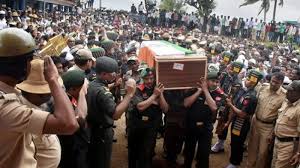
Kargil martyrs Hasan Sab, Basappa Patil laid to rest in Karnataka

August 1, 2016

Bengaluru, Aug 1: The mortal remains of two soldiers from Karnataka who were killed during a landmine blast in Kargil sector along LoC last week were today laid to rest at their native villages.

1braveSubedar Basappa Patil and Sepoy Hasansab Khudavand were killed on July 29 while patrolling when they were caught in a mine blast, the Army had said.

Both their bodies were brought to their native villages via Goa today, where they were laid to rest with full military honors.

Hundreds of villagers from neighboring areas also bid a bid tearful adieu to the martyrs raising patriotic slogans, while their families were inconsolable.

Due to the effect of the blast Subedar Patil, who was the patrol leader and Sepoy Hasansab, the leading scout, suffered injuries which proved to be fatal, officials had said.

Subedar Patil hails from a village in Gokak taluk in Belagavi district and is survived by his wife, a daughter and a son.

Sepoy Hasansab is from a village in Navalagunda taluk in Dharwad district and is survived by his mother, father, a younger sister and brother.

Chief Minister Siddaramaiah has condoled the death of the two soldiers.

"My heartfelt salutes to martyrs Subedar Basappa Patil and Sepoy Hasansab who were killed in a landmine blast in Kargil region of Jammu and Kashmir."

"My deepest condolences to the bereaved families of these two brave soldiers," a post on Chief Minister's official Facebook page said.

Comments

SK
 - 
Tuesday, 2 Aug 2016

Bravo Soldiers .....RIP..... you made your parents proud....
The soldiers have done their duty, now it is the duty of the govt to take care of their Families....

Shuaib
 - 
Tuesday, 2 Aug 2016

Salute to Hasan Sab & Basappa Patil

Shaheed Amar rahe

Add new comment

  • Coastaldigest.com reserves the right to delete or block any comments.
  • Coastaldigset.com is not responsible for its readers’ comments.
  • Comments that are abusive, incendiary or irrelevant are strictly prohibited.
  • Please use a genuine email ID and provide your name to avoid reject.
News Network
March 27,2020

Bengaluru, Mar 27: The Indian Air Force (IAF) on Wednesday said it has created nine quarantine facilities of 200-300 personnel capacity each at its nodal bases across the country to combat the outbreak of novel coronavirus.
"To monitor the prevailing situation and provide immediate response and assistance as required, a 24x7 crisis management cell has been set up at the IAF Headquarters and various Command Headquarters," stated an IAF press release.
IAF aircraft are continuing to fly in medical supplies and doctors to Leh and fly out blood samples for COVID-19 testing to Chandigarh and Delhi, the release noted.
"Command Hospital Air Force Bangalore (CHAFB) has been designated as the first laboratory in the IAF to undertake COVID-19 testing, which will greatly enhance the region's ability to carry out quick testing of suspected cases and allow prompt and timely intervention where required," it mentioned.
All measures and directives issued by the government towards containing the spread of COVID-19 have been strictly enforced across all IAF stations, the release stated.
"The Indian Air Force continues to take measures to provide all possible assistance to civil administration across the country in containing the spread of COVID-19. The IAF has created nine quarantine facilities of 200-300 personnel capacity each at nodal IAF bases across the country," the release noted.

Comments

Add new comment

  • Coastaldigest.com reserves the right to delete or block any comments.
  • Coastaldigset.com is not responsible for its readers’ comments.
  • Comments that are abusive, incendiary or irrelevant are strictly prohibited.
  • Please use a genuine email ID and provide your name to avoid reject.
News Network
April 19,2020

Kasaragod, Apr 19: Kasaragod, Kerala's COVID-19 hotspot, is the only district in the southern state lacking adequate health infrastructure.

In spite of treating the highest number of COVID-19 patients in the state with meagre infrastructural facilities and even without the support of a medical college in the north Kerala district, no deaths have been reported due to coronavirus.

The state health department views the performance of M Kunhiraman and his team, consisting of Janardhana Naik and Krishna Naik, at the General hospital in Kasaragod as a success story.

"Not only did they control the situation quickly with minimum infrastructure, they also started turning out a large number of negative cases within a few weeks and creditably ensured zero mortality.

This can be showcased as a best global model," Chairman of the Information Education and Communication (IEC) Committee and Project Director Kerala State Aids Control Society, R Ramesh said.

Recalling the ordeal, Janardhana Naik said his first major challenge was the physical examination of a patient with suspected COVID-19.

"Even with the PPE kit, nobody knew how effective they were and it took a whole 30 minutes to wear them properly.

But as time passed, we got accustomed to it," he said.

The traditional method of dealing with a patient involved knowing his or her history, observation and physical examination.

For hundreds of years, the hands-on body approach has been the soul of the doctor-patient relationship -- taking the pulse, tapping on and listening to the chest, feeling lumps.

With the onset of COVID-19 all that has changed.

"In fact, the whole exercise was fraught with grave risks because everything connected with COVID-19 was new.

Doctors have to keep a distance even though the physical examination wearing a Personal Protective Equipment (PPE) is difficult.

Sounds from the body are inaudible, vision is blurred through the smog-covered goggles and a stethoscope seldom has any use," Janardhana Naik said.

It was from March 15 that the hospital started receiving COVID-19 patients, primarily from Dubai.

By the time the first person came, the hospital was ready for him.

Soon, patient numbers began to swell and in a couple of weeks they reached about 91.

From then on, it was teamwork.

Committees were formed for each and every task, including the help desk, IT, treatment, medical board, training, food, waste disposal and data maintenance.

Initially, patients had many misgivings about the hospital.

"Some were disillusioned and even aggressive. Some were not happy with the facilities the hospital had to offer.

But gradually through good treatment and counselling by a psychiatrist, who visited the hospital on alternate days, the confidence and mood of the patients changed and they became friendly with the staff," Naik elaborated.

Counselling was also given to the concerned family members of the patients.

Besides treatment, the medical staff had to spend a considerable amount of time clearing the doubts of patients.

When they got discharged some patients insisted on seeing the faces of the medical staff, who till then were anonymous entities covered from head to toe.

Some even wanted to take selfies with them.

However, the medical team politely turned down their requests and preferred to remain hidden in their work attires.

The mood of the patients also rubbed off on the doctors and hospital staff.

All the physicians and hospital staff are now more confident of dealing with contagious diseases after treating COVID-19 patients.

"Our previous experience of treating H1N1, Chikungunya and Dengue cases helped us a lot.

Words of encouragement from the Health Minister K K Shailaja, Health Principal Secretary Dr Rajan N Khobragade and Health Services Director Dr Sarita R L gave us the impetus to build up confidence.

Moreover, the field health workers did a wonderful job in containing the viral spread," Naik added.

As the number of coronavirus cases rose, the state government on April 5 deputed a 26-member medical team from Thiruvananthapuram to set up a COVID-19 hospital in the district.

They turned a block of the under construction Government Medical College as a hospital-like facility, setting up a 200 bed facility to treat coronavirus patients.


Comments

Add new comment

  • Coastaldigest.com reserves the right to delete or block any comments.
  • Coastaldigset.com is not responsible for its readers’ comments.
  • Comments that are abusive, incendiary or irrelevant are strictly prohibited.
  • Please use a genuine email ID and provide your name to avoid reject.
News Network
May 23,2020

Bengaluru, May 23: The Karnataka government on Friday said returnees from six states with high COVID-19 cases will be kept in institutional quarantine for seven days.

The states are - Maharashtra, Gujarat, Delhi, Tamil Nadu, Rajasthan and Madhya Pradesh.

As per the standard operating procedure released by the government, all people to arrive via rain, air road are expected to quarantine.

After they test negative for the disease in pool testing, they will be sent for home quarantine for another seven days, the government said.

Returnees from other low prevalence states will be asked to follow 14 days of home quarantine, according to the standard operating procedure (SOP) for entry of persons from other states to Karnataka issued by the state health department late on Friday night.

However home quarantine is allowed for pregnant ladies, people above 80 years, patients with comorbidities and children below 10 years of age, along with one attendant after they test negative.

In special cases like businessmen coming for urgent work, the quarantine period will be waived if they furnish a report from an ICMR-approved laboratory showing they tested negative for COVID-19, it said.

However, if they don't have reports, they will have to stay in institutional quarantine and can leave once their results test negative.

In case their stay exceeds 5 days, they will be sent to the fever clinic and get a five-day extension if found asymptomatic.

The report should not be more than two days old from the date of travel.

All Karnataka returnees who entered from 4 May will be tested from 5-7 days from the time of their arrival.

If found COVID-19 negative, they will be sent to home quarantine and will have to follow due precautions, the SOP stated.

Comments

Add new comment

  • Coastaldigest.com reserves the right to delete or block any comments.
  • Coastaldigset.com is not responsible for its readers’ comments.
  • Comments that are abusive, incendiary or irrelevant are strictly prohibited.
  • Please use a genuine email ID and provide your name to avoid reject.