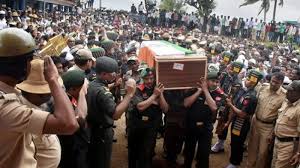
Kargil martyrs Hasan Sab, Basappa Patil laid to rest in Karnataka

August 1, 2016

Bengaluru, Aug 1: The mortal remains of two soldiers from Karnataka who were killed during a landmine blast in Kargil sector along LoC last week were today laid to rest at their native villages.

1braveSubedar Basappa Patil and Sepoy Hasansab Khudavand were killed on July 29 while patrolling when they were caught in a mine blast, the Army had said.

Both their bodies were brought to their native villages via Goa today, where they were laid to rest with full military honors.

Hundreds of villagers from neighboring areas also bid a bid tearful adieu to the martyrs raising patriotic slogans, while their families were inconsolable.

Due to the effect of the blast Subedar Patil, who was the patrol leader and Sepoy Hasansab, the leading scout, suffered injuries which proved to be fatal, officials had said.

Subedar Patil hails from a village in Gokak taluk in Belagavi district and is survived by his wife, a daughter and a son.

Sepoy Hasansab is from a village in Navalagunda taluk in Dharwad district and is survived by his mother, father, a younger sister and brother.

Chief Minister Siddaramaiah has condoled the death of the two soldiers.

"My heartfelt salutes to martyrs Subedar Basappa Patil and Sepoy Hasansab who were killed in a landmine blast in Kargil region of Jammu and Kashmir."

"My deepest condolences to the bereaved families of these two brave soldiers," a post on Chief Minister's official Facebook page said.

Comments

SK
 - 
Tuesday, 2 Aug 2016

Bravo Soldiers .....RIP..... you made your parents proud....
The soldiers have done their duty, now it is the duty of the govt to take care of their Families....

Shuaib
 - 
Tuesday, 2 Aug 2016

Salute to Hasan Sab & Basappa Patil

Shaheed Amar rahe

Add new comment

  • Coastaldigest.com reserves the right to delete or block any comments.
  • Coastaldigset.com is not responsible for its readers’ comments.
  • Comments that are abusive, incendiary or irrelevant are strictly prohibited.
  • Please use a genuine email ID and provide your name to avoid reject.
News Network
April 4,2020

New Delhi, Apr 4: The Supreme Court on Friday urged Karnataka and Kerala to amicably resolve their issues concerning a border blockade that has choked the free flow of vehicles carrying essential items and patients in the midst of the COVID-19 outbreak.

Karnataka, which imposed the blockade, justified that its border was sealed to “combat the spread of the pandemic by preventing the movement of people from the bordering districts of Kerala to Karnataka”.

The State had moved the Supreme Court, challenging a Kerala High Court order on April 1 to open the border. Kerala has countered that patients from the State cannot be denied access to health care. Besides, the blockade has severely affected the supply of essential items, from medicines to food, to Kerala.

On Friday, a Supreme Court Bench of Justices L. Nageswara Rao and Deepak Gupta urged the States to not confront each other in the midst of an unprecedented public health crisis. Instead, it asked the Chief Secretaries of both States to sit with the Union Health Secretary and iron out a solution. Meanwhile, the apex court urged Kerala not to take any precipitative action based on the High Court order.

The court issued notice to Kerala on the appeal filed by Karnataka, represented by advocate Shubhranshu Padhi. It listed the case for further hearing on April 7.

Karnataka, in its appeal against the High Court order, said the blockade was put in place in the interest of public health. The situation regarding Coronavirus was “really dire”, it said. It warned that opening the blockade would cause a law and order issue as its local population wanted the border to remain sealed.

Karnataka argued that Kerala was the “worst-affected” State in the country with nearly 194 coronavirus cases. In this, Kasaragod, adjoining Karnataka, was the “worst affected” district of Kerala with over a 100 positive cases.

MP’s plea

The court also separately considered a writ petition by Kasaragod MP Rajmohan Unnithan for an order to forthwith open the State border.

The parliamentarian, represented by advocates Haris Beeran and Pallavi Pratap, urged the court to issue an ex-parte stay on the operation of the blockade imposed by Karnataka with its border States.

Mr. Unnithan said Karnataka’s blockade was “ill-planned and dangerous” and had led to loss of lives. Two patients from Kerala, in need of urgent medical care, died after their ambulances were denied entry at the border by the Karnataka authorities. 

Comments

Add new comment

  • Coastaldigest.com reserves the right to delete or block any comments.
  • Coastaldigset.com is not responsible for its readers’ comments.
  • Comments that are abusive, incendiary or irrelevant are strictly prohibited.
  • Please use a genuine email ID and provide your name to avoid reject.
News Network
June 26,2020

Bengaluru, Jun 26: The National Restaurant Association of India (NRAI) on Thursday came up with a Standard Operating Procedure (SOP) for restaurants whereby among other physical distancing norms, it has suggested a 2-metre gap between tables.

Formulated in partnership with Releski, a Bengaluru based skill-tech company, the SoP suggests that in case of back-to-back seating, people sitting with their backs towards each other will have their seats divided by 'Plexiglass' divider raised up to 2 meters from the ground.

"In a typical restaurant, the improvised seating plan should have a minimum distance of 2 metres between tables. The distance of 2 metres (6 feet) between tables should measure from one edge of the table to the other table's edge," it said.

In case of loose or free seating such as in banquet style or food court style seating, a minimum 2 meters of distance should be maintained between tables.

The guidelines noted that, to encourage physical distancing, restaurants have to sacrifice their seating capacity, to promote health and safety, and also to gain trust from their patrons.

"In order to perform this, divide your restaurants under different sectors. Pull out your restaurant's floor plan and colour code different sections red and yellow. Red sections are potential areas where maximum footfall or traffic is observed. Yellow sections are areas where the footfalls are average," it said.

All the red sections are encircled or bordered by placing barricades or Q manager and will open at specific points to access the yellow section and all the opening points will have hand sanitisers and sprays, and every guest who walks from red zones to yellow zones will sanitise himself/herself to reduce the chances of contamination.

For air conditioning, the guidelines of CPWD shall be followed which inter alia emphasises that the temperature setting of all air conditioning devices should be in the range of 24-30 degree Celsius, relative humidity should be in the range of 40- 65 per cent, intake of fresh air should be as much as possible and cross ventilation should be adequate, the guidelines suggested.

The industry body has also suggested appointment of a COVID-free Ambassador who would operate as the Chief Health Officer within the restaurant team, preferably from the management team in each shift.

The ambassador's would put the new daily work routines into practice, to monitor compliance with good practice and to lead the preventative measures, adapt to health & safety recommendations and requirements of the restaurant and oversee the implementation of the norms.

Anurag Katriar, President of NRAI and CEO & Executive Director of deGustibus Hospitality, said: "Every restaurant cutting across formats is facing the harsh reality of subdued to shut business volumes in the present and the uncertainty of business environment in the future. One thing is certain that hygiene and safety will be a key differentiator in the post-pandemic restaurant operations."


Comments

Add new comment

  • Coastaldigest.com reserves the right to delete or block any comments.
  • Coastaldigset.com is not responsible for its readers’ comments.
  • Comments that are abusive, incendiary or irrelevant are strictly prohibited.
  • Please use a genuine email ID and provide your name to avoid reject.
News Network
March 27,2020

Bengaluru, Mar 27: India should take a cue from the UK and Italy and allow final year medical students to skip exam and bring them into the hospital system immediately to fight the war against COVID-19, noted cardiac surgeon Devi Prasad Shetty on Friday said.

The Chairman and Founder of the city-based Narayana Health said there should be some reforms in medical education like the UK and Italy.
In the UK, he noted, final year medical students have been told that they don't need to appear for the exam, and they will be given pass based on the past performance and they can get into the hospital system to fill the shortage.

Italy got 10,000 more doctors following the move to cut short the duration of MBBS by nine months, according to him.

COVID-19 battle can be only won by young doctors and young nurses. Its like a war, Shetty told PTI.

He said: Senior doctorsnone of them will be able to touch the patients because they are past the age of 50. A person who is past the age of 50 is very vulnerable himself.

This is a very contagious disease. "But we dont have that many battalion (of doctors). We need one and half lakh doctors to manage all these government
hospitals and private hospitals (to fight COVID-19)", he added.

​​​

Comments

Add new comment

  • Coastaldigest.com reserves the right to delete or block any comments.
  • Coastaldigset.com is not responsible for its readers’ comments.
  • Comments that are abusive, incendiary or irrelevant are strictly prohibited.
  • Please use a genuine email ID and provide your name to avoid reject.