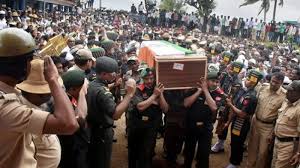
Kargil martyrs Hasan Sab, Basappa Patil laid to rest in Karnataka

August 1, 2016

Bengaluru, Aug 1: The mortal remains of two soldiers from Karnataka who were killed during a landmine blast in Kargil sector along LoC last week were today laid to rest at their native villages.

1braveSubedar Basappa Patil and Sepoy Hasansab Khudavand were killed on July 29 while patrolling when they were caught in a mine blast, the Army had said.

Both their bodies were brought to their native villages via Goa today, where they were laid to rest with full military honors.

Hundreds of villagers from neighboring areas also bid a bid tearful adieu to the martyrs raising patriotic slogans, while their families were inconsolable.

Due to the effect of the blast Subedar Patil, who was the patrol leader and Sepoy Hasansab, the leading scout, suffered injuries which proved to be fatal, officials had said.

Subedar Patil hails from a village in Gokak taluk in Belagavi district and is survived by his wife, a daughter and a son.

Sepoy Hasansab is from a village in Navalagunda taluk in Dharwad district and is survived by his mother, father, a younger sister and brother.

Chief Minister Siddaramaiah has condoled the death of the two soldiers.

"My heartfelt salutes to martyrs Subedar Basappa Patil and Sepoy Hasansab who were killed in a landmine blast in Kargil region of Jammu and Kashmir."

"My deepest condolences to the bereaved families of these two brave soldiers," a post on Chief Minister's official Facebook page said.

Comments

SK
 - 
Tuesday, 2 Aug 2016

Bravo Soldiers .....RIP..... you made your parents proud....
The soldiers have done their duty, now it is the duty of the govt to take care of their Families....

Shuaib
 - 
Tuesday, 2 Aug 2016

Salute to Hasan Sab & Basappa Patil

Shaheed Amar rahe

Add new comment

  • Coastaldigest.com reserves the right to delete or block any comments.
  • Coastaldigset.com is not responsible for its readers’ comments.
  • Comments that are abusive, incendiary or irrelevant are strictly prohibited.
  • Please use a genuine email ID and provide your name to avoid reject.
Agencies
June 26,2020

New Delhi, Jun 26: With looming uncertainty and no likelihood of an early economic recovery in sight, the bull run in gold prices is here to stay. Analysts expect domestic futures to touch ₹ 52,000 per 10 grams in the next few months, till Diwali.

Experts also predict that with the current trend, gold may reach historic levels around ₹ 65,000 per 10 grams in two years time.

Futures of the yellow metal have touched new highs in India off late. On Wednesday, the August contract of gold futures on the Multi-Commodity Exchange (MCX) touched an all-time high of Rs 48,589 per 10 grams.

It has, however corrected since and is currently trading at ₹ 48,057 on the MCX, higher by ₹ 116 or 0.24 per cent from its previous close.

Market experts are of the view that both domestic and international gold prices are yet not done breaching records and will touch new highs in days to come.

The resurgence in the number of new cases of coronavirus infection across the globe has added to the uncertainty and fears.

Speaking to media persons, Anuj Gupta, DVP for Commodities and Currencies Research at Angel Broking, noted: "In short term we are expecting it to reach ₹ 48,800-49,000 and for long term, we are expecting ₹ 51,000-Rs 52,000 till Diwali."

On the prices in the international market, he said that it may reach around $1,790 per ounce in the near term from the current levels of $1,762 and the long term, it is likely to be around $1,820-1,850 per ounce.

Gupta noted that with International Monetary Fund's (IMF) latest downward revision of economic outlook, both global and of India, and the rising number of cases and high demand by gold exchange traded funds (ETF) have led to this record breaking rise in gold prices.

Covid-19 battered India's economy is projected to contract by 4.5 per cent this fiscal, according to the IMF and the global output is projected to decline by 4.9 per cent in 2020, 1.9 percentage points below the IMF's April forecast.

Hareesh V, Head of Commodity Research at Geojit Financial Services, said that gold's safe haven appeal will remain on the higher side as there is little hope of a quick global economic recovery amid rising virus cases across the world.

"Increased geopolitical instability and an under-performing dollar also lift the metal's sentiments," he added.

According to Prathamesh Mallya, AVP Research, Non-Agro Commodities & Currencies at Angel Broking, said that with the global output to contract and the economies in a deeper recession than most anticipate, gold as an asset class is a safe bet for investors across the globe.

"Although, the physical demand has declined drastically due to the restrictions and lockdowns, the activity of global central banks and their net purchases of gold signal that uncertainty will continue for most of 2020," he said.

He was also of the view that in the international market price of the metal may move towards $1,850 per ounce and in the domestic market it is likely to move higher towards Rs 50,000 per 10 grams.

"The investment demand as seen in the net additions of ETF holdings also signals that gold will shine for a much longer time even if the pandemic is under control. Till then, keep buying gold, if not in physical form, but in digital form," Mallya added.

Industry insiders like Aditya Pethe, Director, WHP Jewellers said: "I basically feel that the current trend for the gold is bullish and for the coming next 2 years, it is likely to move upwards. No one can predict the exact price as currently the trend is on rise but it might change after 6 months. In general for the coming 6 months to one year, the gold prices are likely to cross $2,000 which comes to roughly Rs 55,000. For a temporary moment it may reduce, basically fluctuate as well but overall trend of gold is going to be bullish."

On his part, Ishu Datwani, Founder, Anmol Jewellers said: "Yes - it's very likely that the gold price could easily go up to Rs 60,000-Rs 65,000 in the next two years. There is also a possibility of it going up even more."

"A lot of banks have been buying gold and there is also a possibility that the Indian rupee will depreciate against the dollar. This and geopolitical reasons will cause bullishness in gold."


Comments

Add new comment

  • Coastaldigest.com reserves the right to delete or block any comments.
  • Coastaldigset.com is not responsible for its readers’ comments.
  • Comments that are abusive, incendiary or irrelevant are strictly prohibited.
  • Please use a genuine email ID and provide your name to avoid reject.
News Network
July 4,2020

Bengaluru, Jul 4: Amid the rising COVID-19 cases in the state, the Karnataka COVID-19 Task Force has decided to set up booth-level committees across the state including 8,800 here for effective monitoring and surveillance.

The task force also released detailed guidelines for home isolation for asymptomatic cases including 17 days ''home isolation'' for patients below 50 years of age. It also warned of legal action against those health workers for disrespect to the bodies.

Briefing reporters after the meeting on Friday, Medical Education Minister Dr K Sudhakar said the local management will be strengthened for effective monitoring and surveillance of COVID-19 cases. "There will be booth-level task force committees throughout the state right from the village to Bengaluru.

These task force committees will act at the ultra local level. The task force will act as a structural and functional unit of COVID-19 dealing with monitoring, surveillance, checking of all the ILI cases, ambulances and hospitals," he added.

He also said the committees will comprise one member each from the Health department, police department, municipalities or Panchayat, volunteers, valveman. The committee will have five to six members.

The principal secretary in the Village Development and Panchayat Raj department L K Ateeq has been appointed as the nodal officer to manage the task force in the rural areas whereas in the urban areas, the Urban Development secretary, the municipal administration directors and the municipal commissioner will form the local task force.

"In Bengaluru alone 8,800 teams will be formed, which will be coterminous with the 8,800 booths in the city. They will provide the real-time data. They will be imparted training," the minister added. Noting that there were about 8,800 electoral booths in Bengaluru city and each booth will have a task force committee, he said a nodal officer has been appointed to oversee this.

The state level task force also came out with a slew of conditions. As far as home isolation is concerned, it would apply for patients who are below 50 years and have no symptoms of any other disease, and their homes should have a toilet and have an attendant.

He also said home isolation duration has been increased from 14 to 17 days. "People should not get fever in the next three days after completing 14 days, else they will be quarantined for another seven days. If they don''t get fever then they will be freed to perform their personal activities," Sudhakar said.

Those who are above 50 years and have comorbidities, will be treated at the COVID care centres only and they will be under medical supervision and be subjected to regular tests. The state is also making arrangements for telecommunication for those who are asymptomatic but wish to speak to a doctor.

It was also decided to have at least two ambulances in each of the 198 wards of Bengaluru. The minister said the additional commissioner of police (traffic) will be the nodal officer to coordinate the movement of ambulances. The task force has also appointed a nodal officer to manage the hospitals based on the availability of beds and ventilators. The officer will provide real time information about beds.

"We want to make sure that no one has to run from one hospital to another," Sudhakar said. On the cremation of the bodies, Sudhakar said guidelines have been issued on how to handle bodies at mortuaries, taking them in the ambulances, human treatment to the deceased while performing the last rites and fumigation of the bed. "Legal action will be taken against those who treat bodies in an inhuman way," Sudhakar said.

The state-level task force has also decided to arrange for test reports within 24 hours. It has also been decided to increase the testing capacity from the existing 15,000 a day to 25,000. In view of the spurt in COVID-19 cases, the task force also recommended antigen tests in crowded areas to check whether there was community spread.

To a question on closing down the border, the minister said there is no question of lockdown. "We cannot hide from this disease. It is not a solution. We have to live with it now, yet maintain a distance from it," he added. Sudhakar, who is a doctor himself, said COVID-19 is not as deadly a virus as those he had seen in the past and asked people not to be scared of it.

Comments

Add new comment

  • Coastaldigest.com reserves the right to delete or block any comments.
  • Coastaldigset.com is not responsible for its readers’ comments.
  • Comments that are abusive, incendiary or irrelevant are strictly prohibited.
  • Please use a genuine email ID and provide your name to avoid reject.
Agencies
February 23,2020

Bengaluru, Feb 23: Bolstered by the Supreme Court's interim nod for the gazette notification of the Mahadayi Water Dispute Tribunal award by the Central government, Karnataka decided to allot funds for the drinking water project in the state's northwest region, an official said on Saturday.

"Funds will be allotted in the state budget for fiscal 2020-21 to complete the Kalasa-Banduri project across the Mahadayi river for supplying drinking water to the four drought-prone northern districts in the state," the official of the water resources department told media on anonymity.

As Chief Minister B.S. Yediyurappa also holds the finance portfolio, he has agreed to allocate funds for the project, held up for years in the legal battle with the neighbouring Goa and Maharashtra over the sharing of the river water among the three coastal states.

Yediyurappa is slated to present the state budget for the ensuing fiscal in the legislative assembly on March 2.

"We will resume the project work once the Centre notifies the award though it will be binding on the final outcome of the apex court's hearing the review petitions of Goa and Maharashtra against the Tribunal award," the official noted.

A division bench of Justice D.Y. Chandrachud and Justice Hemant Gupta on Thursday passed an interim order on the Tribunal award, allowing the central water resources ministry to notify it for implementation and posted the case for final hearing in July.

The Tribunal on August 14, 2018 allocated 13.42 thousand million cubic feet (tmcft) of the river water to the southern state for irrigation and drinking water supply to towns and villages across Bagalkot, Belagavi, Dharwad and Gadag districts, which are in the arid region of the Deccan plateau.

The four districts are about 400-550 km northwest of Bengaluru in the southern state.

Of the 13.42 tmcft water, 5.5 tmcft will be used in the river basin and for diversion into the depleted Malaprabha reservoir while the balance 7.92 tmcft will be utilized for hydel power generation instead of allowing the water to go into the Arabian Sea on the state's west coast through Goa.

Goa, which opposed Karnataka's demand for 36.66 tmcft, was allocated 24 tmcft, while Maharashtra got 1.3 tmcft.

The Tribunal assessed that 188.06 tmc feet water is available at 75 per cent dependability.

The three-member Tribunal is headed by Chairman Justice J.M. Panchal, Justice Viney Mittal and Justice P.S. Naayana.

The Union government had set up the inter-state Tribunal on November 16, 2010 for the djudication of the Mahadayi basin water allocation among the three riparian and contiguous states.

Goa and Maharashtra claimed 122.6 tmc feet and 6.35 tmc feet of the river water respectively.

The Tribunal, which commenced sittings on September 6, 2012, held 1,209 sittings for over 6 years.

Supreme Court senior counsel F.S. Nariman represented the state before the Tribunal to present its case.

The Tribunal's chairman and two members inspected the river basin area across the three coastal states from December 12-24, 2013.

The 77km-long Mahadayi or Mandovi river originates at Bhimgad in the Western Ghats in Belagavi district and flows into the neighbouring Goa through Maharashtra and joins the Arabian Sea off the west coast.

Though the river flows 29 km in Karnataka and 52 km in Goa, its catchment area is spread over 2,032 km in the southern state as against 1,580 km in the western state (Goa).

Comments

Add new comment

  • Coastaldigest.com reserves the right to delete or block any comments.
  • Coastaldigset.com is not responsible for its readers’ comments.
  • Comments that are abusive, incendiary or irrelevant are strictly prohibited.
  • Please use a genuine email ID and provide your name to avoid reject.