


Karnataka Assembly asks Govt not to release Cauvery water

September 23, 2016

Bengaluru, Sep 23: The Karnataka Assembly passed a unanimous resolution on Friday asking the Government not to release Cauvery water to Tamil Nadu.
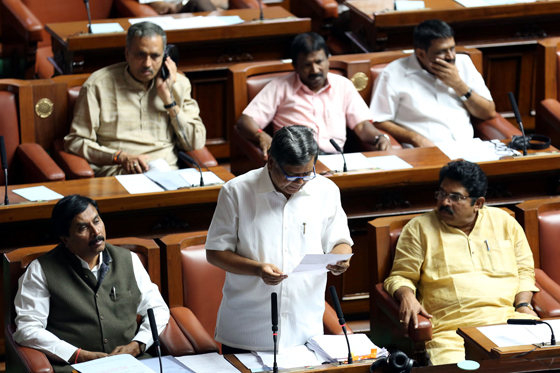
1shettar

The Assembly, at the end of the special session, decided to retain Cauvery water to meet the drinking water needs of the state.

Earlier, a resolution asking the government to use Cauvery water only to meet drinking water needs was moved at a special session of the Karnataka Assembly, implying that the state cannot comply with the latest Supreme Court direction to release water to Tamil Nadu.
Highlighting the "state of acute distress", the resolution, endorsed by all parties, said it was "imperative" that the government ensures that no water from the present storages be drawn "save and except" for meeting drinking water needs of villages and towns in the Cauvery basin and Bengaluru.

The interests of the inhabitants of the state are likely to be gravely jeopardised if water in the four reservoirs in the Cauvery basin was in anyway reduced other than for meeting the drinking water needs of the people in the Cauvery basin, including the entire city of Bengaluru, it said.
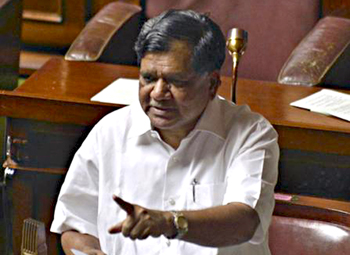
The resolution moved in English by Opposition BJP leader Jagadish Shettar and in Kannada by Y S V Datta of JDS did not refer to the apex Court direction to the state to release 6,000 cusecs of Cauvery water per day to Tamil Nadu but is expected to put Karnataka on a collision course with the judiciary.

The Cauvery Supervisory Committee had on September 19 asked Karnataka to release 3,000 cusecs per day from September 21 to 30, but the apex court had on September 20 doubled the quantum to 6,000 cusecs from September 21 to 27 after Tamil Nadu pressed for water to save its samba paddy crop.

It had also directed the Centre to constitute within four weeks the Cauvery Water Management Board as directed by Cauvery Water Disputes Tribunal in its award.

Backed by an all party meeting mandate, the state cabinet had on Tuesday decided to defer the release of water to Tamil Nadu and convene a day's legislature session amid escalating row between the two neighbouring states.
The resolution noted that in the water year 2016-17, there has been an acute situation of distress but the shortfall in the basin will become known only at the end of the season on January 31, 2017.

It pointed out that the combined storage in four reservoirs in the Cauvery basin -- Krishnaraja Sagar, Hemavathy, Harangi and Kabini -- had reached "alarmingly low levels at 27 TMC ft."

"It is now resolved to direct that in this state of acute distress, it is imperative that the government ensures that no water from the present storages be drawn save and except for meeting drinking water requirements of villages and towns in the cauvery basin and Bengaluru," it said.

Earlier post:

All party resolution asks govt to use water only for drinking needs

Bengaluru, Sep 23: A resolution asking government to use Cauvery water only to meet drinking water needs was moved at a special session of the Karnataka Assembly today, implying that the state cannot comply with the latest Supreme Court direction to release water to Tamil Nadu.

jagadeshHighlighting the "state of acute distress", the resolution, endorsed by all parties, said it was "imperative" that the government ensures that no water from the present storages be drawn "save and except" for meeting drinking water needs of villages and towns in the Cauvery basin and Bengaluru.

The interests of the inhabitants of the state are likely to be gravely jeopardised if water in the four reservoirs in the Cauvery basin was in anyway reduced other than for meeting the drinking water needs of the people in the Cauvery basin, including the entire city of Bengaluru, it said.

 The resolution moved in English by Opposition BJP leader Jagadish Shettar and in Kannada by Y S V Datta of JDS did not refer to the apex Court direction to the state to release 6,000 cusecs of Cauvery water per day to Tamil Nadu but is expected to put Karnataka on a collision course with the judiciary.

The Cauvery Supervisory Committee had on September 19  asked Karnataka to release 3,000 cusecs per day from September 21 to 30, but the apex court had on September 20 doubled the quantum to 6,000 cusecs from September 21 to 27 after Tamil Nadu pressed for water to save its samba paddy crop.

It had also directed the Centre to constitute within four weeks the Cauvery Water Management Board as directed by Cauvery Water Disputes Tribunal in its award.

Backed by an all party meeting mandate, the state cabinet had on Tuesday decided to defer the release of water to Tamil Nadu and convene a day's legislature session amid escalating row between the two neighbouring states.

 The resolution noted that in the water year 2016-17, there has been an acute situation of distress but the shortfall in the basin will become known only at the end of the season on January 31, 2017.

It pointed out that the combined storage in four reservoirs in the Cauvery basin -- Krishnaraja Sagar, Hemavathy, Harangi and Kabini -- had reached "alarmingly low levels at 27 TMC ft."

"It is now resolved to direct that in this state of acute distress, it is imperative that the government ensures that no water from the present storages be drawn save and except for meeting drinking water requirements of villages and towns in the cauvery basin and Bengaluru," it said.


Comments

TRUE INDIAN
 - 
Friday, 23 Sep 2016

Modi is busy with bolochistan.
Modi fooled everybody, but gain there are some fools, chanting har har Modi.

TRUE INDIAN
 - 
Friday, 23 Sep 2016

before they were Shouting Bharat mata. Now what happened Is
tamil nadu not Bharat mata.

Bharat mata all Drama.

Add new comment

  • Coastaldigest.com reserves the right to delete or block any comments.
  • Coastaldigset.com is not responsible for its readers’ comments.
  • Comments that are abusive, incendiary or irrelevant are strictly prohibited.
  • Please use a genuine email ID and provide your name to avoid reject.
News Network
July 19,2020

Bengaluru, Jul 19: The Karnataka Deputy Chief Minister C N Ashwathnarayan on Saturday inspected the country's first modular Intensive Care Unit (ICU) containers.

A notice from the Chief Minister's Office (CMO) said that the new mobile modular container ICUs, which will be used in the fight against the ongoing COVID-19 pandemic, have been created by Rinac India Limited, known for setting up sanitised operation theatres and clean rooms in hospitals.

On a pilot basis, the Deputy CM, who is also in charge of setting up COVID-care centres, said that 10 modular container ICUs will be deployed at the KC General Hospital in Malleshwaram. Each of the containers will have five beds.

Deputy CM Ashwathnarayan also said, "These mobile ICUs donated by Rinac will be useful, particularly in times of a crisis like COVID 19 or any natural calamity."

"The entry of health officials will be through an airlock, and entry of patients will be through a different door. There will be two doors for patients and can be increased if need. ICUs are fitted with cameras to monitor online from a centralized monitoring station, thereby limiting the exposure of the health personnel," the CMO informed.

The CMO further added, "the advantages of this new system are that the prefabricated modules of 5 can be shifted to any location by trailers and it is easy to deploy multiple containers to create a common facility. They are easy to clean and the airtight functionality ensures that no moisture or heat ingression happens, hence, it is easy to air-condition or ventilate."

Comments

Add new comment

  • Coastaldigest.com reserves the right to delete or block any comments.
  • Coastaldigset.com is not responsible for its readers’ comments.
  • Comments that are abusive, incendiary or irrelevant are strictly prohibited.
  • Please use a genuine email ID and provide your name to avoid reject.
News Network
April 21,2020

Global oil markets remained under intense pressure on Tuesday, with Brent crude dropping below $20 per barrel for the first time in 18 years while other major benchmarks across the world tumbled. 

Brent, the international crude marker, slipped to $18.10, indicating that markets see no immediate let-up to the collapse in oil demand that sent some US oil benchmarks plunging under $0 for the first time on Monday, leaving producers paying for buyers to take their oil away while available storage is scarce.

Coronavirus has sent the oil sector into a state of crisis, with lockdowns implemented by authorities to smother the outbreak slashing demand for crude by as much as a third.

Contracts for the US benchmark West Texas Intermediate for delivery next month tumbled as low as minus $40 a barrel on Monday. Analysts at Citi warned that “if global storage worsens more quickly, Brent could chase WTI down to the bottom”.

The collapse in the May WTI contract was partly a technical product of the fact that it expires on Tuesday, meaning trading volumes were low and making the contract for June delivery more noteworthy, analysts said. That contract held above $20 a barrel on Monday but slid as much as 42 per cent on Tuesday to trade at lows of $11.79, suggesting the blowout in the May contract was more than a blip and that the entire global oil market faced challenges.

Goldman Sachs analysts said the June contact was likely to face downward pressure in the coming weeks, pointing to the “still unresolved market surplus”.

“As storage becomes saturated, price volatility will remain exceptionally high in coming weeks,” they said. “But with ultimately a finite amount of storage left to fill, production will soon need to fall sizeably to bring the market into balance, finally setting the stage for higher prices once demand gradually recovers.”

Warren Patterson, head of commodities strategy at ING, said it was likely that “storage this time next month will be even more of an issue, given the surplus environment”.

“And so in the absence of a meaningful demand recovery, negative prices could return for June,” he added.

European equities traded lower, partly dragged down by weaker energy stocks. The continent-wide Stoxx 600 was down 1.9 per cent, with its oil and gas sub-index dropping 3.3 per cent. In London the FTSE shed 1.7 per cent, while Frankfurt’s Dax slid 2.3 per cent. 

Equities were also broadly lower in Asia, with futures tipping US stocks to fall 1 per cent when trading in New York begins later.

On Wall Street overnight, the S&P 500 closed down 1.8 per cent, partly because of weakness in energy shares, but also due to increased pessimism over the time it will take for countries to emerge from lockdowns.

In fixed income, the yield on the 10-year US Treasury fell 0.03 percentage points to 0.585 per cent as investors retreated to the safety of the debt.

Comments

Add new comment

  • Coastaldigest.com reserves the right to delete or block any comments.
  • Coastaldigset.com is not responsible for its readers’ comments.
  • Comments that are abusive, incendiary or irrelevant are strictly prohibited.
  • Please use a genuine email ID and provide your name to avoid reject.
News Network
January 21,2020

Mysuru, Jan 21: South Indian actor Rashmika Mandanna, whose house was raided recently by IT sleuths, appeared for an inquiry along with her father Mr Madan Mandanna, here on Tuesday.

She arrived at the office of Principal Commissioner for IT, at Nazarbad, in the city. She was accompanied by nine persons, including auditors and accountants, who carried two backpacks and a kitbag.

Mr Madan mandanna said, "the IT officials have sought some documents and we are here to submit them."

Comments

Add new comment

  • Coastaldigest.com reserves the right to delete or block any comments.
  • Coastaldigset.com is not responsible for its readers’ comments.
  • Comments that are abusive, incendiary or irrelevant are strictly prohibited.
  • Please use a genuine email ID and provide your name to avoid reject.