


Karnataka Assembly asks Govt not to release Cauvery water

September 23, 2016

Bengaluru, Sep 23: The Karnataka Assembly passed a unanimous resolution on Friday asking the Government not to release Cauvery water to Tamil Nadu.
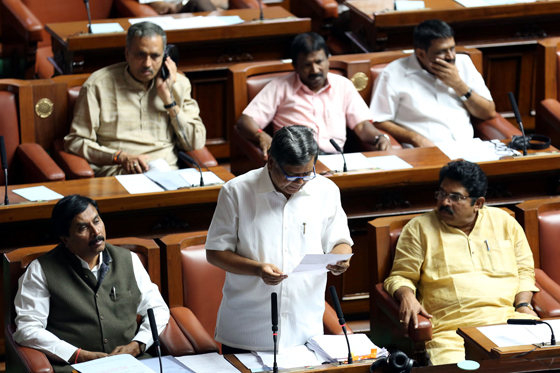
1shettar

The Assembly, at the end of the special session, decided to retain Cauvery water to meet the drinking water needs of the state.

Earlier, a resolution asking the government to use Cauvery water only to meet drinking water needs was moved at a special session of the Karnataka Assembly, implying that the state cannot comply with the latest Supreme Court direction to release water to Tamil Nadu.
Highlighting the "state of acute distress", the resolution, endorsed by all parties, said it was "imperative" that the government ensures that no water from the present storages be drawn "save and except" for meeting drinking water needs of villages and towns in the Cauvery basin and Bengaluru.

The interests of the inhabitants of the state are likely to be gravely jeopardised if water in the four reservoirs in the Cauvery basin was in anyway reduced other than for meeting the drinking water needs of the people in the Cauvery basin, including the entire city of Bengaluru, it said.
The resolution moved in English by Opposition BJP leader Jagadish Shettar and in Kannada by Y S V Datta of JDS did not refer to the apex Court direction to the state to release 6,000 cusecs of Cauvery water per day to Tamil Nadu but is expected to put Karnataka on a collision course with the judiciary.

The Cauvery Supervisory Committee had on September 19 asked Karnataka to release 3,000 cusecs per day from September 21 to 30, but the apex court had on September 20 doubled the quantum to 6,000 cusecs from September 21 to 27 after Tamil Nadu pressed for water to save its samba paddy crop.

It had also directed the Centre to constitute within four weeks the Cauvery Water Management Board as directed by Cauvery Water Disputes Tribunal in its award.

Backed by an all party meeting mandate, the state cabinet had on Tuesday decided to defer the release of water to Tamil Nadu and convene a day's legislature session amid escalating row between the two neighbouring states.
The resolution noted that in the water year 2016-17, there has been an acute situation of distress but the shortfall in the basin will become known only at the end of the season on January 31, 2017.

It pointed out that the combined storage in four reservoirs in the Cauvery basin -- Krishnaraja Sagar, Hemavathy, Harangi and Kabini -- had reached "alarmingly low levels at 27 TMC ft."

"It is now resolved to direct that in this state of acute distress, it is imperative that the government ensures that no water from the present storages be drawn save and except for meeting drinking water requirements of villages and towns in the cauvery basin and Bengaluru," it said.

Earlier post:

All party resolution asks govt to use water only for drinking needs

Bengaluru, Sep 23: A resolution asking government to use Cauvery water only to meet drinking water needs was moved at a special session of the Karnataka Assembly today, implying that the state cannot comply with the latest Supreme Court direction to release water to Tamil Nadu.

jagadeshHighlighting the "state of acute distress", the resolution, endorsed by all parties, said it was "imperative" that the government ensures that no water from the present storages be drawn "save and except" for meeting drinking water needs of villages and towns in the Cauvery basin and Bengaluru.

The interests of the inhabitants of the state are likely to be gravely jeopardised if water in the four reservoirs in the Cauvery basin was in anyway reduced other than for meeting the drinking water needs of the people in the Cauvery basin, including the entire city of Bengaluru, it said.

 The resolution moved in English by Opposition BJP leader Jagadish Shettar and in Kannada by Y S V Datta of JDS did not refer to the apex Court direction to the state to release 6,000 cusecs of Cauvery water per day to Tamil Nadu but is expected to put Karnataka on a collision course with the judiciary.

The Cauvery Supervisory Committee had on September 19  asked Karnataka to release 3,000 cusecs per day from September 21 to 30, but the apex court had on September 20 doubled the quantum to 6,000 cusecs from September 21 to 27 after Tamil Nadu pressed for water to save its samba paddy crop.

It had also directed the Centre to constitute within four weeks the Cauvery Water Management Board as directed by Cauvery Water Disputes Tribunal in its award.

Backed by an all party meeting mandate, the state cabinet had on Tuesday decided to defer the release of water to Tamil Nadu and convene a day's legislature session amid escalating row between the two neighbouring states.

 The resolution noted that in the water year 2016-17, there has been an acute situation of distress but the shortfall in the basin will become known only at the end of the season on January 31, 2017.

It pointed out that the combined storage in four reservoirs in the Cauvery basin -- Krishnaraja Sagar, Hemavathy, Harangi and Kabini -- had reached "alarmingly low levels at 27 TMC ft."

"It is now resolved to direct that in this state of acute distress, it is imperative that the government ensures that no water from the present storages be drawn save and except for meeting drinking water requirements of villages and towns in the cauvery basin and Bengaluru," it said.


Comments

TRUE INDIAN
 - 
Friday, 23 Sep 2016

Modi is busy with bolochistan.
Modi fooled everybody, but gain there are some fools, chanting har har Modi.

TRUE INDIAN
 - 
Friday, 23 Sep 2016

before they were Shouting Bharat mata. Now what happened Is
tamil nadu not Bharat mata.

Bharat mata all Drama.

Add new comment

  • Coastaldigest.com reserves the right to delete or block any comments.
  • Coastaldigset.com is not responsible for its readers’ comments.
  • Comments that are abusive, incendiary or irrelevant are strictly prohibited.
  • Please use a genuine email ID and provide your name to avoid reject.
News Network
January 6,2020

Bengaluru, Jan 6: Former Governor of Karnataka T N Chaturvedi passed away on Sunday late night at a private hospital in Noida.
He was 90.

T N Chaturvedi served as of Comptroller and Auditor General of India from 1984 to 1989. He was awarded the Padma Vibhushan in 1991.

An officer of Indian Administrative Service (IAS), Chaturvedi held several key posts after retirement including Governor’s post of Karnataka and Kerala. He was the governor of Karnataka from 2002 to 2007 and held additional post of Governor of Kerala following death of then Kerala governor Sikander Bakht. He held the post from Feb 2004 to June 2004 and was replaced by newly appointed Governor.

An officer of Indian Administrative Service (IAS), Chaturvedi held several key posts after retirement including Governor’s post of Karnataka and Kerala.

Expressing grief on the demise of T N Chaturvedi Vice President M Venkaiah Naidu, in a tweet said, “T N Chaturvedi was an administrator par excellence, towering intellectual and true nationalist and he was known for his erudition, integrity and knowledge. He had an illustrious career in public life and served every role with distinction.”

Even former Union Minister Anant Kumar Hegde condoled Chaturvedi's demise. "Humble tributes to our ex-Governor of Karnataka TN Chaturvedi who passed away last evening. He was an outstanding bureaucrat who was CAG in the 90's before becoming the Governor of our state. May his soul attain Sadgati. Om Shanti Shanti Shanti!" Hegde tweeted.

Comments

Add new comment

  • Coastaldigest.com reserves the right to delete or block any comments.
  • Coastaldigset.com is not responsible for its readers’ comments.
  • Comments that are abusive, incendiary or irrelevant are strictly prohibited.
  • Please use a genuine email ID and provide your name to avoid reject.
coastaldigest.com news network
May 29,2020

Dammam, May 29: A woman hailing from Mangaluru, who was waiting for repatriation amidst coronavirus lockdown in Saudi Arabia, passed away yesterday after a brief illness.

The deceased has been identified as Lateefa (55), wife of Abdul Azeez, a resident of Angaragundi near Baikampady on the outskirts of the city.

She had flown to Saudi Arabia in November 2019 along with her husband to spend some time with their NRI son in Dammam. They were supposed to return in April this year.

After the sudden cancellation of regular flights due to lockdown, they were waiting for the repatriation flights from Dammam to Mangaluru or Bengaluru.

Meanwhile, Lateefa’s health condition worsened and she was hospitalised. She passed away on Thursday without responding to any treatment. Last rites are expected to take place in Dammam.

Comments

Add new comment

  • Coastaldigest.com reserves the right to delete or block any comments.
  • Coastaldigset.com is not responsible for its readers’ comments.
  • Comments that are abusive, incendiary or irrelevant are strictly prohibited.
  • Please use a genuine email ID and provide your name to avoid reject.
News Network
June 20,2020

Bengaluru,  Jun 19: Following the coronavirus outbreak, Bengaluru's Kempegowda International Airport has introduced ultraviolet treatment while scanning outbound baggage apart from other measures to enhance passenger and staff safety.

"Two custom-designed UV tunnels have been created to disinfect trolleys after every use. Two custom-designed UV tunnels have been created to disinfect trolleys after every use. These Tunnels are located at a cordoned-off area of the Terminal," according to a statement by the Bangalore International Airport Limited (BIAL).

The airport plans to use an ultra-low volume (ULV) spray treatment for check-in bags: all outbound passenger baggage is sanitised before dispatch to the aircraft

Authorities also plan to minimise use of additional trays for footwear by introducing specially designed trays; the trays that are in use are UV treated and sanitised manually after every use.

Officials are currently in the process of implementing silver nano-coating for frequently used touchpoints for self disinfection like check-in counters, Immigration counters, ATRS trays, etc. Currently, sanitisation of high-traffic areas and frequently touched surfaces continues to be done every thirty minutes manually without disrupting the flow of passengers.

All high-traffic areas are sanitised once every three hours by using ULV machines - eight times in 24 hours.

Washrooms across the Airport premises are sanitised on a regular basis with dedicated manpower, irrespective of the frequency of use. 456 units of tabletop hand sanitiser and 107 units of sensor-based hand sanitisers have been placed across the Terminal.

120 biowaste bins located across the Airport campus enable passengers and staff to dispose of their masks, gloves and other PPE conveniently and safely. This bio-waste is managed by a dedicated team and handed over to a Pollution Control Board-approved vendor and taken away for incineration.

The Airport said that the passenger feedback for the contactless process has been positive. "The objective of the process is to minimise physical contact and enhance passenger throughput," it said.

These sanitisation measures come in light of the highly infectious COVID-19 pandemic which spreads through person-to-person contact. Small droplets from the nose or mouth can spread the virus when they land on objects and surfaces around the person.

Comments

Add new comment

  • Coastaldigest.com reserves the right to delete or block any comments.
  • Coastaldigset.com is not responsible for its readers’ comments.
  • Comments that are abusive, incendiary or irrelevant are strictly prohibited.
  • Please use a genuine email ID and provide your name to avoid reject.