


Karnataka Assembly asks Govt not to release Cauvery water

September 23, 2016

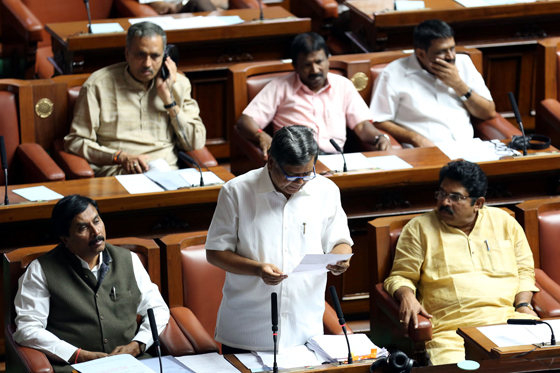
Bengaluru, Sep 23: The Karnataka Assembly passed a unanimous resolution on Friday asking the Government not to release Cauvery water to Tamil Nadu.
1shettar

The Assembly, at the end of the special session, decided to retain Cauvery water to meet the drinking water needs of the state.

Earlier, a resolution asking the government to use Cauvery water only to meet drinking water needs was moved at a special session of the Karnataka Assembly, implying that the state cannot comply with the latest Supreme Court direction to release water to Tamil Nadu.
Highlighting the "state of acute distress", the resolution, endorsed by all parties, said it was "imperative" that the government ensures that no water from the present storages be drawn "save and except" for meeting drinking water needs of villages and towns in the Cauvery basin and Bengaluru.

The interests of the inhabitants of the state are likely to be gravely jeopardised if water in the four reservoirs in the Cauvery basin was in anyway reduced other than for meeting the drinking water needs of the people in the Cauvery basin, including the entire city of Bengaluru, it said.
The resolution moved in English by Opposition BJP leader Jagadish Shettar and in Kannada by Y S V Datta of JDS did not refer to the apex Court direction to the state to release 6,000 cusecs of Cauvery water per day to Tamil Nadu but is expected to put Karnataka on a collision course with the judiciary.

The Cauvery Supervisory Committee had on September 19 asked Karnataka to release 3,000 cusecs per day from September 21 to 30, but the apex court had on September 20 doubled the quantum to 6,000 cusecs from September 21 to 27 after Tamil Nadu pressed for water to save its samba paddy crop.

It had also directed the Centre to constitute within four weeks the Cauvery Water Management Board as directed by Cauvery Water Disputes Tribunal in its award.

Backed by an all party meeting mandate, the state cabinet had on Tuesday decided to defer the release of water to Tamil Nadu and convene a day's legislature session amid escalating row between the two neighbouring states.
The resolution noted that in the water year 2016-17, there has been an acute situation of distress but the shortfall in the basin will become known only at the end of the season on January 31, 2017.

It pointed out that the combined storage in four reservoirs in the Cauvery basin -- Krishnaraja Sagar, Hemavathy, Harangi and Kabini -- had reached "alarmingly low levels at 27 TMC ft."

"It is now resolved to direct that in this state of acute distress, it is imperative that the government ensures that no water from the present storages be drawn save and except for meeting drinking water requirements of villages and towns in the cauvery basin and Bengaluru," it said.

Earlier post:

All party resolution asks govt to use water only for drinking needs

Bengaluru, Sep 23: A resolution asking government to use Cauvery water only to meet drinking water needs was moved at a special session of the Karnataka Assembly today, implying that the state cannot comply with the latest Supreme Court direction to release water to Tamil Nadu.

jagadeshHighlighting the "state of acute distress", the resolution, endorsed by all parties, said it was "imperative" that the government ensures that no water from the present storages be drawn "save and except" for meeting drinking water needs of villages and towns in the Cauvery basin and Bengaluru.

The interests of the inhabitants of the state are likely to be gravely jeopardised if water in the four reservoirs in the Cauvery basin was in anyway reduced other than for meeting the drinking water needs of the people in the Cauvery basin, including the entire city of Bengaluru, it said.

 The resolution moved in English by Opposition BJP leader Jagadish Shettar and in Kannada by Y S V Datta of JDS did not refer to the apex Court direction to the state to release 6,000 cusecs of Cauvery water per day to Tamil Nadu but is expected to put Karnataka on a collision course with the judiciary.

The Cauvery Supervisory Committee had on September 19  asked Karnataka to release 3,000 cusecs per day from September 21 to 30, but the apex court had on September 20 doubled the quantum to 6,000 cusecs from September 21 to 27 after Tamil Nadu pressed for water to save its samba paddy crop.

It had also directed the Centre to constitute within four weeks the Cauvery Water Management Board as directed by Cauvery Water Disputes Tribunal in its award.

Backed by an all party meeting mandate, the state cabinet had on Tuesday decided to defer the release of water to Tamil Nadu and convene a day's legislature session amid escalating row between the two neighbouring states.

 The resolution noted that in the water year 2016-17, there has been an acute situation of distress but the shortfall in the basin will become known only at the end of the season on January 31, 2017.

It pointed out that the combined storage in four reservoirs in the Cauvery basin -- Krishnaraja Sagar, Hemavathy, Harangi and Kabini -- had reached "alarmingly low levels at 27 TMC ft."

"It is now resolved to direct that in this state of acute distress, it is imperative that the government ensures that no water from the present storages be drawn save and except for meeting drinking water requirements of villages and towns in the cauvery basin and Bengaluru," it said.


Comments

TRUE INDIAN
 - 
Friday, 23 Sep 2016

Modi is busy with bolochistan.
Modi fooled everybody, but gain there are some fools, chanting har har Modi.

TRUE INDIAN
 - 
Friday, 23 Sep 2016

before they were Shouting Bharat mata. Now what happened Is
tamil nadu not Bharat mata.

Bharat mata all Drama.

Add new comment

  • Coastaldigest.com reserves the right to delete or block any comments.
  • Coastaldigset.com is not responsible for its readers’ comments.
  • Comments that are abusive, incendiary or irrelevant are strictly prohibited.
  • Please use a genuine email ID and provide your name to avoid reject.
News Network
February 22,2020

Bengaluru, Feb 22: Thanks to joint efforts by the Protector of Emigrants in Bengaluru and Indian Embassy in Qatar, a 26-year-old woman from Karnataka who had been kept in confinement in Qatar has been rescued and brought back to India.

Anupama (name changed) from Holenarasipura in Hassan district arrived in Bengaluru on Thursday night. She was allegedly locked up in a house for 14 days, restrained from using a mobile and wasn't fed. There were three other women with her. On the midnight of February 12, they broke the window panes and fled before contacting local police.

Anupama, a diploma graduate in computer science, was jobless and her friend working in Kuwait suggested she try for a job abroad. She contacted an agency based in Chikkamagaluru which offered her a nanny's job in Qatar. After document verification, the agency demanded she pay Rs 2 lakh but she said she didn't have that kind of money.

The agency sent Anupama on a visitor visa but told her if questioned by immigration officials, she must claim she was visiting her sister. They also gave her a return ticket.

As Anupama was travelling abroad for the first time, she said she was ignorant about several things.

On January 12, Anupama left Bengaluru. But as she reached Qatar, all her documents, including passport, were confiscated by the agency. Her return ticket was cancelled and she was sent to a house to work as babysitter-cum-cook for Rs 30,000. She lived with four other maids in the same house, where they were made to work for 16-18 hours a day.

"I used to wake up around 5.30am every day and had to prepare breakfast for the employers by 6.30am. My work would end around 11pm every day. We never even got time to eat," Anupama told media on Friday. Four days into work, Anupama's nose started bleeding. However, the employers cared little and insisted she continue to work. After 18 days, she requested her employers that she be relieved.

The agency sent her to a house where three women were already present and locked her up with them. "They used to give us a glass of raw rice, an onion, tomato and potato to cook for ourselves. While we got rice every day, we had to use the vegetables for three days. We were not supposed to use mobiles or go out. Two people were monitoring us," she recalled.

Anupama and the others decided to approach police but for that they needed to escape. Around 1.30am on February 12, the four women managed to break window panes and jumped out. They ran for more than a kilometre and managed to approach police, who summoned the agency and got the women to speak to their families.

Anupama called her brother-in-law, who approached the Protector of Emigrants office in Koramangala, Bengaluru. Shubham Singh, PoE in Bengaluru, said they took up the issue with the Indian Embassy in Qatar, which immediately got in touch with Qatar police. Anupama said, "We were kept in prison for a couple of days and were sent to the deportation centre later."

Meanwhile, the Indian embassy got the agency to return the women's documents. However, the agents did not pay their salaries. Two of the women were sent to Hyderabad and the third to Kerala. On Friday, Anupama met Singh at his office, where her statement was recorded. "We have started the process of initiating action against the agency in India," he said.

Comments

Add new comment

  • Coastaldigest.com reserves the right to delete or block any comments.
  • Coastaldigset.com is not responsible for its readers’ comments.
  • Comments that are abusive, incendiary or irrelevant are strictly prohibited.
  • Please use a genuine email ID and provide your name to avoid reject.
News Network
March 19,2020

Kolkatta, Mar 19: A local leader of BJP has been arrested for organising a cow urine consumption event in Kolkata, claiming that it will protect people from coronavirus or cure those already infected, leading to a civic volunteer falling ill after drinking it.

The police said that 40-year-old Narayan Chatterjee, who had on Monday organised a cow worship programme at a cowshed and distributed cow urine, was arrested following a complaint filed by the victim.

He had vouched for its "miraculous" properties while offering gaumutra to others.

A civic volunteer, who was on duty near the cow shed also consumed gaumutra and fell sick on Tuesday, following which he lodged a complaint with the police against Chatterjee.

Reacting to the arrest, the state BJP leadership criticised the state government.

"Chatterjee had distributed cow urine, but he didn't fool people in consuming it. When he distributed it he clearly said it was cow urine, he didn't force anyone to drink it. It has not been proved whether it is harmful or not.

"So how can just police arrest him without any reason. This is completely undemocratic," state BJP General Secretary Sayantan Basu said.

West Bengal BJP chief Dilip Ghosh has said there is no harm in drinking cow urine and he has no qualms in admitting he consumes it.

His party colleague and MP Locket Chatterjee, however, differed, terming it an "unscientific belief" that should be shunned.

The cow urine distribution as a cure for coronavirus had drawn sharp criticism from the doctors.

Comments

Add new comment

  • Coastaldigest.com reserves the right to delete or block any comments.
  • Coastaldigset.com is not responsible for its readers’ comments.
  • Comments that are abusive, incendiary or irrelevant are strictly prohibited.
  • Please use a genuine email ID and provide your name to avoid reject.
News Network
June 18,2020

Mysuru, Jun 18: The Karnataka government's proposal announced on Thursday to hold online classes for students amid concerns over COVID-19 has not gone down well with thousands of tribal students residing in villages across the state.

A team from Karnataka State Commission for Protection of Child Rights (KSCPCR) visited a few tribal hamlets in Mysuru and Kodagu recently and found that the students, unlike their urban counterparts, lack accessibility to not just smartphones and computers, but basic necessities like power supply.

''When such is the situation in the tribal hamlets, how can you expect students to catch up on their studies if classes are held online?'' wondered M L Parashurama Member, KSCPCR, who toured villages like Thithimathi, Beematagere, Devamachchi and Gaddadi in Kodagu's Virajpet taluk, besides Bavali, Balyadi, Machchuru, and Anemone in Mysuru's HD Kote taluk along with Chairperson Antony Sebastian.

Comments

Add new comment

  • Coastaldigest.com reserves the right to delete or block any comments.
  • Coastaldigset.com is not responsible for its readers’ comments.
  • Comments that are abusive, incendiary or irrelevant are strictly prohibited.
  • Please use a genuine email ID and provide your name to avoid reject.