


Karnataka Assembly asks Govt not to release Cauvery water

September 23, 2016

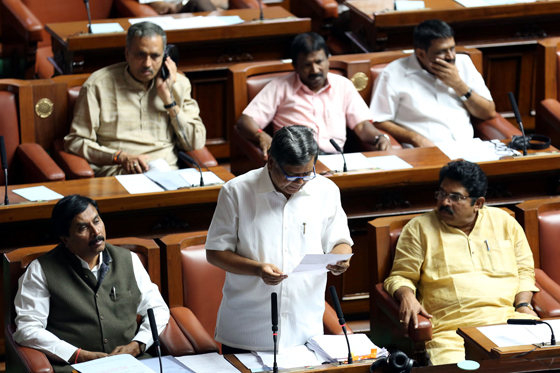
Bengaluru, Sep 23: The Karnataka Assembly passed a unanimous resolution on Friday asking the Government not to release Cauvery water to Tamil Nadu.
1shettar

The Assembly, at the end of the special session, decided to retain Cauvery water to meet the drinking water needs of the state.

Earlier, a resolution asking the government to use Cauvery water only to meet drinking water needs was moved at a special session of the Karnataka Assembly, implying that the state cannot comply with the latest Supreme Court direction to release water to Tamil Nadu.
Highlighting the "state of acute distress", the resolution, endorsed by all parties, said it was "imperative" that the government ensures that no water from the present storages be drawn "save and except" for meeting drinking water needs of villages and towns in the Cauvery basin and Bengaluru.

The interests of the inhabitants of the state are likely to be gravely jeopardised if water in the four reservoirs in the Cauvery basin was in anyway reduced other than for meeting the drinking water needs of the people in the Cauvery basin, including the entire city of Bengaluru, it said.
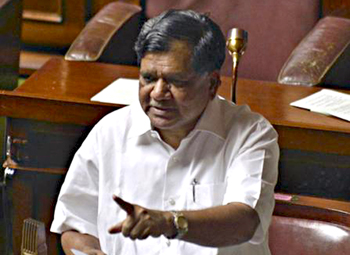
The resolution moved in English by Opposition BJP leader Jagadish Shettar and in Kannada by Y S V Datta of JDS did not refer to the apex Court direction to the state to release 6,000 cusecs of Cauvery water per day to Tamil Nadu but is expected to put Karnataka on a collision course with the judiciary.

The Cauvery Supervisory Committee had on September 19 asked Karnataka to release 3,000 cusecs per day from September 21 to 30, but the apex court had on September 20 doubled the quantum to 6,000 cusecs from September 21 to 27 after Tamil Nadu pressed for water to save its samba paddy crop.

It had also directed the Centre to constitute within four weeks the Cauvery Water Management Board as directed by Cauvery Water Disputes Tribunal in its award.

Backed by an all party meeting mandate, the state cabinet had on Tuesday decided to defer the release of water to Tamil Nadu and convene a day's legislature session amid escalating row between the two neighbouring states.
The resolution noted that in the water year 2016-17, there has been an acute situation of distress but the shortfall in the basin will become known only at the end of the season on January 31, 2017.

It pointed out that the combined storage in four reservoirs in the Cauvery basin -- Krishnaraja Sagar, Hemavathy, Harangi and Kabini -- had reached "alarmingly low levels at 27 TMC ft."

"It is now resolved to direct that in this state of acute distress, it is imperative that the government ensures that no water from the present storages be drawn save and except for meeting drinking water requirements of villages and towns in the cauvery basin and Bengaluru," it said.

Earlier post:

All party resolution asks govt to use water only for drinking needs

Bengaluru, Sep 23: A resolution asking government to use Cauvery water only to meet drinking water needs was moved at a special session of the Karnataka Assembly today, implying that the state cannot comply with the latest Supreme Court direction to release water to Tamil Nadu.

jagadeshHighlighting the "state of acute distress", the resolution, endorsed by all parties, said it was "imperative" that the government ensures that no water from the present storages be drawn "save and except" for meeting drinking water needs of villages and towns in the Cauvery basin and Bengaluru.

The interests of the inhabitants of the state are likely to be gravely jeopardised if water in the four reservoirs in the Cauvery basin was in anyway reduced other than for meeting the drinking water needs of the people in the Cauvery basin, including the entire city of Bengaluru, it said.

 The resolution moved in English by Opposition BJP leader Jagadish Shettar and in Kannada by Y S V Datta of JDS did not refer to the apex Court direction to the state to release 6,000 cusecs of Cauvery water per day to Tamil Nadu but is expected to put Karnataka on a collision course with the judiciary.

The Cauvery Supervisory Committee had on September 19  asked Karnataka to release 3,000 cusecs per day from September 21 to 30, but the apex court had on September 20 doubled the quantum to 6,000 cusecs from September 21 to 27 after Tamil Nadu pressed for water to save its samba paddy crop.

It had also directed the Centre to constitute within four weeks the Cauvery Water Management Board as directed by Cauvery Water Disputes Tribunal in its award.

Backed by an all party meeting mandate, the state cabinet had on Tuesday decided to defer the release of water to Tamil Nadu and convene a day's legislature session amid escalating row between the two neighbouring states.

 The resolution noted that in the water year 2016-17, there has been an acute situation of distress but the shortfall in the basin will become known only at the end of the season on January 31, 2017.

It pointed out that the combined storage in four reservoirs in the Cauvery basin -- Krishnaraja Sagar, Hemavathy, Harangi and Kabini -- had reached "alarmingly low levels at 27 TMC ft."

"It is now resolved to direct that in this state of acute distress, it is imperative that the government ensures that no water from the present storages be drawn save and except for meeting drinking water requirements of villages and towns in the cauvery basin and Bengaluru," it said.


Comments

TRUE INDIAN
 - 
Friday, 23 Sep 2016

Modi is busy with bolochistan.
Modi fooled everybody, but gain there are some fools, chanting har har Modi.

TRUE INDIAN
 - 
Friday, 23 Sep 2016

before they were Shouting Bharat mata. Now what happened Is
tamil nadu not Bharat mata.

Bharat mata all Drama.

Add new comment

  • Coastaldigest.com reserves the right to delete or block any comments.
  • Coastaldigset.com is not responsible for its readers’ comments.
  • Comments that are abusive, incendiary or irrelevant are strictly prohibited.
  • Please use a genuine email ID and provide your name to avoid reject.
News Network
January 29,2020

Newsroom, Jan 29: Karnataka’s capital has earned the unwelcome distinction of global capital of traffic congestion. According to a report by TomTom, the Netherlands-based global provider of navigation, traffic and map products, Bengaluru beat 415 other cities across 57 countries to earn the title of world's most traffic congested city in 2019.

“Bengaluru takes the top spot this year with drivers in the southern Indian city expecting to spend an average of 71% extra travel time stuck in traffic," TomTom said in the ninth edition of its annual Traffic Index.

Three other Indian cities, namely, Mumbai, Pune and New Delhi are also ranked in the 2019 edition of TomTom’s Traffic Index of the world’s most traffic-congested cities. 

The report released on Tuesday ranks cities by the average time added to a trip. TomTom index also includes details on when congestion is heaviest and lightest, how highways compare with surface streets, and how much time drivers wasted waiting for other drivers to get out of their way.

Following closely on the heels of Bengaluru is Manila, Philippines, with the similar 71% traffic congestion. Among the top five worst traffic affected cities are Mumbai and Pune from India at the fourth and fifth place respectively, while Bogota, Colombia is on third spot.

Delhi, the national capital of India is on the 8th spot, while Moscow (Russia), Lima (Peru), Istanbul (Turkey) and Jakarta (Indonesia) are on 6th, 7th, 9th and 10th spot respectively.

Mumbai recorded a 65% traffic congestion with 9th September, 2019 being the worst day. On an average, a Mumbaikar lost 209 hours in traffic congestion. Pune has 59% traffic congestion with 2nd August, 2019 being the worst day. 193 hours are lost due to congestion. Delhi, on the other hand, has 56% traffic congestion. 23rd October, 2019 was the worst day, while 190 hours are lost in traffic congestion.

Interestingly, among all the four Indian cities, Delhi has the most number of cars. Previous studies have concluded that Delhi has the best road conditions among the Metro cities of India.

If you are wondering what exactly the percentages mean, a 53% congestion level in Bangkok, for example, means that a trip will take 53% more time than it would during Bangkok’s baseline uncongested conditions.

TomTom calculates the baseline per city by analyzing free-flow travel times of all vehicles on the entire road network – recorded 24/7, 365 days a year. The report by Dutch navigation and mapping company ranks cities by the average time added to a trip. It also includes details on when congestion is heaviest and lightest, and how much time drivers wasted waiting for other drivers to get out of their way.

Comments

Add new comment

  • Coastaldigest.com reserves the right to delete or block any comments.
  • Coastaldigset.com is not responsible for its readers’ comments.
  • Comments that are abusive, incendiary or irrelevant are strictly prohibited.
  • Please use a genuine email ID and provide your name to avoid reject.
News Network
April 13,2020

Bengaluru, Apr 13: Karnataka Pradesh Congress Committee (KPCC) President and former Minister D K Shivakumar has demanded resignation of Minister In-Charge of COVID-19 for his alleged irresponsible comment, despite holding a responsible post.

Mr Shivakumar's comments came after Dr Sudhakar on Sunday shared a picture of him and his children in a swimming pool, on Twitter with a caption, ''After a long time joined my children for swimming hope maintaining social distance here as well…hahaha.''

However, Dr Sudhakar deleted the tweet from his account, soon after he was criticised for sharing such a picture, when the country is facing a health crisis.

Comments

Add new comment

  • Coastaldigest.com reserves the right to delete or block any comments.
  • Coastaldigset.com is not responsible for its readers’ comments.
  • Comments that are abusive, incendiary or irrelevant are strictly prohibited.
  • Please use a genuine email ID and provide your name to avoid reject.
News Network
July 9,2020

Bengaluru, Jul 9: Alarmed over surging COVID-19 cases, the Karnataka government has decided to divide this tech city into containment zones to curb the spread of the pandemic, a state minister said on Thursday.

"The city will be divided into red, orange and yellow zones in commensurate with the number of Covid cases in them for containing the virus spread on war footing," Law and Parliamentary Affairs Minister J.C. Madhuswamy told reporters here.

Cabinet ministers representing assembly segments in the city will be in-charge of the zones to ensure the cases are curbed with strict enforcement of lockdown guidelines, especially wearing mask and maintaining social distancing by the people in the confinement areas.

"Chief Minister B.S. Yediyurappa has convened a meeting of ministers, MLAs, MPs and corporators of all the 198 civic wards across the city on Friday to discuss and draw an action plan to contain the pandemic," said Madhuswamy.

With 1,148 positive cases, the city''s Covid tally rose to 12,509 and active to 10,103, while 2,228 were discharged, including 418 on Wednesday, while 177 succumbed to the infection since March 9, with 23 in the last 24 hours.

"The Chief Minister ordered deploying more ambulances in the containment areas where cases have been spiking daily to rush Covid patients to the nearest hospital for immediate treatment," said Madhuswamy.

The city civic corporation -- Bruhat Bengaluru Mahanagara Palike (BBMP) --has increased the containment zones to 3,181 due to more cases spiking, with southern and western suburbs accounting for most infections.

"The containment zones are concentrated more in the city''s southern and western suburbs. Active cases doubled over the last 8 days and shot up to a whopping 12,509 from 4,555 on June 30," an official said.

Refuting graft charges by opposition Congress leader Siddaramaiah in the purchase of medical equipment for treatment of Covid patients, Madhuswamy said the state government had not spent more than Rs 600 crore so far.

"We are running a government. Not a private office. We will give account. He (Siddaramaiah) is welcome to check the accounts and verify the documents," asserted the minister.

In a related development, the cabinet also approved an ordinance to increase the state contingency fund to Rs 500 crore from Rs 80 crore for the Covid-19 induced economic relief measures announced by the chief minister in June.

Comments

Add new comment

  • Coastaldigest.com reserves the right to delete or block any comments.
  • Coastaldigset.com is not responsible for its readers’ comments.
  • Comments that are abusive, incendiary or irrelevant are strictly prohibited.
  • Please use a genuine email ID and provide your name to avoid reject.