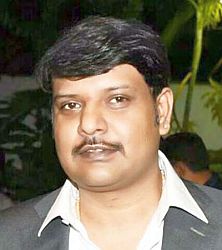
Karnataka CM Siddaramaiah's son Rakesh, 39, dies in Belgium hospital

[email protected] (CD Network)
July 30, 2016

rakesh

Bengaluru, Jul 30: Karnataka Chief Minister Siddaramaiah's son, Rakesh Siddaramaiah, died of multi-organ failure at a hospital in Belgium today, official sources said.

Rakesh, aged 39, was undergoing treatment at Antwerp University Hospital in Brussels, where he was rushed on Tuesday after he developed sudden pancreas-related complications. He had been on a European tour with his friends since last week.

Rakesh, the eldest son of Siddaramaiah, who had an acute pancreatic ailment for long, was critical but stable before his condition worsened, the sources said.

"Rakesh died of multi-organ failure," the Chief Minister's Office said. Siddaramaiah, his wife and second son Yathindra Siddaramaiah, a doctor, and the family doctor were in Brussels to be with Rakesh. He is survived by his wife, a son and daughter.

He had met with an accident 15 years ago, when he suffered injuries to his pancreas.
Soon after his son was hospitalised, Siddaramaiah had spoken to External Affairs Minister Sushma Swaraj, seeking her assistance in getting the best treatment for his son in Belgium.

Also Read:

Son dead, but they' show no sympathy for CM Siddaramaiah

I can understand Siddu's pain, I too have lost my son: Sadananda Gowda

Comments

praddeep
 - 
Sunday, 31 Jul 2016

Ee lost one good ruller

praddeep
 - 
Sunday, 31 Jul 2016

We lost one good leader

Abdul Latif
 - 
Saturday, 30 Jul 2016

Condolence......

Zuhair
 - 
Saturday, 30 Jul 2016

Shocking, heartfelt condolence to the Siddaramaiah and family

gunakara
 - 
Saturday, 30 Jul 2016

Really Shocking, RIP Sir.

Rikaz
 - 
Saturday, 30 Jul 2016

RIP
So sad! May God help CM and his family to over come the grief....

Siddu fan
 - 
Saturday, 30 Jul 2016

Rakesh sir was supposed to contest in next assembly polls. His demise is a great loss not only for Siddairamaiah family but also for Congress, party, Kuruba community and entire Karnataka. RIP

AAPian
 - 
Saturday, 30 Jul 2016

RIP. very tragic news.

Add new comment

  • Coastaldigest.com reserves the right to delete or block any comments.
  • Coastaldigset.com is not responsible for its readers’ comments.
  • Comments that are abusive, incendiary or irrelevant are strictly prohibited.
  • Please use a genuine email ID and provide your name to avoid reject.
News Network
January 21,2020

Jan 21: Info Edge (India)'s shareholding in Zomato reduces to 22.71%; Uber receives 9.99% stake in Zomato.

Info Edge (India) announced that Zomato Media (Zomato) has signed a definitive agreement to acquire Uber's food delivery business in India (Uber) in an all-stock transaction, which gives Uber 9.99% ownership in Zomato.

Uber Eats in India will discontinue operations and direct restaurants, delivery partners, and users of the Uber Eats apps to the Zomato platform, effective 21 January 2020.

Upon closing of said acquisition, the company's shareholding in Zomato shall stand reduced to about 22. 71 % on fully converted & diluted basis.

Comments

Add new comment

  • Coastaldigest.com reserves the right to delete or block any comments.
  • Coastaldigset.com is not responsible for its readers’ comments.
  • Comments that are abusive, incendiary or irrelevant are strictly prohibited.
  • Please use a genuine email ID and provide your name to avoid reject.
Agencies
July 13,2020

Bengaluru, July 13: The Karnataka government today announced the cancellation of I PUC supplementary examinations across the state. 

Primary and Secondary Education minister S Suresh Kumar announced that the government took the decision in the wake of rising cases of Covid-19 and re-introduction of the lockdown. According to sources in the education department, as many as 60,000 students were supposed to appear for the examination.

Previously, the state government had decided to hold these exams at the college level in every district and publish the results by 30 July. However, the government has withdrawn even that arrangement and completely cancelled the exams. 

According to the minister, all the students who failed in the I PUC examination, shall also be promoted to II PUC. "The students who have attended all the subjects but unable to pass the exams will also be promoted to the next class," Suresh Kumar said.

However, those who missed out on the exams due to health reasons or failed in the examinations will be given a small test at the time of commencing classes for II PUC to assess their learning ability at the college level, according to the minister. "Only those students who missed out on the examination due to shortage of attendance will not be promoted to the next class," Suresh Kumar clarified.

Comments

Add new comment

  • Coastaldigest.com reserves the right to delete or block any comments.
  • Coastaldigset.com is not responsible for its readers’ comments.
  • Comments that are abusive, incendiary or irrelevant are strictly prohibited.
  • Please use a genuine email ID and provide your name to avoid reject.
News Network
April 2,2020

The current physical distancing guidelines provided by the World Health Organisation (WHO) and by the US Centers for Disease Control and Prevention (CDC) may not be adequate to curb the coronavirus spread, according to a research which says the gas cloud from a cough or sneeze may help virus particles travel up to 8 metres. The research, published in the Journal of the American Medical Association, noted that the the current guidelines issued by the WHO and CDC are based on outdated models from the 1930s of how gas clouds from a cough, sneeze, or exhalation spread.

Study author, MIT associate professor Lydia Bourouiba, warned that droplets of all sizes can travel 23 to 27 feet, or 7-8 metres, carrying the pathogen.

According to Bourouiba, the current guidelines are based on "arbitrary" assumptions of droplet size, "overly simplified", and "may limit the effectiveness of the proposed interventions" against the deadly pandemic.

 She explained that the old guidelines assume droplets to be one of two categories, small or large, taking short-range semi-ballistic trajectories when a person exhales, coughs, or sneezes.

However based on more recent discoveries, the MIT scientist said, sneezes and coughs are made of a puff cloud that carries ambient air, transporting within it clusters of droplets of a wide range of sizes.

Bourouiba warned that this puff cloud, with ambient air entrapped in it, can offer the droplets moisture and warmth that can prevent it from evaporation in the outer environment.

"The locally moist and warm atmosphere within the turbulent gas cloud allows the contained droplets to evade evaporation for much longer than occurs with isolated droplets," she said.

"Under these conditions, the lifetime of a droplet could be considerably extended by a factor of up to 1000, from a fraction of a second to minutes," the researcher explained in the study.

The MIT scientist, who has researched the dynamics of coughs and sneezes for years, added that these droplets settle along the trajectory of a cough or sneeze contaminating surfaces, with their residues staying suspended in the air for hours.

"Even when maximum containment policies were enforced, the rapid international spread of COVID-19 suggests that using arbitrary droplet size cutoffs may not accurately reflect what actually occurs with respiratory emissions, possibly contributing to the ineffectiveness of some procedures used to limit the spread of respiratory disease," Bourouiba wrote in the study


Comments

Add new comment

  • Coastaldigest.com reserves the right to delete or block any comments.
  • Coastaldigset.com is not responsible for its readers’ comments.
  • Comments that are abusive, incendiary or irrelevant are strictly prohibited.
  • Please use a genuine email ID and provide your name to avoid reject.