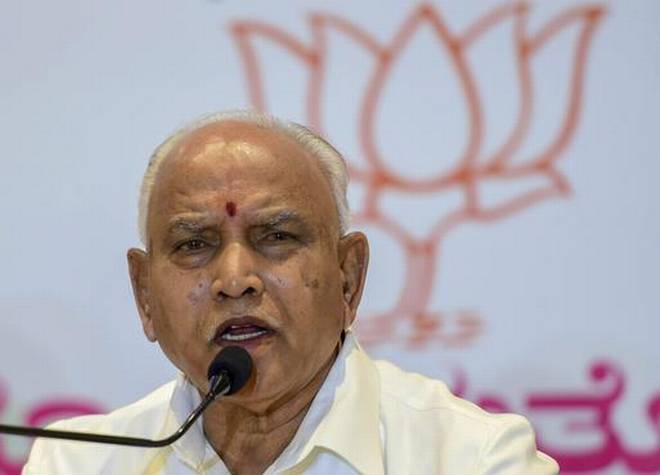
Karnataka crisis: Governor sets second deadline; asks CM to finish floor test today itself

Agencies
July 19, 2019

Bengaluru, Jul 19: Karnataka Governor Vajubhai Vala on Friday sent a letter to Chief Minister H.D. Kumaraswamy to prove his government's majority in the assembly before 6pm on Friday. Vala set the second deadline for the floor test, after the first deadline went in vain on Friday without the assembly taking up the voting on the motion of confidence to decide the fate of his shaky government.

"I have respect for the governor. But the second love letter from the governor has hurt me. He only came to know about horse trading 10 days ago?" Kumaraswamy asked, flashing photos of B.S. Yeddyurappa's personal staff Santosh reportedly boarding a plane with independent MLA H. Nagesh. "I leave the decision on the floor test to you (the speaker). It won't be directed by Delhi. I request you to protect me from the letter sent by the governor." A debate on the motion of confidence is currently underway at the Vidhana Soudha.

Earlier in the day, as the deadline neared, the ruling coalition vociferously questioned the governor's power to issue such a direction, with Kumaraswamy citing a Supreme Court verdict that a governor cannot act as ombudsman of the legislature.

Kumaraswamy said he would not criticise the governor and requested Speaker K.R. Ramesh Kumar to decide whether the governor can set a deadline. As the assembly clock struck 1.30 pm, the BJP insisted on a division on the confidence motion moved by Kumaraswamy on Thursday in accordance with the letter by the governor to him. The House was then adjourned till 3 pm amid ruckus with both BJP and Congress members locked in heated exchanges over the governor's role.

Vala had on Thursday set the 1.30pm deadline for proving the majority within hours after the voting on the confidence motion could not take place with the speaker adjourning the day's proceedings in the assembly. The governor, in his letter to the chief minister, had observed resignation of 15 MLAs of the ruling JD(S)-Congress and withdrawal of support by two independents "prima facie" indicated Kumaraswamy had lost confidence of the House.

Meanwhile, the Karnataka Congress moved the Supreme Court on Friday contending that its July 17 order on the resignation of 15 rebel Congress-JD(S) MLAs was coming in the way of the party issuing whip to its legislators in the ongoing trust vote. The application filed by Karnataka Congress chief Dinesh Gundu Rao sought clarification on the order which said the 15 rebel MLAs cannot be compelled to participate in the ongoing assembly proceedings, saying that the direction compromises with the party's right to issue whip.

It said the apex court order "whittles down" the power of a political party to issue whip to its MLAs as it has a constitutional right to do so and the court can't restrict that.

Further, in the plea, it is stated that the order was passed without involving the Congress legislature party, which presently has 79 MLAs in the Karnataka assembly.

The Congress, while referring to a judgement delivered by a constitution bench of the apex court, submitted that any interpretation of the order of July 17 "which whittles down the power of a political party to issue a whip to its legislators would be in the teeth of the provisions of the Tenth Schedule of the Constitution". It sought a clarification that the direction passed on July 17 does not refer to the rights of a political party to proceed under the Tenth Schedule.

Comments

Wellwisher
 - 
Saturday, 20 Jul 2019

Another Gujrati of nagpur HQ  spoiling our states future. MLA are choosed by state citizens and not by any Desh Drohi  anti India organizations. With money power and muscle power they are spoiling our country's unity

then very soon all these will be kicked out from our state is the real fact.


Jai Hind !

Add new comment

  • Coastaldigest.com reserves the right to delete or block any comments.
  • Coastaldigset.com is not responsible for its readers’ comments.
  • Comments that are abusive, incendiary or irrelevant are strictly prohibited.
  • Please use a genuine email ID and provide your name to avoid reject.
Ram Puniyani
January 14,2020

In the beginning of January 2020 two very disturbing events were reported from Pakistan. One was the attack on Nankana Sahib, the holy shrine where Sant Guru Nanak was born. While one report said that the place has been desecrated, the other stated that it was a fight between two Muslim groups. Prime Minister of Pakistan Imran Khan condemned the incident and the main accused Imran Chisti was arrested. The matter related to abduction and conversion of a Sikh girl Jagjit Kaur, daughter of Pathi (One who reads Holy Guru Granth Sahib in Gurudwara) of the Gurudwara. In another incident one Sikh youth Ravinder Singh, who was out on shopping for his marriage, was shot dead in Peshawar.

While these condemnable attacks took place on the Sikh minority in Pakistan, BJP was quick enough to jump to state that it is events like this which justify the Citizenship Amendment Act (CAA). Incidentally CAA is the Act which is discriminatory and relates to citizenship with Religion, which is not as per the norms of Indian constitution. There are constant debates and propaganda that population of Hindus has come down drastically in Pakistan and Bangla Desh. Amit Shah, the Home minister stated that in Pakistan the population of Hindus has come down from 23% at the time of partition to 3.7% at present. And in Bangla Desh it has come down from 22% to present 8%.

While not denying the fact that the religious minorities are getting a rough deal in both these countries, the figures which are presented are totally off the mark. These figures don’t take into consideration the painful migrations, which took place at the time of partition and formation of Bangla Desh later. Pakistan census figures tell a different tale. Their first census was held in 1951. As per this census the overall percentage of Non Muslim in Pakistan (East and West together) was 14.2%, of this in West Pakistan (Now Pakistan) it was 3.44 and in Eat Pakistan it was 23.2. In the census held in Pakistan 1998 it became 3.72%. As far as Bangla Desh is concerned the share of Non Muslims has gone down from 23.2 (1951) to 9.6% in 2011.

The largest minority of Pakistan is Ahmadis, (https://minorityrights.org/country/pakistan/) who are close to 4 Million and are not recognised as Muslims in Pakistan. In Bangla Desh the major migrations of Hindus from Bangla Desh took place in the backdrop of Pakistan army’s atrocities in the then East Pakistan.

As far as UN data on refugees in India it went up by 17% between 2016-2019 and largest numbers were from Tibet and Sri Lanka.  (https://www.un.org/en/development/desa/population/migration/publication…)

The state of minorities is in a way the index of strength of democracy. Most South Asian Countries have not been able to sustain democratic values properly. In Pakistan, the Republic began with Jinnah’s classic speech where secularism was to be central credo of Pakistan. This 11th August speech was in a way what the state policy should be, as per which people of all faiths are free to practice their religion. Soon enough the logic of ‘Two Nation theory” and formation of Pakistan, a separate state for Muslim took over. Army stepped in and dictatorship was to reign there intermittently. Democratic elements were suppressed and the worst came when Zia Ul Haq Islamized the state in collusion with Maulanas. The army was already a strong presence in Pakistan. The popular formulation for Pakistan was that it is ruled by three A’s, Army, America and Allah (Mullah).

Bangla Desh had a different trajectory. Its very formation was a nail in the coffin of ‘two nation theory’; that religion can be the basis of a state. Bangla Desh did begin as a secular republic but communal forces and secular forces kept struggling for their dominance and in 1988 it also became Islamic republic. At another level Myanmar, in the grip of military dictatorship, with democratic elements trying to retain their presence is also seeing a hard battle. Democracy or not, the army and Sanghas (Buddhist Sang has) are strong, in Myanmar as well. The most visible result is persecution of Rohingya Muslims.

Similar phenomenon is dominating in Sri Lanka also where Budhhist Sanghas and army have strong say in the political affairs, irrespective of which Government is ruling. Muslim and Christian minorities are a big victim there, while Tamils (Hindus, Christians etc.) suffered the biggest damage as ethnic and religious minorities. India had the best prospect of democracy, pluralism and secularism flourishing here. The secular constitution, the outcome of India’s freedom struggle, the leadership of Gandhi and Nehru did ensure the rooting of democracy and secularism in a strong way.

India so far had best democratic credentials amongst all the south Asian countries. Despite that though the population of minorities rose mainly due to poverty and illiteracy, their overall marginalisation was order of the day, it went on worsening with the rise of communal forces, with communal forces resorting to identity issues, and indulging in propaganda against minorities.

While other South Asian countries should had followed India to focus more on infrastructure and political culture of liberalism, today India is following the footsteps of Pakistan. The retrograde march of India is most visible in the issues which have dominated the political space during last few years. Issues like Ram Temple, Ghar Wapasi, Love Jihad, Beef-Cow are now finding their peak in CAA.

India’s reversal towards a polity with religion’s identity dominating the political scene was nicely presented by the late Pakistani poetess Fahmida Riaz in her poem, Tum bhi Hum Jaise Nikle (You also turned out to be like us). While trying to resist communal forces has been an arduous task, it is becoming more difficult by the day. This phenomenon has been variously called, Fundamentalism, Communalism or religious nationalism among others. Surely it has nothing to do with the religion as practiced by the great Saint and Sufi traditions of India; it resorts mainly to political mobilization by using religion as a tool.

Comments

Ashi
 - 
Tuesday, 14 Jan 2020

If Malaysia implement similar NRC/CAA, India and China are the loser.

Add new comment

  • Coastaldigest.com reserves the right to delete or block any comments.
  • Coastaldigset.com is not responsible for its readers’ comments.
  • Comments that are abusive, incendiary or irrelevant are strictly prohibited.
  • Please use a genuine email ID and provide your name to avoid reject.
coastaldigest.com news network
July 27,2020

Bengaluru, Jul 27: Karnataka Chief Minister B.S. Yediyurappa, on completion of one year of his government, today said coronavirus hampered his development plans for the state.

He said the state will not see a lockdown again "at any cost".

"Due to coronavirus we couldn't meet people's expectations but now we'll not have lockdown in Karnataka at any cost. In future we're going to fulfill whatever I announced in Budget. If necessary we'll take loans and complete all development work," said Yediyurappa.

"Covid has hampered development plans of Karnataka, lot more needs to be done, i'm committed to providing an able, stable government," he said.

Arrangements were made for virtual celebrations to mark the one-year anniversary of Yediyurappa government at Banquet Hall in Vidhana Soudha in Bengaluru. Social distancing was maintained at the event.

A record 5,199 new COVID-19 cases and 82 deaths were reported from Karnataka on Sunday, the state's health department said.

With this, the total number of coronavirus cases in the state stands at 96,141, including 58,417 active cases and 35,838 recoveries.

So far, 1,878 deaths have been reported from Karnataka. Karnataka is the only state to have over 50,000 active cases with overall tally below 1 lakh.

Comments

Add new comment

  • Coastaldigest.com reserves the right to delete or block any comments.
  • Coastaldigset.com is not responsible for its readers’ comments.
  • Comments that are abusive, incendiary or irrelevant are strictly prohibited.
  • Please use a genuine email ID and provide your name to avoid reject.
News Network
July 26,2020

Bengaluru, Jul 26: A year-long probe by Coffee Day Enterprises Ltd (CDEL) has found that its late founder V G Siddhartha routed Rs 2,693 crore out of the company to Mysore Amalgamated Coffee Estates Ltd (MACEL), another privately-owned entity of him.

The MACEL owes Rs 3,535 crore to subsidiaries of Coffee Day Enterprises as of July 31, 2019 of which only Rs 842 crore was accounted.

"Therefore, a sum of Rs 2,693 crore is the incremental outstanding that needs to be addressed," said the report of an investigation headed by Ashok Kumar Malhotra, a retired DIG of Central Bureau of Investigation (CBI) and assisted by law firm Agastya Agastya Legal.

Siddhartha was found dead in early August 2019, and many suspected that he had committed suicide.

Steps are being taken by subsidiaries of CDEL for recovery of dues from MACEL, the company said.

"The board authorised the Chairman to appoint an ex-judge of the Supreme Court or the High Court, or any other person of eminence, to suggest and oversee actions for recovery of the dues from MACEL and to help on any other associated matters," it said in regulatory filings at stock exchanges late on Friday.

The probe further gives clean chits to the Income Tax Department and the private equity firms who Siddhartha in his parting letter had alleged of harassment.

"We have not been provided with any documentary evidence to draw an inference that there may have been any advertent or inadvertent harassment from the Income Tax Department," said the probe report.

The probe also highlighted severe liquidity crunch at CDEL in the build-up to Siddhartha's death.

A committee supported by senior professionals was formed to protect the interest of all stakeholders. CDEL said the debt levels which were about Rs 7,200 crore on March 31, 2019 have been brought down significantly by Rs 4,000 crore. The present debt of the group is around Rs 3,200 crore.

"The disinvestment process in the group continues and we are confident to have effective solution to all stakeholders," it said.

Comments

Add new comment

  • Coastaldigest.com reserves the right to delete or block any comments.
  • Coastaldigset.com is not responsible for its readers’ comments.
  • Comments that are abusive, incendiary or irrelevant are strictly prohibited.
  • Please use a genuine email ID and provide your name to avoid reject.