Karnataka expat jailed in Saudi for social media post; Sushma takes up case

March 22, 2016

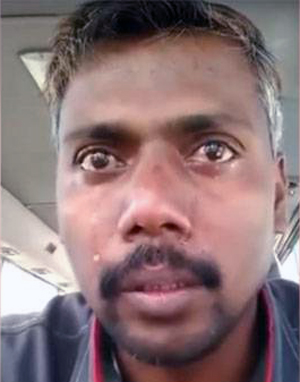
New Delhi, Mar 22: Abdul Sattar Makandar, a truck driver, working in Saudi Arabia from the past 23 months has been arrested on the charges of 'spreading misinformation' on social media.

Recently, a video of an Indian migrant worker crying his eyes out due to bad working conditions in Saudi Arabia went viral on social media. The worker has been jailed, according to activists.abdul

Abdul Sattar Makandar, a truck driver and a native of Dandeli, Uttara Kannada district in Karnataka, has been working in the Arab country from the past 23 months. He had applied for leave to come home over five months ago.

In the video, Abdul talks about his grievances and explains how his employer is not giving him proper salary or any money for food.

The video was posted by Indian human rights activist Kundan Srivastava but was soon taken down after the legal representatives of Al Suroor United Group approached him. "I urge the Government, Minister of External Affairs Sushma Swaraj, PMO India Narendra Modi to help Abdul Sattar Makandar to come back to India," said Srivastava, reports The Independent.

Abdul was arrested on charges of 'spreading misinformation' on social media

The Al Suroor United Group has denied the claims made by Abdul and said all workers were entitled leave after two years of service and he is six weeks away from it.

Sushma Swaraj, External Affairs Minister, tweeted about this issue and this is what the Ministry is doing-


Comments

Zahoor Ahmed
 - 
Wednesday, 23 Mar 2016

Thanks Sushmaji

Add new comment

  • Coastaldigest.com reserves the right to delete or block any comments.
  • Coastaldigset.com is not responsible for its readers’ comments.
  • Comments that are abusive, incendiary or irrelevant are strictly prohibited.
  • Please use a genuine email ID and provide your name to avoid reject.
News Network
April 29,2020

Washington, Apr 29: A US government panel on Tuesday called for India to be put on a religious freedom blacklist over a "drastic" downturn under Prime Minister Narendra Modi, triggering a sharp rebuttal from New Delhi.

The US Commission on International Religious Freedom recommends but does not set policy, and there is virtually no chance the State Department will follow its lead on India, an increasingly close US ally.

In an annual report, the bipartisan panel narrowly agreed that India should join the ranks of "countries of particular concern" that would be subject to sanctions if they do not improve their records.

"In 2019, religious freedom conditions in India experienced a drastic turn downward, with religious minorities under increasing assault," the report said.

It called on the United States to impose punitive measures, including visa bans, on Indian officials believed responsible and grant funding to civil society groups that monitor hate speech.

The commission said that Modi's Hindu nationalist government, which won a convincing election victory last year, "allowed violence against minorities and their houses of worship to continue with impunity, and also engaged in and tolerated hate speech and incitement to violence."

It pointed to comments by Home Minister Amit Shah, who notoriously referred to mostly Muslim migrants as "termites," and to a citizenship law that has triggered nationwide protests.

It also highlighted the revocation of the autonomy of Kashmir, which was India's only Muslim-majority state, and allegations that Delhi police turned a blind eye to mobs who attacked Muslim neighborhoods in February this year.

Coronavirus state-wise India update: Total number of confirmed cases, deaths on April 29

The Indian government, long irritated by the commission's comments, quickly rejected the report.

"Its biased and tendentious comments against India are not new. But on this occasion, its misrepresentation has reached new levels," foreign ministry spokesman Anurag Srivastava said.

"We regard it as an organization of particular concern and will treat it accordingly," he said in a statement.

The State Department designates nine "countries of particular concern" on religious freedom -- China, Eritrea, Iran, Myanmar, North Korea, Pakistan, Saudi Arabia, Tajikistan and Turkmenistan.

The commission asked that all nine countries remain on the list. In addition to India, it sought the inclusion of four more -- Nigeria, Russia, Syria and Vietnam.

Pakistan, India's historic rival, was added by the State Department in 2018 after years of appeals by the commission.

In its latest report, the commission said that Pakistan "continued to trend negatively," voicing alarm at forced conversions of Hindus and other minorities, abuse of blasphemy prosecutions and a ban on the Ahmadi sect calling itself Muslim.

India's citizenship law fast-tracks naturalization for minorities from neighbouring countries -- but not if they are Muslim.

Modi's government says it is not targeting Muslims but rather providing refuge to persecuted people and should be commended.

But critics consider it a watershed move by Modi to define the world's largest democracy as a Hindu nation and chip away at independent India's founding principle of secularism.

Tony Perkins, the commission's chair, called the law a "tipping point" and voiced concern about a registry in the northeastern state of Assam, under which 1.9 million people failed to produce documentation to prove that they were Indian citizens before 1971 when mostly Muslim migrants flowed in during Bangladesh's bloody war of independence.

"The intentions of the national leaders are to bring this about throughout the entire country," Perkins told an online news conference.

"You could potentially have 100 million people, mostly Muslims, left stateless because of their religion. That would be, obviously, an international issue," said Perkins, a Christian activist known for his opposition to gay rights who is close to President Donald Trump's administration.

Three of the nine commissioners dissented -- including another prominent Christian conservative, Gary Bauer, who voiced alarm about India's direction but said the ally could not be likened to non-democracies such as China.

"I am deeply concerned that this public denunciation risks exactly the opposite outcome than the one we all desire," Bauer said.

Trump, who called for a ban on Muslim immigration to the US when he ran for president, hailed Modi on a February visit to New Delhi.


Comments

Add new comment

  • Coastaldigest.com reserves the right to delete or block any comments.
  • Coastaldigset.com is not responsible for its readers’ comments.
  • Comments that are abusive, incendiary or irrelevant are strictly prohibited.
  • Please use a genuine email ID and provide your name to avoid reject.
News Network
February 4,2020

New Delhi: The Ministry of Home Affairs of Government of India today clarified to the Lok Sabha in a written reply that the so called “Love Jihad” is not defined under the extant laws and no such cases have been reported by any central agency.

It was ministry’s formal response to questions about whether the central government is aware of the observation of Kerala High Court that there is no case of Love Jihad in Kerala.

“The term ‘Love Jihad’ is not defined under the extant laws. No such case of ‘Love Jihad’ has been reported by any of the central agencies. However, two cases from Kerala involving interfaith marriages have been investigated by the NIA,” said the reply.

Communal and anti-Muslim political outfits backed by a section of media often use the term “Love Jihad” to accuse Muslims of marrying Hindu and Christian girls and then forcing them to change religion. Dr Hadiya’s conversion was also termed ‘love jihad’ by the BJP and media. The Supreme Court finally ruled that it wasn’t.

In January 2020, an influential Catholic Church in Kerala had said that “love jihad is a reality” and alleged that scores of women from Christian community from the southern state were being lured into the trap of Islamic State and used in terror activities.

The Viswa Hindu Parishad (VHP) had welcomed the Church statement and called for a united fight against ‘Love Jihad’ in Kerala Society.

The response comes weeks after the MHA, responding to an RTI query, said it has "no information" concerning the 'Tukde Tukde Gang' -- a term that has been used a number of times by PM Narendra Modi and Home Minister Amit Shah to attack opponents.

The RTI application was filed by activist Saket Gokhle on December 26 last year. In his RTI application, Saket Gokhle said Home Minister "Amit Shah addressed a public event in New Delhi, and in his address said, 'The Tukde Tukde Gang of Delhi needs to be taught a lesson and punished'." Gokhle's RTI asked for details of the 'Tukde Tukde Gang'.

The home ministry, in its reply to Saket Gokhle's RTI application, said, "Ministry of Home Affairs has no information concerning tukde-tukde gang."

Comments

Add new comment

  • Coastaldigest.com reserves the right to delete or block any comments.
  • Coastaldigset.com is not responsible for its readers’ comments.
  • Comments that are abusive, incendiary or irrelevant are strictly prohibited.
  • Please use a genuine email ID and provide your name to avoid reject.
News Network
March 5,2020

Mangaluru, Mar 5: As many as 29 police officers and personnel were examined by Udupi Deputy Commissioner G Jagadeesha, head of the magisterial enquiry into the police firing in the city in December 2019 which killed two anti- Citizenship (Amendment) Act (CAA) protesters.

A total of 176 police personnel have been directed to present their evidence before the magistrate for the enquiry.

ACPs K U Belliappa and Kodandarama presented his evidence on Wednesday, while ACP (central sub division) M Jagdish and ACP (traffic) M Manjunatha Shetty submitted their evidencein writing.

The next hearing is slated to be held on March 9 when statements of 41 officers including DCP (law and order) Arunangshu Giri will be recorded.

City police commissioner P S Harsha has been asked to submit his evidence on March 12, Jagadeesha said.

The enquiry report is to be submitted to the government on March 23.

Jagadeesha said he will seek an extension in the case of any delay in the recording of evidences.

Two people - Nausheen and Jaleel - were killed in the firing on December 19, 2019 during the protests here against the CAA.

The Karnataka government had decided to hold a CID probe and a magisterial enquiry into the incident.

Comments

Add new comment

  • Coastaldigest.com reserves the right to delete or block any comments.
  • Coastaldigset.com is not responsible for its readers’ comments.
  • Comments that are abusive, incendiary or irrelevant are strictly prohibited.
  • Please use a genuine email ID and provide your name to avoid reject.