


Karnataka fears massive revenue loss after currency chaos

November 16, 2016

Bengaluru, Nov 16: The Centre's move to demonetize high value currency notes threatens to derail Karnataka's revenue collection this financial year. Officials fear that the state might miss its revenue target by at least Rs 5,000-Rs 15,000 crore for the current fiscal. The move has already affected liquor sales, property transactions, and sale of new and used vehicles.
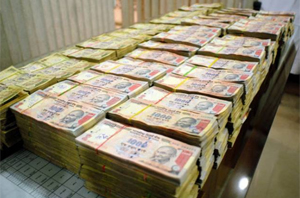
Untitled-1"We are still assessing the impact and will get a clear picture by the weekend. We are certainly expecting some impact,'' said ISN Prasad, additional chief secretary, state finance department. "The government's revenues have taken a severe beating following the demonetization move. Whatever taxes were supposed to come to the state, including commercial taxes, sales taxes and all the revenues have been hampered. It will certainly have a huge impact on this fiscal's tax collection," said another finance department official.

The government's excise department has been the worst hit. The sale of foreign liquor has come down drastically in the past few days. A senior excise department official said: "Most of the excise revenue come from the sale of Indian Manufactured Foreign Liquor. Officials at government outlets have claimed that the sale has gone down by at least 50%."

The government had fixed an ambitious revenue target of Rs 16,510 crore for the excise department this year following a 25% hike in taxes on liquor. The government has collected only about Rs 7,500 crore so far. "People have stopped buying liquor, especially the expensive ones, due to shortage of high-value currency," added the official.

The revenue target for the stamps and registration department had been fixed at a higher Rs 9,100 crore for the current fiscal. Most of this amount comes from revenue layouts through stamp duty and property registration, which has completely stopped since November 8. "Bengaluru is a big market for secondary real estate, which traditionally works on 60:40 white and black money ratio. Ban on transaction of black money has badly hit property registration," said a senior official of the stamps and registration department.

Comments

Althaf
 - 
Wednesday, 16 Nov 2016

Not only in karnataka All over india it will effect.

Skazi
 - 
Wednesday, 16 Nov 2016

let the Govt reduce the Value of lands for registration purposes... then the govt will get back the revenues.... as the buyers will come forward in the real estate business .....
The govt does not apply its mind while fixing the land values ... It goes by survey no.... whether the site has road connection or not,, the govt value is same for all sites ....

Add new comment

  • Coastaldigest.com reserves the right to delete or block any comments.
  • Coastaldigset.com is not responsible for its readers’ comments.
  • Comments that are abusive, incendiary or irrelevant are strictly prohibited.
  • Please use a genuine email ID and provide your name to avoid reject.
Agencies
June 30,2020

Washington, Jun 30: Researchers in China have discovered a new type of swine flu that is capable of triggering a pandemic, according to a study published Monday in the US science journal PNAS.

Named G4, it is genetically descended from the H1N1 strain that caused a pandemic in 2009.

It possesses "all the essential hallmarks of being highly adapted to infect humans," say the authors, scientists at Chinese universities and China's Center for Disease Control and Prevention.

The researchers then carried out various experiments including on ferrets, which are widely used in flu studies because they experience similar symptoms to humans -- principally fever, coughing and sneezing. 

G4 was observed to be highly infectious, replicating in human cells and causing more serious symptoms in ferrets than other viruses.

Tests also showed that any immunity humans gain from exposure to seasonal flu does not provide protection from G4.

According to blood tests which showed up antibodies created by exposure to the virus, 10.4 percent of swine workers had already been infected.

The tests showed that as many as 4.4 percent of the general population also appeared to have been exposed.

The virus has therefore already passed from animals to humans but there is no evidence yet that it can be passed from human to human -- the scientists' main worry.

"It is of concern that human infection of G4 virus will further human adaptation and increase the risk of a human pandemic," the researchers wrote.

The authors called for urgent measures to monitor people working with pigs.

"The work comes as a salutary reminder that we are constantly at risk of new emergence of zoonotic pathogens and that farmed animals, with which humans have greater contact than with wildlife, may act as the source for important pandemic viruses," said James Wood, head of the department of veterinary medicine at Cambridge University.

A zoonotic infection is caused by a pathogen that has jumped from a non-human animal into a human.

Comments

Add new comment

  • Coastaldigest.com reserves the right to delete or block any comments.
  • Coastaldigset.com is not responsible for its readers’ comments.
  • Comments that are abusive, incendiary or irrelevant are strictly prohibited.
  • Please use a genuine email ID and provide your name to avoid reject.
News Network
January 5,2020

Dharwad, Jan 5: Hameed Khan, a noted sitar exponent and descendant of renowned sitarist Ustad Rahimat Khan, passed away at his residence here on Saturday night.

He was 69 and survived by wife Fareeda, son Mohsin Khan (a musician) and daughter Arma Khan (an artist).

Hameed Khan taught sitar at Karnatak University’s college of music and also at the family-run music school ‘Bharateeya Sangeeta Vidyalaya’. Several of his disciples who were foreign nationals helped him establish ‘Kalakeri Sangeet Vidyalaya’ at Kalakeri village near Dharwad, which provides music lessons to the deprived.

Comments

Add new comment

  • Coastaldigest.com reserves the right to delete or block any comments.
  • Coastaldigset.com is not responsible for its readers’ comments.
  • Comments that are abusive, incendiary or irrelevant are strictly prohibited.
  • Please use a genuine email ID and provide your name to avoid reject.
News Network
February 28,2020

Kozhikode, Feb 28: Nearly 200 Umrah pilgrims from Kerala were deboarded from their flights to Saudi Arabia from Calicut international Airport here on Thursday after the gulf nation enforced a temporary ban on foreigners seeking to visit the holy cities of Makkah and Madina, following coronavirus scare.

Saudi Arabia halted travel to the holiest sites in Islam over fears about a viral epidemic just months ahead of the annual hajj pilgrimage, a move that came as the Mideast has over 240 confirmed cases of the new coronavirus.

According to Airports Authority of India officials, as many as 84 of passengers from the Saudi Airlines and 104 from the Spice Jet Airlines were denied permission to board the flights and travel to Saudi Arabia.

However, other passengers bound to Jeddah were permitted to fly, they said.

A private tour operator here said two batches of 40 pilgrims each were denied permission to travel to Makkah to perform Umrah on February 27.

Umrah is an Islamic pilgrimage that can be performed at any time of year.

"The pilgrims were denied entry by the two airlines, Spice Jet scheduled at 05.30 hrs and Saudi Airlines at 1130 hrs," Naiful Akbar, a travel agent said.

The Airport Authority of India sources said, "the passengers were asked to alight by the Spice Jet airline staff following an instruction received by them."

Comments

Add new comment

  • Coastaldigest.com reserves the right to delete or block any comments.
  • Coastaldigset.com is not responsible for its readers’ comments.
  • Comments that are abusive, incendiary or irrelevant are strictly prohibited.
  • Please use a genuine email ID and provide your name to avoid reject.