


Karnataka fears massive revenue loss after currency chaos

November 16, 2016

Bengaluru, Nov 16: The Centre's move to demonetize high value currency notes threatens to derail Karnataka's revenue collection this financial year. Officials fear that the state might miss its revenue target by at least Rs 5,000-Rs 15,000 crore for the current fiscal. The move has already affected liquor sales, property transactions, and sale of new and used vehicles.
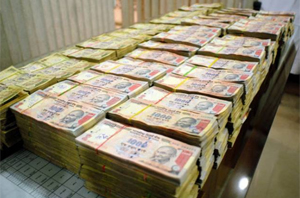
Untitled-1"We are still assessing the impact and will get a clear picture by the weekend. We are certainly expecting some impact,'' said ISN Prasad, additional chief secretary, state finance department. "The government's revenues have taken a severe beating following the demonetization move. Whatever taxes were supposed to come to the state, including commercial taxes, sales taxes and all the revenues have been hampered. It will certainly have a huge impact on this fiscal's tax collection," said another finance department official.

The government's excise department has been the worst hit. The sale of foreign liquor has come down drastically in the past few days. A senior excise department official said: "Most of the excise revenue come from the sale of Indian Manufactured Foreign Liquor. Officials at government outlets have claimed that the sale has gone down by at least 50%."

The government had fixed an ambitious revenue target of Rs 16,510 crore for the excise department this year following a 25% hike in taxes on liquor. The government has collected only about Rs 7,500 crore so far. "People have stopped buying liquor, especially the expensive ones, due to shortage of high-value currency," added the official.

The revenue target for the stamps and registration department had been fixed at a higher Rs 9,100 crore for the current fiscal. Most of this amount comes from revenue layouts through stamp duty and property registration, which has completely stopped since November 8. "Bengaluru is a big market for secondary real estate, which traditionally works on 60:40 white and black money ratio. Ban on transaction of black money has badly hit property registration," said a senior official of the stamps and registration department.

Comments

Althaf
 - 
Wednesday, 16 Nov 2016

Not only in karnataka All over india it will effect.

Skazi
 - 
Wednesday, 16 Nov 2016

let the Govt reduce the Value of lands for registration purposes... then the govt will get back the revenues.... as the buyers will come forward in the real estate business .....
The govt does not apply its mind while fixing the land values ... It goes by survey no.... whether the site has road connection or not,, the govt value is same for all sites ....

Add new comment

  • Coastaldigest.com reserves the right to delete or block any comments.
  • Coastaldigset.com is not responsible for its readers’ comments.
  • Comments that are abusive, incendiary or irrelevant are strictly prohibited.
  • Please use a genuine email ID and provide your name to avoid reject.
News Network
January 31,2020

Mangaluru, Jan 31: Mahesh Vikram Hegde, the co-founder of website 'Postcard News', known for spreading fake news on behalf of Sangh Parivar, was taken aback when he was asked to sing 'Vande Mataram' to prove his patriotism by a group of women activists at Mangaluru International Airport.

The video of the incident which occurred on Friday, days after editor-in-chief and co-founder of Republic TV Arnab Goswami was heckled by comedian Kunal Kamra on a flight, went viral on social media within hours.

Hegde was spotted by social activist Kavitha Reddy, and other young orators – Najma Nazeer and Amulya Leona – at the airport where he was waiting to board a plane to Bengaluru.

In a video, the three women are seen coercing Hegde to sing 'Vande Mataram' and prove his patriotism. In another video being circulated, the women are heard telling the journalist that he is getting an opportunity to become a 'hero' from 'zero' if he sings 'Vande Mataram.' However, he refused to open his mouth.

Reddy is seen asking Hegde whether he knew the time when Nathuram Godse assassinated Mahatma Gandhi.

Hegde was arrested in 2018 for posting a fake news aimed at creating communal conflict.

Comments

Add new comment

  • Coastaldigest.com reserves the right to delete or block any comments.
  • Coastaldigset.com is not responsible for its readers’ comments.
  • Comments that are abusive, incendiary or irrelevant are strictly prohibited.
  • Please use a genuine email ID and provide your name to avoid reject.
News Network
February 28,2020

Bengaluru, Feb 28: Historian S. Shettar, 85, breathed his last early on February 28 in Bengaluru. He was suffering from respiratory problems and was hospitalised for over a week.

Shettar was known for his multi-disciplinary work, encompassing linguistics, epigraphy, anthropology, the study of religions and art history. He had extensively worked on the Jain practice of ritual death in Karnataka and Asoka edicts. He had studied and compiled early edicts in Kannada and worked extensively on the growth of Kannada language down the ages.

Born in 1935 at Hampasagara, Ballari district, he went on to study at Cambridge University and started his career as a Professor of History at Karnatak University, Dharwad, his alma mater. He later headed the National Museum Institute of the History of Art, Conservation and Museology in 1978 and Indian Council for Historical Research in 1996. He was also a visiting professor at the National Institute of Advanced Studies, Bengaluru.

He was a bilingual historian who wrote in English for most of his career, but started writing in Kannada in later years. In the last two decades, he developed a keen interest in linguistics and wrote multiple books on classical Kannada and Prakrit. His 2007 book “Shangam Tamilagam” is considered a seminal work in the study of the early period of Dravidian languages. It won him Bhasha Samman from Central Sahitya Akademi. He later wrote two works on Halegannada, classical Kannada. His most recent work was “Prakrita Jagadvalaya” in 2018.

Comments

Add new comment

  • Coastaldigest.com reserves the right to delete or block any comments.
  • Coastaldigset.com is not responsible for its readers’ comments.
  • Comments that are abusive, incendiary or irrelevant are strictly prohibited.
  • Please use a genuine email ID and provide your name to avoid reject.
News Network
April 23,2020

Bengaluru, Apr 23: The Karnataka government on Wednesday promulgated 'The Karnataka Epidemic Diseases Ordinance 2020' that provides the state with a power to seal borders, restrict essential services and punish those attacking public servants and damaging public property.

The Ordinance comes after violence in Padarayanapura when the police and BBMP officials were attacked while they tried to take some secondary contacts of a deceased COVID-19 patient into quarantine on April 19.

The Ordinance, which was promulgated after the Centre's guidelines in this regard, said, "The offender shall be liable for a penalty of twice the value of public or private property damaged as determined by the Deputy Commissioner after an inquiry."

It further said that if the penalty is not paid by the offender, then the amount shall be recovered under provisions of the Karnataka Land Revenue Act, 1964. The Deputy Commissioner can even attach the property of such offender in due course.

Also, abetment of offence would attract imprisonment of up to two years and a penalty of Rs 10,000 or both.

"No person shall commit or attempt to commit or instigate, incite or otherwise abet the commission of offence to cause loss or damage to any public or private property in any area when restrictions and regulations are in force to contain any epidemic disease," the Ordinance said.

Whoever contravenes such provision shall be punished with imprisonment for a term which shall not be less than six months, but may extend to three years and with fine which may extend to Rs 50,000, it added.

On Wednesday, the Centre brought an Ordinance to end violence against health workers, making it a cognisable and non-bailable offence with imprisonment up to seven years for those found guilty.

"We have brought an Ordinance under which any attack on health workers will be a cognisable and non-bailable offence. In the case of grievous injuries, the accused can be sentenced from six months to seven years. They can be penalised from Rs 1 lakh to Rs 5 lakhs," Union Minister Prakash Javadekar briefed media after Cabinet meeting.

Javadekar said that an amendment will be made to the Epidemic Diseases Act, 1897 and ordinance will be implemented.
This comes amid nationwide lockdown in the wake of COVID-19.

Comments

Add new comment

  • Coastaldigest.com reserves the right to delete or block any comments.
  • Coastaldigset.com is not responsible for its readers’ comments.
  • Comments that are abusive, incendiary or irrelevant are strictly prohibited.
  • Please use a genuine email ID and provide your name to avoid reject.