


Karnataka fears massive revenue loss after currency chaos

November 16, 2016

Bengaluru, Nov 16: The Centre's move to demonetize high value currency notes threatens to derail Karnataka's revenue collection this financial year. Officials fear that the state might miss its revenue target by at least Rs 5,000-Rs 15,000 crore for the current fiscal. The move has already affected liquor sales, property transactions, and sale of new and used vehicles.
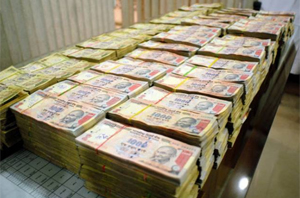
Untitled-1"We are still assessing the impact and will get a clear picture by the weekend. We are certainly expecting some impact,'' said ISN Prasad, additional chief secretary, state finance department. "The government's revenues have taken a severe beating following the demonetization move. Whatever taxes were supposed to come to the state, including commercial taxes, sales taxes and all the revenues have been hampered. It will certainly have a huge impact on this fiscal's tax collection," said another finance department official.

The government's excise department has been the worst hit. The sale of foreign liquor has come down drastically in the past few days. A senior excise department official said: "Most of the excise revenue come from the sale of Indian Manufactured Foreign Liquor. Officials at government outlets have claimed that the sale has gone down by at least 50%."

The government had fixed an ambitious revenue target of Rs 16,510 crore for the excise department this year following a 25% hike in taxes on liquor. The government has collected only about Rs 7,500 crore so far. "People have stopped buying liquor, especially the expensive ones, due to shortage of high-value currency," added the official.

The revenue target for the stamps and registration department had been fixed at a higher Rs 9,100 crore for the current fiscal. Most of this amount comes from revenue layouts through stamp duty and property registration, which has completely stopped since November 8. "Bengaluru is a big market for secondary real estate, which traditionally works on 60:40 white and black money ratio. Ban on transaction of black money has badly hit property registration," said a senior official of the stamps and registration department.

Comments

Althaf
 - 
Wednesday, 16 Nov 2016

Not only in karnataka All over india it will effect.

Skazi
 - 
Wednesday, 16 Nov 2016

let the Govt reduce the Value of lands for registration purposes... then the govt will get back the revenues.... as the buyers will come forward in the real estate business .....
The govt does not apply its mind while fixing the land values ... It goes by survey no.... whether the site has road connection or not,, the govt value is same for all sites ....

Add new comment

  • Coastaldigest.com reserves the right to delete or block any comments.
  • Coastaldigset.com is not responsible for its readers’ comments.
  • Comments that are abusive, incendiary or irrelevant are strictly prohibited.
  • Please use a genuine email ID and provide your name to avoid reject.
IBTimes
June 3,2020

A pregnant elephant in Kerala ate a pineapple, which was filled with country-made bombs or dynamites. It led to a painful death as the elephant was pregnant and died standing in the Velliyar River in Palakkad in Kerala. People are venting out their anger and concerns all over social media about the gruesome incident.

Yesterday, it was reported that the pregnant elephant was killed after locals allegedly fed her a pineapple stuffed with crackers.

However, when International Business Times, India, reached out to Dr Ab Qayoom, who is an Indian Forest Service Officer, for his comments about what actually must have happened, we got to know that no one have fed the pineapple to the elephant.

Snares used for keeping animals away

Dr Qayoom stated that pineapples filled with firecrackers are used as a snare for catching wild boars. He said, "No one would have fed the pineapple to the elephant. The animal must have found it lying somewhere and must have consumed it herself not knowing what lies ahead for her."

He also stated a second possibility. He said, "Some people actually do such insane things as they consider wild animals as a threat to their property and life. Such incidents do happen at places where wild animals create problems for human beings."

Snares are often found around farms, coffee plantations

He added that wild boars often spoil crops and people use snares as a way to protect their farms and crops. This year, it was reported that the government would soon permit farmers with licensed firearms to shoot wild boars that wander into their lands. The problem is that people do not limit their snares to only wild boars and there have been several incidents when tigers, leopards and other animals have fallen prey to these haphazardly placed snares around farms, coffee farms and wildlife corridors.

Elephant kept standing in water before dying

The pregnant wild elephant originally belonged to Silent Valley National Park (SVNP), Palakkad. As the elephant died, she remained calm despite being in excruciating pain. The elephant kept standing and died at Velliyar River, Malappuram, with its trunk in the water.

The elephant was 15-years-old and was probably getting some relief as it stood in the water after her tongue and mouth exploded. Mohan Krishnan, Section Forest Officer, Nilambur, shared the sad incident on his Facebook page where he had acted as the Rapid Response Team official to rescue the elephant, which was in distress.

When a postmortem examination was carried out, it was learnt that the reason for the elephant's death was due to asphyxia where water had got into her lungs and trachea. Dr David Abraham, Assistant Forest Veterinary Officer, Thrissur, carried out the postmortem.

Dr David said, "I have so far done more than 250 postmortems of elephants alone in my more than two decades career. But this was the first time I was so moved as I could hold the foetus of the baby in my hands. Initially, none of us was aware that the elephant was pregnant. After seeing her heart, I spotted the amniotic fluid and realized that she was pregnant."

Claim reviewed :

Fact checking Palakkad elephant death

Claimed By :

Twitter, Facebook and Youtube posts.

Fact Check :

False

https://t.co/uR4p7rDUli

Comments

Peta
 - 
Thursday, 4 Jun 2020

Still killed by human, what this media want to justify the killing will be filing suit on this media soon...u will be in trouble soon.

MOHAMMED MOOLU…
 - 
Wednesday, 3 Jun 2020

A very cruel, henious and inhumen act. This culprit should be with murder and punished sevierly. 

Add new comment

  • Coastaldigest.com reserves the right to delete or block any comments.
  • Coastaldigset.com is not responsible for its readers’ comments.
  • Comments that are abusive, incendiary or irrelevant are strictly prohibited.
  • Please use a genuine email ID and provide your name to avoid reject.
News Network
May 8,2020

New Delhi, May 8: After deadly styrene gas leak in Visakhapatnam, Union Chemicals and Fertilisers Minister D V Sadananda Gowda urged all public and private chemical makers to exercise caution and care while reopening their plants.

Union Environment Ministry and State Pollution Control Boards have also issued separate directives to all companies to take extreme precaution while restarting their units that remained suspended due to the lockdown imposed to contain the spread of COVID-19 in the country, he said.

There was a gas leak from LG Polymers plant at Visakhapatnam in the early hours on Thursday, causing 10 deaths and hundreds of people getting hospitalised.

"LG Polymers does not come under direct control of our ministry. However, we have asked all public and private chemicals manufacturers to exercise caution and care while reopening their plants," Gowda told PTI.

The minister said his officers are coordinating with the Andhra Pradesh government.

He further said LG Polymers, a multinational chemical company, had kept its unit ready for reopening after one and half month of lockdown. The unit started leaking at around 3.40 am on Thursday due to pressure.

"The toxic gas leak has affected both people and animals. Around 850 people have been hospitalised," Gowda said, adding that measures have been taken to control the situation at the plant site and final updates are awaited.

At present, Indian chemicals market size is about USD 163 billion, which is only three per cent of the global chemical industry of USD 5 trillion, as per the official data.

Comments

Add new comment

  • Coastaldigest.com reserves the right to delete or block any comments.
  • Coastaldigset.com is not responsible for its readers’ comments.
  • Comments that are abusive, incendiary or irrelevant are strictly prohibited.
  • Please use a genuine email ID and provide your name to avoid reject.
News Network
February 28,2020

Bengaluru, Feb 28: Historian S. Shettar, 85, breathed his last early on February 28 in Bengaluru. He was suffering from respiratory problems and was hospitalised for over a week.

Shettar was known for his multi-disciplinary work, encompassing linguistics, epigraphy, anthropology, the study of religions and art history. He had extensively worked on the Jain practice of ritual death in Karnataka and Asoka edicts. He had studied and compiled early edicts in Kannada and worked extensively on the growth of Kannada language down the ages.

Born in 1935 at Hampasagara, Ballari district, he went on to study at Cambridge University and started his career as a Professor of History at Karnatak University, Dharwad, his alma mater. He later headed the National Museum Institute of the History of Art, Conservation and Museology in 1978 and Indian Council for Historical Research in 1996. He was also a visiting professor at the National Institute of Advanced Studies, Bengaluru.

He was a bilingual historian who wrote in English for most of his career, but started writing in Kannada in later years. In the last two decades, he developed a keen interest in linguistics and wrote multiple books on classical Kannada and Prakrit. His 2007 book “Shangam Tamilagam” is considered a seminal work in the study of the early period of Dravidian languages. It won him Bhasha Samman from Central Sahitya Akademi. He later wrote two works on Halegannada, classical Kannada. His most recent work was “Prakrita Jagadvalaya” in 2018.

Comments

Add new comment

  • Coastaldigest.com reserves the right to delete or block any comments.
  • Coastaldigset.com is not responsible for its readers’ comments.
  • Comments that are abusive, incendiary or irrelevant are strictly prohibited.
  • Please use a genuine email ID and provide your name to avoid reject.