



Karnataka Govt firm on Tipu Jayanti despite intelligence warning

October 29, 2016

Bengaluru, Oct 29: The Kannada and Culture department on Friday decided to go ahead with the Tipu Jayanti celebrations on November 10. The state-level celebrations will be organised in Bengaluru.
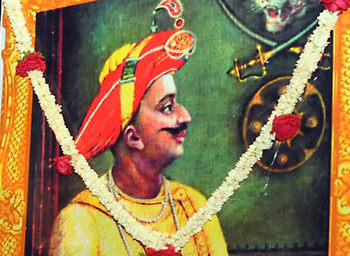
tipuThis was decided at a meeting convened by Kannada and Culture Minister Umashree in Bengaluru.

According to official sources, the meeting was convened after the state intelligence wing reportedly advised the government not to organise the Jayanti, especially after the incidents of violence witnessed in Kodagu last year.

Two persons, including a member of the Vishwa Hindu Parishad, had died in the clashes between two groups.

However, Chief Minister Siddaramaiah is supposed to have instructed officials to go ahead with the Jayanti celebrations. Also, unlike last year, this year, the Kannada and Culture department has been vested with the responsibility of organising the event. Last year, the Directorate of Minorities had organised the celebration.

To invite Hindu seers

Umashree had convened the meeting, which was attended by Ministers Tanveer Sait and Roshan Baig as well as the heads of the Wakf Board and Urdu Academy.

At the meeting, it was resolved to invite Hindu religious leaders, including seers Veerabhadra Channamalla of Nidumamidi Mutt, Sri Bharati Teertha of Sringeri Shankar Mutt and Vishwesha Teertha of Pejawar Mutt, in a bid to showcase that the Jayanti is not a “religious” event.

When contacted, Baig said that there were no reports from the intelligence wing. He said that the Nidumamidi Mutt seer would be the speaker, and efforts were on to contact other seers.

He argued that Tipu Jayanti is not a religious celebration. “We are keen that the Sringeri Mutt swami participates because till date the Mutt has carried on with the tradition ofSultan Aarti'. Tipu had helped restore the temple at Sringeri after it was plundered by the Marathas. He had even donated money and jewels to the temple,” Baig added.

RSS?to back protests against event

The RSS will oppose the government's plan to celebrate Tipu Jayanti and will support protests planned by members of the Sangha Parivar.

Addressing reporters, RSS?Kshetriya Sanchalak V?Nagaraj said Tipu was “intolerant and a bigot”. “He was an intolerant king. He killed innocent Kodavas. Several historians including Kirmani and Mutthanna have chronicled Tipu's religious hatred and bigotry,” he said, reports DHNS from Bengaluru .

Nagaraj said there was no demand from the Muslim community for holding Tipu Jayanti. “It is obvious that the government is organising Tipu Jayanti on November 10 with political interest in mind.”

The RSS has not organised any protest to oppose Tipu Jayanti. The RSS?will support protest rallies planned by various organisations in Chitradurga and Bengaluru on November 2 and 8 respectively, he said.

Roshan baig, Minister: We are keen that the Sringeri Mutt swami participates because till date the Mutt has carried on with the tradition ofSultan Aarti'. Tipu had helped restore the temple at Sringeri after it was plundered by the Marathas. He had even donated money and jewels to the temple.

Comments

Fairman
 - 
Sunday, 30 Oct 2016

Why and how to celebrate Jayanti.

In Islam, there is no such thing to celebrate birthday.
However there is no harm in remembering someone who was helpful.
I can suggest, don't spend for any statue, don't irrect any statue.
If you have such money, spend it for poor people, poor children. Islam does not sanction any wastage. Spend money for useful purpose, in the memory of such brave people.
In Gujrat state Mody spent huge money for Sardar Patel's statue, Marathis did the same in Maharashtra for Shivaji. The amount spent is 1000 of crore rupees.

Despite of difference of opinions of Tippu's attitude, it is true,

- He was brave, he is the first king to fight against British, he fought 4times. He participated in all wars. Not only that He became martyre in the war like a soldier.

- How many such kings have spent their life in this country or in other parts of this world.
- He Proved If we start resisting our enemy boldly, courageously, one day we can win.

- Therefore the spirit to fight against the British is his inspiration.

- Anyway we have so much approval from so many seers, swamees who admit Tippu was TOLERANT, All his ministers were Hindus.

Rashid
 - 
Saturday, 29 Oct 2016

What intelligent report says, instead of stopping program govt should investigate, and should take necessary actions, find out criminal mongers and punish them..

Asif
 - 
Saturday, 29 Oct 2016

Intelligence is filled with RSS backed people. this report is RSS activist motivated...dont believe Chaddi Intelligence reports. need to sck all RSS backed officers from government agencies.
Also note that, if any law & order disturbers from Chaddis ofcourse there is police department to face the situation.

Devanand
 - 
Saturday, 29 Oct 2016

this s all congress cheap politics, Muslims never celebrated any jayanthi.

Add new comment

  • Coastaldigest.com reserves the right to delete or block any comments.
  • Coastaldigset.com is not responsible for its readers’ comments.
  • Comments that are abusive, incendiary or irrelevant are strictly prohibited.
  • Please use a genuine email ID and provide your name to avoid reject.
Ram Puniyani
February 10,2020

Noam Chomsky is one of the leading peace workers in the world. In the wake of America’s attack on Vietnam, he brought out his classic formulation, ‘manufacturing consent’. The phrase explains the state manipulating public opinion to have the public approve of it policies—in this case, the attack of the American state on Vietnam, which was then struggling to free itself from French colonial rule.

In India, we are witness to manufactured hate against religious minorities. This hatred serves to enhance polarisation in society, which undermines India’s democracy and Constitution and promotes support for a Hindu nation. Hate is being manufactured through multiple mechanisms. For example, it manifests in violence against religious minorities. Some recent ghastly expressions of this manufactured hate was the massive communal violence witnessed in Mumbai (1992-93), Gujarat (2002), Kandhamal (2008) and Muzaffarnagar (2013). Its other manifestation was in the form of lynching of those accused of having killed a cow or consumed beef. A parallel phenomenon is the brutal flogging, often to death, of Dalits who deal with animal carcasses or leather.

Yet another form of this was seen when Shambhulal Regar, indoctrinated by the propaganda of Hindu nationalists, burned alive Afrazul Khan and shot the video of the heinous act. For his brutality, he was praised by many. Regar was incited into the act by the propaganda around love jihad. Lately, we have the same phenomenon of manufactured hate taking on even more dastardly proportions as youth related to Hindu nationalist organisations have been caught using pistols, while police authorities look on.

Anurag Thakur, a BJP minster in the central government recently incited a crowd in Delhi to complete his chant of what should happen to ‘traitors of the country...” with a “they should be shot”. Just two days later, a youth brought a pistol to the site of a protest at Jamia Millia Islamia university and shouted “take Azaadi!” and fired it. One bullet hit a student of Jamia. This happened on 30 January, the day Nathuram Godse had shot Mahatma Gandhi in 1948. A few days later, another youth fired near the site of protests against the CAA and NRC at Shaheen Bagh. Soon after, he said that in India, “only Hindus will rule”.

What is very obvious is that the shootings by those associated with Hindu nationalist organisations are the culmination of a long campaign of spreading hate against religious minorities in India in general and against Muslims in particular. The present phase is the outcome of a long and sustained hate campaign, the beginning of which lies in nationalism in the name of religion; Muslim nationalism and Hindu nationalism. This sectarian nationalism picked up the communal view of history and the communal historiography which the British introduced in order to pursue their ‘divide and rule’ policy.

In India what became part of “social common sense” was that Muslim kings had destroyed Hindu temples, that Islam was spread by force, and that it is a foreign religion, and so on. Campaigns, such as the one for a temple dedicated to the Hindu god Rama to be built at the site where the Babri masjid once stood, further deepened the idea of a Muslim as a “temple-destroyer”. Aurangzeb, Tipu Sultan and other Muslim kings were tarnished as the ones who spread Islam by force in the subcontinent. The tragic Partition, which was primarily due to British policies, and was well-supported by communal streams also, was entirely attributed to Muslims. The Kashmir conflict, which is the outcome of regional, ethnic and other historical issues, coupled with the American policy of supporting Pakistan’s ambitions of regional hegemony, (which also fostered the birth of Al-Qaeda), was also attributed to the Muslims.

With recurring incidents of communal violence, these falsehoods went on going deeper into the social thinking. Violence itself led to ghettoisation of Muslims and further broke inter-community social bonds. On the one hand, a ghettoised community is cut off from others and on the other hand the victims come to be presented as culprits. The percolation of this hate through word-of-mouth propaganda, media and re-writing of school curricula, had a strong impact on social attitudes towards the minorities.

In the last couple of decades, the process of manufacturing hate has been intensified by the social media platforms which are being cleverly used by the communal forces. Swati Chaturvedi’s book, I Am a Troll: Inside the Secret World of the BJP’s Digital Army, tells us how the BJP used social media to spread hate. Whatapp University became the source of understanding for large sections of society and hate for the ‘Other’, went up by leaps and bounds. To add on to this process, the phenomenon of fake news was shrewdly deployed to intensify divisiveness.

Currently, the Shaheen Bagh movement is a big uniting force for the country; but it is being demonised as a gathering of ‘anti-nationals’. Another BJP leader has said that these protesters will indulge in crimes like rape. This has intensified the prevalent hate.

While there is a general dominance of hate, the likes of Shambhulal Regar and the Jamia shooter do get taken in by the incitement and act out the violence that is constantly hinted at. The deeper issue involved is the prevalence of hate, misconceptions and biases, which have become the part of social thinking.

These misconceptions are undoing the amity between different religious communities which was built during the freedom movement. They are undoing the fraternity which emerged with the process of India as a nation in the making. The processes which brought these communities together broadly drew from Gandhi, Bhagat Singh and Ambedkar. It is these values which need to be rooted again in the society. The communal forces have resorted to false propaganda against the minorities, and that needs to be undone with sincerity.

Combating those foundational misconceptions which create hatred is a massive task which needs to be taken up by the social organisations and political parties which have faith in the Indian Constitution and values of freedom movement. It needs to be done right away as a priority issue in with a focus on cultivating Indian fraternity yet again.

Comments

Add new comment

  • Coastaldigest.com reserves the right to delete or block any comments.
  • Coastaldigset.com is not responsible for its readers’ comments.
  • Comments that are abusive, incendiary or irrelevant are strictly prohibited.
  • Please use a genuine email ID and provide your name to avoid reject.
News Network
June 10,2020

Bengaluru, Jun 10: The Karnataka government on Wednesday said coronavirus tests conducted in the state has crossed the four lakh mark, while the recovery rate remained at 44 per cent.

Sharing the daily COVID-19 bulletin on his Twitter handle, Medical Education Minister Dr K Sudhakar said till Tuesday 4,00,257 samples were tested in 71 COVID-19 testing labs across the state.

"Karnataka crossed 4 lakh tests mark on Tuesday. So far, we tested 4,00,257 samples in 71 #COVID19 testing labs across the state with a positivity rate of 1.4 per cent," he said.

He tweeted that the state's recovery rate remained healthy at 44 per cent with 2,605 discharges and 5,921 cumulative cases.

The minister said Karnataka was home to nearly a tenth of the total testing labs in India.

According to the Karnataka Health department, out of the four lakh odd samples tested, 3,87,027 samples were reported negative.

The total active cases in the state as on Tuesday evening were 3,248 whereas 66 people lost their lives to coronavirus so far.

Major contributors to the spike in COVID-19 cases in Karnataka are those who returned from Maharashtra recently.

Comments

Add new comment

  • Coastaldigest.com reserves the right to delete or block any comments.
  • Coastaldigset.com is not responsible for its readers’ comments.
  • Comments that are abusive, incendiary or irrelevant are strictly prohibited.
  • Please use a genuine email ID and provide your name to avoid reject.
News Network
January 25,2020

Bengaluru, Jan 25: The Karnataka government would hold a Global Investors' Meet (GIM 2020) in Bengaluru from November 3-5 to showcase the southern state's ecosystem for attracting investments from the world over, an official said on Friday.

"Our Chief Minister B.S. Yediyurappa held the first road show on the GIM at the 50th World Economic Forum (WEF) annual meeting, being held at Davos in Switzerland and invited global firms to participate in the 3-day event for investment opportunities," additional secretary P. Ravikumar told IANS.

At a curtain-raiser on "Invest Karnataka 2020" on Thursday, the BJP Chief Minister said the theme of the GIM would be "Innovate Now. Growth Forever" as the state had one of the best natural and human resources for investing in manufacturing, services and agriculture sectors and creating jobs.

"About 100 entrepreneurs, businessmen and heads of global firms participated in the roadshow to assess the state's industrial policies, incentives, infrastructure, tax system and its ease of doing business for investment potential," Ravikumar said.

Among the participants at the event were Swiss-India parliamentary group president Niklaus-Samuel Gugger, Uber Chief Executive Dara Khosrowshahi, General Electric (GE) executive William Cowan and heads of Gemini Corporation, Coca Cola, SAP Labs, Swiss Re and Mitsubishi Heavy Industries.

"Khosrowshahi discussed Uber's expansion plans in Bengaluru and assured the Chief Minister of investing more in the state. Cowen expressed interest in the development of healthcare, renewable energy and power distribution across the state through partnership with the state government," the official noted.

The US-based transnational firm (GE) has a large presence in Bengaluru with one its largest engineering and technology centres and two production plants.

"A Coca Cola executive told Yediyurappa that the soft beverage firm would initially invest $25 million in its plants in the state and enhance it to $200 million to benefit farmers and rural people with access to clean drinking water in their villages," Ravikumar said.

The Chief Minister also sought to know the investment or expansion plans of global firms present in the state, especially Bengaluru and assured their heads of the state support in creating hundreds of jobs and wealth.

About 100 members of the Indian delegation to the WEF, led by Union Commerce and Industries Minister Piyush Goyal, Confederation of Indian Industry (CII) director-general Chandrajit Bannerjee, Bharat Forge chairman Baba Kalyani, Kirloskar Systems Managing Director Vikram Kirloskar, also participated in the state's GIM roadshow.

State Industries Minister Jagdish Shettar, chief secretary T. M. Vijaya Bhaskar, additional chief secretary E.V. Ramana Reddy and industrial department principal secretary Gurav Gupta also attended the state event.

"Emiriti Lulu Group chairman M.A. Yusuf Ali discussed plans to invest $300 million (Rs 2,160 crore) in logistics, hospitality and health/wellness sectors across the state with Yediyurappa," said Ravikumar.

Ali, an NRI (non-resident Indian) migrated to the United Arab Emirates (UAE) from Kerala two decades ago and founded the Lulu Group at Abu Dhabi to operate a chain of hypermarkets and retail firms since 2000.

"The Chief Minister assured Ali of speedy approvals and incentives for investing in the state, with ease of doing business," the official said in an e-mail to IANS from the Swiss town.

Asserting that his proactive government would work overtime to facilitate global investments in the southern state, Yediyurappa said he was committed to create more jobs across sectors.

Dassault Systems executive Florene Verzelen told the chief minister about her company's plans to set up centres of excellence in smart manufacturing and smart cities in the southern state.

"The centres will train and equip the youth with skilled jobs in large corporations the world over," Ravikumar reiterated.

Yediyurappa apprised US aerospace behemoth Lockheed Martin executive Richard Ambrose of the ecosystem for aerospace and defence industry in the state, especially Bengaluru.

"I will soon visit Bengaluru to explore the possibilities of investing more in Karnataka and taking up research and development work," said Ambrose on the occasion.

A delegation from global automotive component maker Denso also called on the chief minister and interacted with the state delegation.

The Japanese firm has an excellence and research centre in New Delhi and a manufacturing unit at Nelamangala on the outskirts of Bengaluru.

Denso executive Hiroyuki Wakabasyi said he would visit Bengaluru soon to explore further investments in the state.

"Arcelor Mittal chairman Laxmi Mittal also met the chief minister and discussed his company's investment plans in the state," the official added.

Mittal backed out of setting up a steel plant in the state's northern region over a decade ago due to delays in acquiring land and mandatory approvals.

Drug maker Novo Nordisk chief executive Lars Fruergaard expressed readiness to work with the state government in taking up educative and awareness programmes for diabetic patients.

Comments

Add new comment

  • Coastaldigest.com reserves the right to delete or block any comments.
  • Coastaldigset.com is not responsible for its readers’ comments.
  • Comments that are abusive, incendiary or irrelevant are strictly prohibited.
  • Please use a genuine email ID and provide your name to avoid reject.