


Karnataka heading for fixed load-shedding

August 22, 2015

Bengaluru, Aug 22: The deficient southwest monsoon has led to reduced power production forcing the Sate to resort to scheduled load-shedding in the next few days.30BGPOWERCUT 1222570f
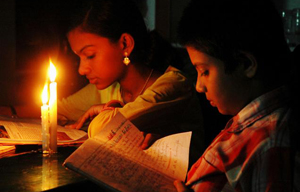
The State government may have directed Bengaluru Electricity Supply Company (Bescom) to ensure effective power supply till Saturday, the day of polling for the Bruhat Bengaluru Mahanagara Palike elections, but many areas of Bengaluru have been experiencing unscheduled power cuts for the past two days.

Bescom Managing Director Pankaj Kumar Pande, however, attributed them to local problems and denied that the company had resorted to load-shedding.

Kumar said the government had been drawing up a plan to conduct scheduled load-shedding, including in Bengaluru.

“Now that we have completed the process of power purchase from the open market, a plan will be chalked out for load-shedding in a day or two. It will be finalised based on the shortage and availability,” he said.

Meanwhile, escoms, including the Bescom, will spend an estimated Rs 3,400 crore to purchase power from the open market to tide over the power crisis resulting from the deficient monsoon.

They are expected to spend an estimated Rs 350 crore per month on short-term power purchases.

The Karnataka Electricity Regulatory Commission on Friday gave escoms the nod to purchase 1,000 mega watts (MW) of power at Rs 5.08 per unit till May 2016.

Currently, about 6,400 MW is available against the total requirement of 8,000 MW.

The power shortage is mainly to due to a decline in water levels of hydel reservoirs and recent outages at the Udupi Power Corporation Ltd and Ballari Thermal Power Station (BTPS).

The total capacity in the three major hydel reservoirs of Linganamakki, Mani and Supa is about 4,000 million units (MU) against 6,573 MU during the same period last year, said Additional Chief Secretary to the Energy Department P Ravi Kumar.

Due to these outages, the State is now generating hydel power at its full capacity of 40 MU, as against a normal of 12-14 MU during the monsoon season. The current storage at the reservoirs will be exhausted in about 100 days if this continues.

Of the two 500-MW BTPS units, one is under maintenance and another tripped on Thursday, said Karnataka Power Transmission Corporation Limited (KPTCL) Managing Director Jawaid Akhtar.

He added that the KPTCL had planned to procure 750 MW at Rs 5.08 per unit from this September 15 to May 2016.

Comments

Filomena
 - 
Wednesday, 16 Mar 2016

Asking questions are actually good thing if you are not understanding anything totally,
however this paragraph provides pleasant understanding even.

Here is my web-site - buy followers for your instagram account (Adrian: http://igboost.net/)

Add new comment

  • Coastaldigest.com reserves the right to delete or block any comments.
  • Coastaldigset.com is not responsible for its readers’ comments.
  • Comments that are abusive, incendiary or irrelevant are strictly prohibited.
  • Please use a genuine email ID and provide your name to avoid reject.
News Network
March 22,2020

Bengaluru, Mar 22: The Karnataka government on Sunday afternoon announced that 9 districts in the State will be under lock down till March 31, barring essential services. It also announced imposition of Section 144 across the state for 3 hours - between 9 p.m. (when the "Janata curfew" will end) to 12 midnight.

The nine COVID-19-affected districts are Bengaluru, Bengaluru Rural, Mysuru, Kodagu, Dakshina Kannada (Mangaluru), Dharwad, Belagavi, Kalaburgi and Chikkablapur.

Announcing these measures after attending a meeting chaired by Chief Minister B. S Yeddyurappa, Home Minister Basavaraj Bommai said that there will be no commercial activity in these districts till March 31.

Inter-district movement, including public transport will be restricted. "Public transport will not work across the state tomorrow too. Air conditioned buses will be stopped till March 31," he added. He also clarified that while public transport, including KSRTC, BMTC and Namma Metro, will be withdrawn, private transport services such as cabs and autos will continue to ply.

According to Mr. Bommai, the State government will put in place further measures next week depending on how the situation will unfold in the State and the neighbouring States.

"Government offices will be operational in the State, including in the nine COVID 19-affected districts. As per the current schedule, the legislature sessions will also continue. Pourakarmikas will be working at 50% strength," he added.

Comments

Add new comment

  • Coastaldigest.com reserves the right to delete or block any comments.
  • Coastaldigset.com is not responsible for its readers’ comments.
  • Comments that are abusive, incendiary or irrelevant are strictly prohibited.
  • Please use a genuine email ID and provide your name to avoid reject.
News Network
January 29,2020

Newsroom, Jan 29: Karnataka’s capital has earned the unwelcome distinction of global capital of traffic congestion. According to a report by TomTom, the Netherlands-based global provider of navigation, traffic and map products, Bengaluru beat 415 other cities across 57 countries to earn the title of world's most traffic congested city in 2019.

“Bengaluru takes the top spot this year with drivers in the southern Indian city expecting to spend an average of 71% extra travel time stuck in traffic," TomTom said in the ninth edition of its annual Traffic Index.

Three other Indian cities, namely, Mumbai, Pune and New Delhi are also ranked in the 2019 edition of TomTom’s Traffic Index of the world’s most traffic-congested cities. 

The report released on Tuesday ranks cities by the average time added to a trip. TomTom index also includes details on when congestion is heaviest and lightest, how highways compare with surface streets, and how much time drivers wasted waiting for other drivers to get out of their way.

Following closely on the heels of Bengaluru is Manila, Philippines, with the similar 71% traffic congestion. Among the top five worst traffic affected cities are Mumbai and Pune from India at the fourth and fifth place respectively, while Bogota, Colombia is on third spot.

Delhi, the national capital of India is on the 8th spot, while Moscow (Russia), Lima (Peru), Istanbul (Turkey) and Jakarta (Indonesia) are on 6th, 7th, 9th and 10th spot respectively.

Mumbai recorded a 65% traffic congestion with 9th September, 2019 being the worst day. On an average, a Mumbaikar lost 209 hours in traffic congestion. Pune has 59% traffic congestion with 2nd August, 2019 being the worst day. 193 hours are lost due to congestion. Delhi, on the other hand, has 56% traffic congestion. 23rd October, 2019 was the worst day, while 190 hours are lost in traffic congestion.

Interestingly, among all the four Indian cities, Delhi has the most number of cars. Previous studies have concluded that Delhi has the best road conditions among the Metro cities of India.

If you are wondering what exactly the percentages mean, a 53% congestion level in Bangkok, for example, means that a trip will take 53% more time than it would during Bangkok’s baseline uncongested conditions.

TomTom calculates the baseline per city by analyzing free-flow travel times of all vehicles on the entire road network – recorded 24/7, 365 days a year. The report by Dutch navigation and mapping company ranks cities by the average time added to a trip. It also includes details on when congestion is heaviest and lightest, and how much time drivers wasted waiting for other drivers to get out of their way.

Comments

Add new comment

  • Coastaldigest.com reserves the right to delete or block any comments.
  • Coastaldigset.com is not responsible for its readers’ comments.
  • Comments that are abusive, incendiary or irrelevant are strictly prohibited.
  • Please use a genuine email ID and provide your name to avoid reject.
News Network
March 25,2020

Bengaluru, Mar 25: In what is suspected to be the second COVID-19 death in Karnataka, a 70-year-old woman from Gouribidanuru, who was under house quarantine for the last one week has died at Rajiv Gandhi Hospital for Chest Diseases.

The woman, who had recently returned from the Mecca pilgrimage developed fever on Tuesday afternoon. She was rushed to hospital, where she died on Wednesday morning.

Health and Family Welfare officials said that the throat swab sample of the woman had been sent to the laboratory for testing and the result was expected to come by afternoon.

Since last week, at least three cases of COVID-19 positive had been reported in Gouribidanuru in Chikkaballpura district, about 80 kms from Bengaluru.

Most of the suspects and confirmed cases had returned from Makkah pilgrimage. Even the deceased woman was one of them and had been advised house quarantine.

On Tuesday morning, she developed fever and was shifted to Gouribidanur hospital and later to Chikkaballapura hospital. By evening, she was moved to Rajiv Gandhi hospital, where she died on Wednesday morning.

The Chikkaballapura district administration has proclaimed prohibitory orders in the locality. They have also taken the woman's family members for testing.

Comments

Add new comment

  • Coastaldigest.com reserves the right to delete or block any comments.
  • Coastaldigset.com is not responsible for its readers’ comments.
  • Comments that are abusive, incendiary or irrelevant are strictly prohibited.
  • Please use a genuine email ID and provide your name to avoid reject.