Karnataka: Highest sex ratio among Christians; Muslims overtake Hindus in literacy

[email protected] (News Network)
January 4, 2016

Bengaluru, Jan 4: Christians continued to record the highest sex ratio with the figure increasing from 1,030 in the 2001 Census to 1,049 in the 2011 Census. Although the child sex ratio was also high among Christians in the State, the growth was very marginal and it rose from 961 in 2001 census to 962 in 2011.

censusEconomist Sangeeta Kattimani, who compiled these data from the two Census reports and the Religion Data of the Census 2011 released now, said that the lowest sex ratio of 739 was reported among Buddhists.

In fact, the sex ratio among Buddhists had seen a steep fall from 907 in the 2001 Census to 739 in the 2011 Census. The child sex ratio among Buddhists decreased from 953 in 2001 to 949 in 2011.

Prof. Kattimani said that the sex ratio of other major religious groups, including Hindus, Muslims, Sikhs and Jains, showed a marginal improvement when compared to the 2001 and 2011 census and same was the case under the child sex ratio head. While the sex ratio of Hindus rose from 966 in 2001 to 972 in 2011, the sex ratio of Muslims rose from 957 in 2001 to 969 in 2011.

There was a marked improvement in the sex ratio of Sikhs — from 739 in 2001 to 803 in 2011 census. The sex ratio of Jains rose from 926 in 2001 to 951 in 2011.

The child sex ratio of Hindus saw a marginal increase from 945 in 2001 to 947 in 2011. Among Muslims, it was 945 in 2001 and 947 in 2011.

The child sex ratio of Sikhs saw an increase from 882 in 2001 to 913 in 2011. Similarly, the child sex ratio of Jains rose from 882 in 2001 to 913 in 2011. Prof. Kattimani said that the latest figures released by the Registrar General of Census provided some interesting data of literacy levels of different religious groups. While the literacy rate of Christians and Jains, who always placed education as a priority in their life, was high, the literacy level of Muslims was higher than Hindus in the State.

As much as 90.80 per cent of Christians were literate and it was 88.32 per cent among Jains in the State.

Surprisingly, a higher number of Muslims were literate when compared to Hindus in the State. The literacy percentage of Hindus was 74.36 per cent as per the 2011 census figures while it was 78.89 per cent among Muslims in the State.

Prof. Kattimani said that the literacy rate of Buddhists saw a record increase from 53.16 per cent in 2001 census to 76.11 per cent.

Comments

Gennie
 - 
Sunday, 4 Jun 2017

When I initially commented I clicked the \Notify me when new comments are added\" checkbox and
now each time a comment is added I get four emails with the same comment.
Is there any way you can remove me from that service? Thank you!

Here is my blog

CID
 - 
Monday, 4 Jan 2016

This is Congress sponsored survey to help to keep minorities happy. They must have counted Madarasa education for literacy.

True teller
 - 
Monday, 4 Jan 2016

Education is the light. It eradicates dark, enriches brotherhood, eradicates hunger, shows the light to prosper.

Where as Divine education is the mother of all educations, it shows how to live from birth to death so that success in this world and in the EVERLASTING other world which starts after the small life in this world.

The Quran has come for everyone in this planet regardless caste, creed, gender, rays.
It is God's message, not by human author. So, no errors or mistakes.

Learn and practice daringly, sincerely, it unites, makes humbles, brings equality. It is not just for Muslims, IT IS FOR ALL.

Once you know it, share with others.

Kushwant Bhat
 - 
Monday, 4 Jan 2016

Am really pathetic to see all these counting against Religious base, at least you all Buffoons must understand Bajrangi, Sudapi, or Caracos all are citizens of Hindustan that is fraud to all say Hindustani, not Bajrangi Mr Shetty, any way you all do not be happy or unhappy we Hindustanis must to achieve 100% literature then only be happy that Literacy is Fraud of our country blaming a Buffoon group these and that I am watching every day in \Great Pump well\" doing nothing Gang leaders keeping all Chelas around to loot and bring he never says go to school, destroy these Goons bring each and every citizen in top that's HINDUSTANI.
Jai Bharath."

Nityanada Shetty
 - 
Monday, 4 Jan 2016

Muslims overtook Hindus in literacy because Hindus are running behind Bajrangees :p

Hyda
 - 
Monday, 4 Jan 2016

Good. Quran's fist word is for education, study or learn.

Add new comment

  • Coastaldigest.com reserves the right to delete or block any comments.
  • Coastaldigset.com is not responsible for its readers’ comments.
  • Comments that are abusive, incendiary or irrelevant are strictly prohibited.
  • Please use a genuine email ID and provide your name to avoid reject.
coastaldigest.com news network
July 31,2020

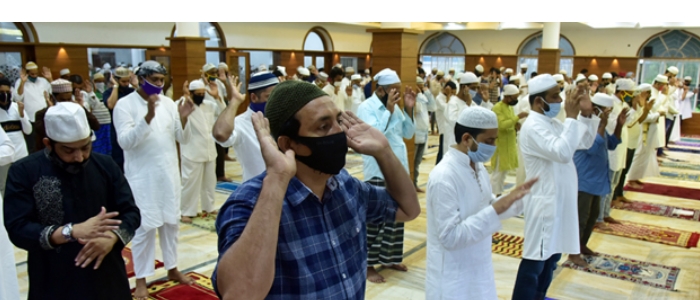
Mangaluru, Jul 31: Muslims across coastal districts of Dakshina Kannada, Udupi and Uttara Kannada today observed Eid al Adha following the safety guidelines issued by the government amidst covid-19 pandemic. 

While coastal Karnataka is celebrating the festival of sacrifice today, it will be observed in other parts of Karnataka and country tomorrow. 

Congregational Eid prayers were held in many mosques while ensuring physical distancing norms. Only 50 devotees were allowed in mosques. Children below 10 years of age and elders above 60 years of age weren’t allowed. 

Eidgahs in the region wore a deserted look as the government has temporarily prohibited prayers in the open grounds. The Eidgah at Lighthouse Hill in Mangaluru, which usually witnessed huge crowd during Eid celebrations, was also closed this time. 

As expected, the celebration this time was a low key thanks to the restrictions placed in tune with the threat of coronavirus infection.

Prayers were held in Kudroli’s Nadupalli and Bundar’s Zeenat Bakhsh Central mosque. All those who entered mosque were wearing masks. 

In Udupi city, Eid prayers were held at Jamia Masjid and other mosques with limited number of devotees. In Bhatkal took some of the mosques hosted Eid prayers with all precautionary measures.

Comments

Add new comment

  • Coastaldigest.com reserves the right to delete or block any comments.
  • Coastaldigset.com is not responsible for its readers’ comments.
  • Comments that are abusive, incendiary or irrelevant are strictly prohibited.
  • Please use a genuine email ID and provide your name to avoid reject.
News Network
February 23,2020

The euphoria over the claim that around 3,000 tonnes of gold reserves, worth Rs 12 trillion, have been discovered in Uttar Pradesh’s Sonbhadra district could not last even 24 hours, with the Geological Survey of India (GSI) clarifying on Saturday there had been no such discovery.

The GSI, headquartered in Kolkata, rebutted the claims of the Uttar Pradesh Directorate of Geology and Mining (UPDGM), and said “miscommunication” must have led to the wrong reporting of facts.

M Sridhar, director general of the GSI, said nobody in the agency gave any such data. He said 52,806 tonnes of gold ore was found in Sonbhadra district during the exploration work in 1998-2000. From this reserve, only 160 kg of gold can be extracted.

“There must have been some miscommunication of facts because of which the gold ore deposits have been overestimated. We have written a letter to Uttar Pradesh (UPDGM), stating the facts. The GSI has not estimated such kind of vast resource of gold deposits in Sonbhadra,” Sridhar said.

ALSO READ: 2,900-tonne gold mine found in Sonbhadra, 4 times that of India's reserves

The UPDGM had said on Friday that gold deposits were found in Son Pahadi and Hardi areas of the district. Sridhar said while gold ore was found in the area during the GSI’s exploration work in 1998-2000, it had told the state government about the discovery in November last year.

Under the new regulation, which came into effect from 2015, the GSI has to inform the state government when ore deposits are discovered. Earlier, no such action was mandatory. In its report, the GSI estimated that only 3.03 gm of gold can be extracted from a tonne of ore. It also clarified that even the extraction amount was tentative and could not be established for certain.

Moreover, Sridhar said the deposits were spread across only 0.5 sq km in forest land, which made the mining of ore economically unviable. “When there are several mines nearby, we can club it into a block and then it makes sense to mine the ore. But in this case, the deposits are too small to make it viable for any company to mine it,” he said. The GSI usually prioritises its exploration work based on the needs of the Centre. While strategic minerals like tin, cobalt, lithium, beryllium, germanium, gallium, indium, tantalum, niobium, selenium, and bismuth are atop the list in GSI exploration, gold is another commodity on its priority list.

According to the World Gold Council, India has reserves of 630 tonnes of gold.

Comments

Add new comment

  • Coastaldigest.com reserves the right to delete or block any comments.
  • Coastaldigset.com is not responsible for its readers’ comments.
  • Comments that are abusive, incendiary or irrelevant are strictly prohibited.
  • Please use a genuine email ID and provide your name to avoid reject.
Agencies
June 13,2020

New Delhi, Jun 13: Loss of smell or taste has been added to the list of COVID-19 symptoms, according to the revised clinical management protocols released by the Union Health Ministry on Saturday.

The ministry said that coronavirus-infected patients reporting to various COVID-19 treatment facilities have been reporting symptoms like fever, cough, fatigue, shortness of breath, expectoration, myalgia, rhinorrhea, sore throat and diarrhea.

They have also complained of loss of smell (anosmia) or loss of taste (ageusia) preceding the onset of respiratory symptoms.

Older people and immune-suppressed patients in particular may present with atypical symptoms such as fatigue, reduced alertness, reduced mobility, diarrhoea, loss of appetite, delirium, and absence of fever, the ministry said.

Children might not have reported fever or cough as frequently as adults.

The US's national public health institute, the Centers for Disease Control and Prevention (CDC), had in early May incorporated "a new loss of taste or smell" in the list of COVID-19 symptoms.

According to the data from Integrated Health Information Platform and Integrated Disease Surveillance Programme, portal case investigation forms for COVID 19 (n=15,366), the details on the signs and symptoms reported are (as on June 11), fever (27 per cent), cough (21 pc), sore throat (10 pc), breathlessness (8 pc), Weakness (7 pc), running nose (3pc ) and others 24 pc.

According to the health ministry, people infected by the novel coronavirus are the main source of infection.

Direct person-to-person transmission occurs through close contact, mainly through respiratory droplets that are released when the infected person coughs, sneezes, or talks.

These droplets may also land on surfaces, where the virus remains viable. Infection can also occur if a person touches an infected surface and then touches his or her eyes, nose, or mouth.

The median incubation period is 5.1 days (range 2–14 days). The precise interval during which an individual with COVID-19 is infectious is uncertain.

As per the current evidence, the period of infectivity starts 2 days prior to onset of symptoms and lasts up to 8 days.

The extent and role played by pre-clinical/ asymptomatic infections in transmission still remain under investigation.

Comments

Add new comment

  • Coastaldigest.com reserves the right to delete or block any comments.
  • Coastaldigset.com is not responsible for its readers’ comments.
  • Comments that are abusive, incendiary or irrelevant are strictly prohibited.
  • Please use a genuine email ID and provide your name to avoid reject.