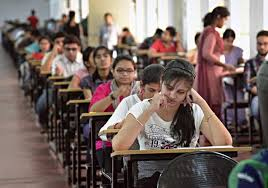
Karnataka: No change in engg, medical fees this year

May 25, 2013

Medical_feesBangalore, May 25: The state government has decided not to change the fee structure or the seat-sharing agreement for professional courses for this academic year.

This was decided in a meeting held with the private educational institutions on Friday by Chief Minister Siddaramaiah, Minister for Higher Education R V Deshpande, Medical Education Minister Sharan Prakash Patil and education department officials.

Private college managements have been demanding a hike in the fees, stating that many of them are finding it difficult to sustain. The government decided it was too late to consider fee revision this year.

Deshpande said the meeting was “amicable” and the decision to go with last year"s structure was applicable to undergraduate and postgraduate courses of medicine and engineering. Patil said: “Any hike had to go through the fee and admission regulatory committees, which had to be formed before December.

“However, the previous government did not form any such committee, and the change in fee cannot be decided in haste now.” The Fee Regulatory Committee and Admission Overseeing Committee are prescribed by the Karnataka Professional Educational Institutions (Regulation of Admission and Determination of Fee) Act, 2006, which the government plans to implement from next year.

Hence, these committees will have to be formed before December as per the guidelines in order to consider any fee revision next year.

According to the existing structure, the fee for a medical seat is Rs 16,700 in government colleges and Rs 46,000 in private colleges. For engineering, the fee is Rs 18,090 in government and aided institutions, and Rs 36,090-41,590 in private colleges.

The government"s share of seats in private non-minority medical colleges is 40 per cent, and 25 per cent in minority institutions. In private engineering colleges, the government quota is 45 per cent of seats in non-minority and 40 per cent in minority colleges.

"The government has asked us to cooperate with them for this year, because it is already time for counselling and admissions. Any further delay would inconvenience the students," said M K Panduranga Shetty, vice-president, Karnataka Unaided Private Engineering Colleges Association.

He added that the managements of private colleges would meet again with government officials on May 28.

CET results on Tuesday

The Karnataka Examination Authority (KEA) will declare the results of the Common Entrance Test (CET) 2013 on May 28, according to KEA Administrative Officer S P Kulkarni.

The document verification process will be held on June 3 from 11 am for disabled and NCC/NSS candidates, on June 4 for sports-quota candidates and on June 5 for regular candidates.

Meanwhile, the counselling for the Post Graduate Entrance Test (PGET) to the Rajiv Gandhi University of Health Sciences will be held between May 26 and May 29. Details on www.rguhspget2013.com and www.rguhs.ac.in.

Comments

Add new comment

  • Coastaldigest.com reserves the right to delete or block any comments.
  • Coastaldigset.com is not responsible for its readers’ comments.
  • Comments that are abusive, incendiary or irrelevant are strictly prohibited.
  • Please use a genuine email ID and provide your name to avoid reject.
Media Release
June 12,2020

Mangaluru: Agnes Towards Community (ATC) is a five-year old project of social responsibility undertaken by St Agnes College (Autonomous), Mangaluru to give their students a taste for community service before they leave the portals of the College.  For this purpose the College has adopted five villages in the vicinity of Mangaluru, namely Harekala, Amblamogaru, Munnuru, Kotekar and Hosabettu.  The ATC programmes are undertaken on saturdays wherein all the final year students as guided by their staff members are given hands on experience of community interaction and service.  The four saturdays in a month are divided to plan, prepare, execute and evaluate the whole service exercise.

The year 2019-20 saw a major change in the format of the project. The Science and Arts faculty came together with projects based on the syllabus of study and apply it for their service learning activity.  This was done with the dual purpose of helping students to learn the topic practically in a real social set up and to identify and render useful scientific based practical solutions to the problems faced by the villagers.  

One such problem is water purity. Since water plays an important role in maintaining the human health and welfare, water quality testing is important because it identifies contaminants and prevents water borne diseases. In this regard, Departments of Chemistry and Microbiology took up a project on water analysis.   The major objectives of the project were: 1. To provide hands on experience on water analysis, a topic learnt by the students in their course of study.  2. To test the potability of water sources of the villages, so that the scientific and practical solutions can be provided, wherever needed.  

The first village chosen for the study was Amblamogaru.  The two batches of students (20 students in each batch) were led by Mrs.Prajwal Rao, Assistant Professor, Department of Microbiology and Ms.Smitha, Assistant Professor, Department of Chemistry. They were assisted by Ms.Hezil Saldanha, Assistant Professor, Department of Chemistry in carrying out the project. 

The water samples from different sources were collected in sterilised glass bottles. The students were enthusiastic in collecting water samples and also interacted with the village folk regarding the availability of drinking water supplies. The students under the guidance of faculty carried out the experiments in water analysis in Chemistry and Microbiology Laboratories at St Agnes College. This included testing for parameters such as pH, conductivity, total hardness and turbidity, presumptive, confirmed and completed Coliform test. From chemical analysis, it is found that all parameters satisfy the standards of potable water. Microbiological analysis showed that the water samples were potable for human consumption (No faecal contamination observed). 

The project has been envisaged to help the villagers to have recourse to the information on the results of the tests conducted. The water samples collected for the analysis were found to be potable for human consumption. If the water samples not been found to be potable, the departments had strategized to guide the villagers on useful scientific and practical solutions wherever needed.

This project of Agnes Towards Community (ATC) helped students to go beyond classroom learning, develop practical skills, disseminate knowledge and render service to the community. This activity also provided direct and relevant experiences to the students that deepened and enriched their learning abilities.

Comments

Add new comment

  • Coastaldigest.com reserves the right to delete or block any comments.
  • Coastaldigset.com is not responsible for its readers’ comments.
  • Comments that are abusive, incendiary or irrelevant are strictly prohibited.
  • Please use a genuine email ID and provide your name to avoid reject.
Media Release
January 14,2020

Mangaluru, Jan 14: The Star Education Institute organized Talents day celebration on 14th January 2020.

This program was presided by Janab Muhammed Saleem Malar, the Director of Star Education Institute, who gave the message about the encouragement of students talent.

The Chief guest of today’s program was Sunil Kumar Bajal , Ex- President old students union Mangaluru, who gave a message about Young generation and their role in the development of the nation.

Mrs. Prabha Naveen, Principal of Star Education Institute who gave the report of the activities of the Institute.

Mohammed Fatheen SPL and Zohara Farahath Secretary were also present on the dias.

Miss. Raksha P. J Science faculty welcomed the gathering. Miss Dipthi D’silva, Commerce faculty and Miss. Thanushree Computer faculty call out the prize list. Mrs. Deepa Lokanath, Commerce faculty proposed a vote of thanks. This programme was anchored by Mrs. Mohini. S. Thereafter the cultural programme was presented by the students.

Comments

Add new comment

  • Coastaldigest.com reserves the right to delete or block any comments.
  • Coastaldigset.com is not responsible for its readers’ comments.
  • Comments that are abusive, incendiary or irrelevant are strictly prohibited.
  • Please use a genuine email ID and provide your name to avoid reject.
News Network
August 9,2020

The core objective of the new National Education Policy (NEP), which has given freedom for amalgamation of different concepts, will be translated into action through the National Curriculum Framework, CBSE director said on Friday.

CBSE Director Biswajit Saha made the comments during an e-conclave on the new NEP organised by the PHD Chamber of Commerce and Industry.

“The core objective of the policy will be translated into action through the National Curriculum Framework (NCF), which needs more participatory approach. The policy has given freedom for amalgamation of different concepts and multidisciplinary approach. The NCF will give a roadmap for implementation of reforms laid down in the policy,” he said.

Saha said the training required for competency-based education and learning outcomes can be achieved with progressive participation of stakeholders.

“There could be a debate about the training required for competency-based education and learning outcomes but once we have decided we want to do it, it can be achieved with progressive participation of stakeholders. It is a forward-looking policy,” the Central Board of Secondary Education (CBSE) director said.

The NEP approved by the Union Cabinet replaces the 34-year-old National Policy on Education framed in 1986 and is aimed at paving the way for transformational reforms in school and higher education systems to make India a global knowledge superpower.

Choice between 3 or 4 year undergraduate courses, multiple entry and exit options in degree courses, adding 3.5 crore seats in higher education institutions, which will now have a single regulator, discontinuation of M.Phil programmes and fixation of fees are among the higher education reforms outlined in the new NEP.

Comments

Add new comment

  • Coastaldigest.com reserves the right to delete or block any comments.
  • Coastaldigset.com is not responsible for its readers’ comments.
  • Comments that are abusive, incendiary or irrelevant are strictly prohibited.
  • Please use a genuine email ID and provide your name to avoid reject.