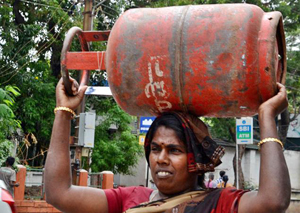
Karnataka's free LPG scheme for BPL families by July 10

DHNS
June 17, 2017

Bengaluru, Jun 17: The chief minister’s ‘Anila Bhagya’ scheme of providing free LPG connections to BPL families will be in place by July 10, Food and Civil Supplies Minister U T Khader said on Friday.

LPGAddressing a press conference in Bengaluru, Khader said BPL card holders who have not been selected for the Centre’s Pradhan Mantri Ujjwal Yojana (PMUY) will be eligible for the state scheme.

Under the scheme, BPL card holders will be provided a free LPG cylinder, regulator, tube and stove. Each connection will cost the government Rs 1,920 which will be provided directly to the oil marketing companies, Khader said.

Those who want to apply for the scheme will have to approach their jurisdictional gram panchayats, the minister said. The government has earmarked Rs 600 crore for the scheme, he said. Option will be given to ration card holders in rural areas with gas connection to choose either kerosene or free re-chargeable LED sets, he added.

He said some technical glitches in processing applications for issue of new BPL cards had been sorted out. The cards will be despatched to the applicants by Speed Post soon, he said.

Khader said a circular that barred renewal of licence to fair price shops if the owner has crossed 65 years has been withdrawn.

Comments

CHIKKANNA
 - 
Tuesday, 10 Oct 2017

POOR FAMILY IS A HELP .AND HAPPY 

Add new comment

  • Coastaldigest.com reserves the right to delete or block any comments.
  • Coastaldigset.com is not responsible for its readers’ comments.
  • Comments that are abusive, incendiary or irrelevant are strictly prohibited.
  • Please use a genuine email ID and provide your name to avoid reject.
Ram Puniyani
February 22,2020

This January 2020, it is thirty years since the Kashmiri Pundits’ exodus from the Kashmir valley took place. They had suffered grave injustices, violence and humiliation prior to the migration away from the place of their social and cultural roots in Kashmir Valley. The phenomenon of this exodus had been due to the communalization of militancy in Kashmir in the decade of 1980s. While no ruling Government has applied itself enough to ‘solve’ this uprooting of pundits from their roots, there are communal elements who have been aggressively using ‘what about Kashmiri Pundits?’, every time liberal, human rights defenders talk about the plight of Muslim minority in India. This minority is now facing an overall erosion of their citizenship rights.

Time and over again in the aftermath of communal violence in particular, the human rights groups have been trying to put forward the demands for justice and rehabilitation of the victim minority. Instead of being listened to those particularly from Hindu nationalist combine, as a matter of routine shout back, where were you when Kashmiri Pundits were driven away from the Valley? In a way the tragedy being heaped on one minority is being justified in the name of suffering of Pundits and in the process violence is being normalized. This sounds as if two wrongs make a right, as if the suffering Muslim minority or those who are trying to talk in defense of minority rights have been responsible for the pain of Kashmiri Pundits.

During these three, many political formations have come to power, including BJP, Congress, third front and what have you. To begin with when the exodus took place Kashmir was under President’s rule and V. P. Singh Government was in power at the center. This Government had the external support of BJP at that time. Later BJP led NDA came to power for close to six years from 1998, under the leadership of Atal Bihari Vajpayee. Then from 2014 it is BJP, with Narerda Modi as PM, with BJP brute majority is in power. Other components of NDA are there to enjoy some spoils of power without any say in the policies being pursued by the Government. Modi is having absolute power with Amit Shah occasionally presenting Modi’s viewpoints.

Those blurting, ‘what about Kashmiri Pundits?’ are using it as a mere rhetoric to hide their communal color. The matters of Kashmir are very disturbing and cannot be attributed to be the making of Indian Muslims as it is being projected in an overt and subtle manner. Today, of course the steps taken by the Modi Government, that of abrogation of Article 370, abolition of clause 35 A, downgrading the status of Kashmir from a state to union territory have created a situation where the return of Kashmiri Pundits may have become more difficult, as the local atmosphere is more stifling and the leaders with democratic potential have been slapped with Public Safety Act, where they can be interned for long time without any answerability to the Courts. The internet had been suspended, communication being stifled in an atmosphere where democratic freedoms are curtailed which makes solution of any problem more difficult.

Kashmir has been a vexed issue where the suppression of the clause of autonomy, leading to alienation led to rise of militancy. This was duly supported by Pakistan. The entry of Al Qaeda elements, who having played their role against Russian army in 1980s entered into Kashmir and communalized the situation in Kashmir. The initial Kashmir militancy was on the grounds of Kashmiriyat. Kashmiriyat is not Islam, it is synthesis of teachings of Buddha, values of Vedant and preaching’s of Sufi Islam. The tormenting of Kashmiri Pundits begins with these elements entering Kashmir.

Also the pundits, who have been the integral part of Kashmir Valley, were urged upon by Goodwill mission to stay on, with local Muslims promising to counter the anti Pundit atmosphere. Jagmohan, the Governor, who later became a minister in NDA Government, instead of providing security to the Pundits thought, is fit to provide facilities for their mass migration. He could have intensified counter militancy and protected the vulnerable Pundit community. Why this was not done?

Today, ‘What about Kashmiri Pundits?’ needs to be given a serious thought away from the blame game or using it as a hammer to beat the ‘Muslims of India’ or human rights defenders? The previous NDA regime (2014) had thought of setting up enclosures of Pundits in the Valley. Is that a solution? Solution lies in giving justice to them. There is a need for judicial commission to identify the culprits and legal measures to reassure the Pundit community. Will they like to return if the high handed stifling atmosphere, with large number of military being present in the area? The cultural and religious spaces of Pundits need to be revived and Kashmiryat has to be made the base of any reconciliation process.

Surely, the Al Qaeda type elements do not represent the alienation of local Kashmiris, who need to be drawn into the process of dialogue for a peaceful Kashmir, which is the best guarantee for progress in this ex-state, now a Union territory. Communal amity, the hallmark of Kashmir cannot be brought in by changing the demographic composition by settling outsiders in the Valley. A true introspection is needed for this troubled area. Democracy is the only path for solving the emigration of Pundits and also of large numbers of Muslims, who also had to leave the valley due to the intimidating militancy and presence of armed forces in large numbers. One recalls Times of India report of 5th February 1992 which states that militants killed 1585 people from January 1990 to October 1992 out of which 982 were Muslims and 218 Hindus.

We have been taking a path where democratic norms are being stifled, and the promises of autonomy which were part of treaty of accession being ignored. Can it solve the problem of Pundits?

Comments

Add new comment

  • Coastaldigest.com reserves the right to delete or block any comments.
  • Coastaldigset.com is not responsible for its readers’ comments.
  • Comments that are abusive, incendiary or irrelevant are strictly prohibited.
  • Please use a genuine email ID and provide your name to avoid reject.
News Network
July 12,2020

Bosnia, Jul 12: Bosnians commemorated on Saturday the massacre of about 8,000 Muslim men and boys in Srebrenica, marking the 25th anniversary of killings that shocked the world and have stood out as Europe's only atrocity since World War Two constituting genocide.

Nine newly identified victims were buried at a flower-shaped cemetery near the town, where tall white tombstones mark the graves of 6,643 other victims.

"After 25 years we succeeded in finding his mortal remains, so they can be laid to their final rest," said Fikret Pezic, who buried his father Hasan.

The remains of some 1,000 victims of the massacre in the eastern town during Bosnia's 1992-1995 war are still missing.

Ifeta Hasanovic decided to bury incomplete remains of her husband, saying: "We were aware they cannot be complete after 25 years, at least there are some, I did not want to make any new delays."

World leaders addressed the ceremony by video link, unable to attend because of coronavirus epidemic. Instead of the tens of thousands visitors who typically attend the commemoration each year, only a few thousand came after organisers banned organised visits.

During the Bosnian war, Bosnian Serb forces pushed non-Serbs out of territories they sought for their Serb statelet. Fleeing Muslims took shelter in several eastern towns, including Srebrenica, that were designated as United Nations "safe zones".

On July 11, 1995, the Serb forces commanded by General Ratko Mladic overran Srebrenica, which was protected by lightly armed Dutch peacekeepers.

They sent women and children away and captured and executed the men and boys they found. The bodies were dumped into mass graves and later exhumed by U.N. investigators and used as evidence in war crimes trials of Bosnian Serb leaders.

"We grieve with the families that tirelessly seek justice for the 8,000 innocent lives lost, all these years later," said U.S. Secretary of State Mike Pompeo. Washington brokered Bosnia's peace deal months after the massacre.

Most people at the commemoration were Muslim Bosniaks, reflecting conflicting narratives about the bloodshed - which hinders reconciliation nearly 25 years after the end of war in which about 100,000 people were killed.

The U.N. war crimes tribunal for the former Yugoslavia convicted Mladic and his political chief Radovan Karadzic over Srebrenica genocide but they remained heroes for Serbs, many of whom deny that genocide happened.

On Saturday, the Serbs in the nearby town of Bratunac organised an event marking July 11 as the "Srebrenica Liberation Day".

Sefik Dzaferovic, the Bosniak chairman of Bosnia's tripartite presidency, called for legislation that would ban denial of genocide.

"There can be no trust as long as we witness attacks on the truth, denial of genocide and glorification and celebration of executors," Dzaferovic told the commemoration gathering.


Comments

Add new comment

  • Coastaldigest.com reserves the right to delete or block any comments.
  • Coastaldigset.com is not responsible for its readers’ comments.
  • Comments that are abusive, incendiary or irrelevant are strictly prohibited.
  • Please use a genuine email ID and provide your name to avoid reject.
News Network
June 8,2020

Bengaluru, Jun 8: More than two months after the nationwide lockdown was imposed to curb the spread of coronavirus, people offered prayers at Bengaluru's Saint Mary's Church and Shree Dodda Ganapathi Temple as the government has allowed reopening of religious places from today.

Fewer devotees here visited Saint Mary's Church in Shivaji Nagar and were seen maintaining social distancing inside the church premises.

Meanwhile, people queued outside Shree Dodda Ganapathi Temple at Basavanagudi to offer prayers in the wee hours of Monday.

Floor markings have been made here to maintain social distancing.

Social distancing norms are also being followed in Hubli's Nagashetty Koppa where only a few devotees thronged the temple on Monday morning.

In Kalaburagi's Sharana Basaveshwara Temple the visiting hours for devotees have been fixed from 7 am to 10 am and three hours in the evening from 5 pm to 8 pm.

Thermal screening is being conducted here and a disinfectant tunnel has also been installed at the entry point.

Floor markings have also been made here to ensure social distancing while barricades have also been installed on the temple premises.

Comments

Add new comment

  • Coastaldigest.com reserves the right to delete or block any comments.
  • Coastaldigset.com is not responsible for its readers’ comments.
  • Comments that are abusive, incendiary or irrelevant are strictly prohibited.
  • Please use a genuine email ID and provide your name to avoid reject.