


Kasaragod’s newly named 'Gaza Street' on the radar of IB, NIA

News Network
June 19, 2017

Kasaragod, Jun 19: A street in Thuruthi ward of Kasaragod municipality that was recently named 'Gaza', a reference to a part of the Palestinian territory, has got intelligence agencies interested.
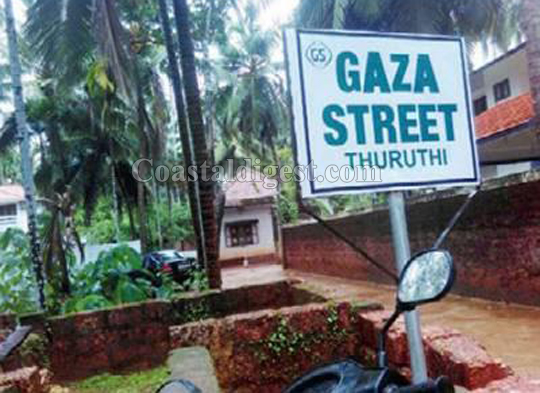
gaza street

The agencies are looking at possible “radical” influence behind the naming, considering the locality's proximity to Padane from where the majority of the 21 youths from Kerala, who have gone missing since 2016 and are suspected to have joined the Islamic State terror outfit, hail.

The road adjacent to Thuruthi Juma Masjid was named 'Gaza' last month and was inaugurated by Kasaragod district panchayat president AGC Basheer. "I was not the person who was supposed to inaugurate the street as the area falls under the municipality's jurisdiction. But I had to step in at the last moment," Basheer said.

Though municipality funds were believed to have been used to concretise the street, municipal authorities claim they are clueless about the naming. Municipal chairperson Beefathima Ibrahim said she does not have any knowledge about such a street under her jurisdiction.

But local BJP leaders said, "There is a deliberate attempt to change the names of various areas in Kasaragod. When such matters come to the municipal council, there will be a debate and if the name is not of public acceptance, it will be rejected. For the same reason, many such names are not brought to the attention of the council," said Kasaragod municipality opposition leader P Ramesh.

Kasaragod district has been under the radar of central agencies like Intelligence Bureau and National Investigation Agency following the case of the missing youths.

"Kasaragod is a district where communal divisions are deepening along with inroads being made organisations like the IS. Though this particular incident has not come to our attention, the watchful eyes of central agencies capture even minor developments happening in the district for the above reason", a top police official said.

Comments

Abdullah
 - 
Monday, 19 Jun 2017

If RSS, BJP changes names all over India then no matter!!!!

Izuddin Mohamm…
 - 
Monday, 19 Jun 2017

If named isreal.... No issues

Add new comment

  • Coastaldigest.com reserves the right to delete or block any comments.
  • Coastaldigset.com is not responsible for its readers’ comments.
  • Comments that are abusive, incendiary or irrelevant are strictly prohibited.
  • Please use a genuine email ID and provide your name to avoid reject.
Ram Puniyani
February 22,2020

This January 2020, it is thirty years since the Kashmiri Pundits’ exodus from the Kashmir valley took place. They had suffered grave injustices, violence and humiliation prior to the migration away from the place of their social and cultural roots in Kashmir Valley. The phenomenon of this exodus had been due to the communalization of militancy in Kashmir in the decade of 1980s. While no ruling Government has applied itself enough to ‘solve’ this uprooting of pundits from their roots, there are communal elements who have been aggressively using ‘what about Kashmiri Pundits?’, every time liberal, human rights defenders talk about the plight of Muslim minority in India. This minority is now facing an overall erosion of their citizenship rights.

Time and over again in the aftermath of communal violence in particular, the human rights groups have been trying to put forward the demands for justice and rehabilitation of the victim minority. Instead of being listened to those particularly from Hindu nationalist combine, as a matter of routine shout back, where were you when Kashmiri Pundits were driven away from the Valley? In a way the tragedy being heaped on one minority is being justified in the name of suffering of Pundits and in the process violence is being normalized. This sounds as if two wrongs make a right, as if the suffering Muslim minority or those who are trying to talk in defense of minority rights have been responsible for the pain of Kashmiri Pundits.

During these three, many political formations have come to power, including BJP, Congress, third front and what have you. To begin with when the exodus took place Kashmir was under President’s rule and V. P. Singh Government was in power at the center. This Government had the external support of BJP at that time. Later BJP led NDA came to power for close to six years from 1998, under the leadership of Atal Bihari Vajpayee. Then from 2014 it is BJP, with Narerda Modi as PM, with BJP brute majority is in power. Other components of NDA are there to enjoy some spoils of power without any say in the policies being pursued by the Government. Modi is having absolute power with Amit Shah occasionally presenting Modi’s viewpoints.

Those blurting, ‘what about Kashmiri Pundits?’ are using it as a mere rhetoric to hide their communal color. The matters of Kashmir are very disturbing and cannot be attributed to be the making of Indian Muslims as it is being projected in an overt and subtle manner. Today, of course the steps taken by the Modi Government, that of abrogation of Article 370, abolition of clause 35 A, downgrading the status of Kashmir from a state to union territory have created a situation where the return of Kashmiri Pundits may have become more difficult, as the local atmosphere is more stifling and the leaders with democratic potential have been slapped with Public Safety Act, where they can be interned for long time without any answerability to the Courts. The internet had been suspended, communication being stifled in an atmosphere where democratic freedoms are curtailed which makes solution of any problem more difficult.

Kashmir has been a vexed issue where the suppression of the clause of autonomy, leading to alienation led to rise of militancy. This was duly supported by Pakistan. The entry of Al Qaeda elements, who having played their role against Russian army in 1980s entered into Kashmir and communalized the situation in Kashmir. The initial Kashmir militancy was on the grounds of Kashmiriyat. Kashmiriyat is not Islam, it is synthesis of teachings of Buddha, values of Vedant and preaching’s of Sufi Islam. The tormenting of Kashmiri Pundits begins with these elements entering Kashmir.

Also the pundits, who have been the integral part of Kashmir Valley, were urged upon by Goodwill mission to stay on, with local Muslims promising to counter the anti Pundit atmosphere. Jagmohan, the Governor, who later became a minister in NDA Government, instead of providing security to the Pundits thought, is fit to provide facilities for their mass migration. He could have intensified counter militancy and protected the vulnerable Pundit community. Why this was not done?

Today, ‘What about Kashmiri Pundits?’ needs to be given a serious thought away from the blame game or using it as a hammer to beat the ‘Muslims of India’ or human rights defenders? The previous NDA regime (2014) had thought of setting up enclosures of Pundits in the Valley. Is that a solution? Solution lies in giving justice to them. There is a need for judicial commission to identify the culprits and legal measures to reassure the Pundit community. Will they like to return if the high handed stifling atmosphere, with large number of military being present in the area? The cultural and religious spaces of Pundits need to be revived and Kashmiryat has to be made the base of any reconciliation process.

Surely, the Al Qaeda type elements do not represent the alienation of local Kashmiris, who need to be drawn into the process of dialogue for a peaceful Kashmir, which is the best guarantee for progress in this ex-state, now a Union territory. Communal amity, the hallmark of Kashmir cannot be brought in by changing the demographic composition by settling outsiders in the Valley. A true introspection is needed for this troubled area. Democracy is the only path for solving the emigration of Pundits and also of large numbers of Muslims, who also had to leave the valley due to the intimidating militancy and presence of armed forces in large numbers. One recalls Times of India report of 5th February 1992 which states that militants killed 1585 people from January 1990 to October 1992 out of which 982 were Muslims and 218 Hindus.

We have been taking a path where democratic norms are being stifled, and the promises of autonomy which were part of treaty of accession being ignored. Can it solve the problem of Pundits?

Comments

Add new comment

  • Coastaldigest.com reserves the right to delete or block any comments.
  • Coastaldigset.com is not responsible for its readers’ comments.
  • Comments that are abusive, incendiary or irrelevant are strictly prohibited.
  • Please use a genuine email ID and provide your name to avoid reject.
Agencies
January 12,2020

New Delhi, Jan 12: In a shocking revelation, one unemployed person committed suicide every hour during 2018 when a total of 1,34,516 suicides, including 92,114 male and 42,391 female, were reported in the country, NCRB's "Suicide in India 2018" says.

The latest data, issued by the National Crime Records Bureau (NCRB), which comes under Ministry of Home Affairs, last week reveals that a total of 12,936 unemployed persons committed suicide in 2018, which accounted for 9.6 per cent of the total suicides, and were of aged below 18 years to above 60 years.

Those below 18 years include 31 males and nine females while those between 18 and 30 years comprise 1,240 male and 180 female. A total of 868 male and 95 female were aged between 30 and 45 years. A number of 237 males and 21 females were aged between 45 and 60 years while 2,431 males and 310 females were above 60 years.

Of the total suicides by unemployed persons, males are 10,687 while the females are 2,249.

The highest number of suicides - 12.3 per cent - committed by unemployed persons were in Kerala (1,585 out of 12,936 suicides), 12.2 per cent in Tamil Nadu (1,579), 9.7 per cent in Maharashtra (1,260 suicides), 8.5 per cent in Karnataka (1,094 suicides) and 7 per cent in Uttar Pradesh (902 suicides).

"Each suicide is a personal tragedy that prematurely takes the life of an individual and has a continuing ripple effect, dramatically affecting the lives of families, friends and communities. Every year, more than 1 lakh people commit suicide in our country. There are various causes of suicides like professional/career problems, sense of isolation, abuse, violence, family problems, mental disorders, addiction to alcohol, financial loss, chronic pain etc," says the NCRB adding it collects data on suicides from police recorded suicide cases.

As per the NCRB, rate of suicides has been calculated using projected population for the non-census years whereas for 2011, the population of the Population Census 2011 was used.

The NCRB data says that a total of 1,34,516 suicides were reported in the country during 2018 showing an increase of 3.6 per cent in comparison to 2017 and the rate of suicides has increased by 0.3 during 2018 over 2017.

Government servants accounted for 1.3 per cent (1,707 out of 1,34,516) of the total suicide victims as compared to 6.1 per cent (8,246 out of 1,34,516) of total victims from Private Sector Enterprises.

Employees from Public Sector Undertakings formed 1.5 per cent (2,022 out of 1,34,516) of the total suicide victims, whereas students and unemployed victims accounted for 7.6 per (10,159 victims) of total suicides. Self-employed category accounted for 9.8 per cent of total suicide victims (13,149 out of 1,34,516).

A total of 10,349 persons involved in farming sector (consisting of 5,763 farmers and cultivators and 4,586 agricultural labourers) have committed suicide during 2018, accounting for 7.7 per cent of total suicides victims (1,34,516) in the country.

A total of 11 transgenders have committed suicide in which three were daily wage earners, one each were 'professionals and salaried persons' and 'unemployed persons' while six falls under 'Other Persons'.

Comments

Add new comment

  • Coastaldigest.com reserves the right to delete or block any comments.
  • Coastaldigset.com is not responsible for its readers’ comments.
  • Comments that are abusive, incendiary or irrelevant are strictly prohibited.
  • Please use a genuine email ID and provide your name to avoid reject.
News Network
February 5,2020

Tightening control over companies misleading advertisements of medicines and products, the Indian government could soon slap a fine of up to Rs10 lakh and up to two years' imprisonment. While repeat offender could be fined up to Rs50 and imprisonment up to five years.

The Ministry of Health and Family Welfare's new draft of the Drugs and Magic Remedies (Objectionable Advertisements) (Amendment) Bill, 2020, provides extremely stringent penalties compared to the current law.

Under the new Act, companies advertising medicines and products falsely claiming to make a person fairer, improve height and memory or cure issues like hair loss or greying and premature ageing, among several others, may attract more stringent fines and jail time.

The current Act, 1954, leaves scope for companies to create deceptive advertisements as first time offender can be jailed for six months while repeat offender can be up to one year in prison, reported The Indian Express.

Under the Bill, deceptive advertisements will cover digital advertising, notice, circular, label, wrapper, invoice, banner and poster, among others. The government also plans to expand the scope of the law under the proposed amendments to cover 24 more deceptive claims not included in the current law, like medicines that can cure AIDS, change the sex of a foetus, among others, reported Livemint.

Comments

Add new comment

  • Coastaldigest.com reserves the right to delete or block any comments.
  • Coastaldigset.com is not responsible for its readers’ comments.
  • Comments that are abusive, incendiary or irrelevant are strictly prohibited.
  • Please use a genuine email ID and provide your name to avoid reject.