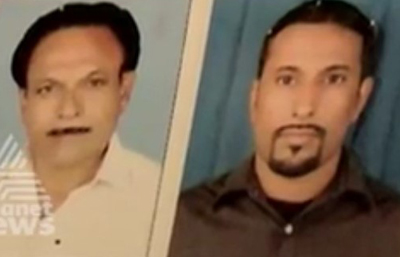
Kerala techie kills NRI father, dumps body parts separately

[email protected] (CD Network)
May 31, 2016

Chengannur, May 30: In a gruesome incident of patricide over property dispute, a 36-year-old IT professional has allegedly shot dead his NRI father, cut his body into pieces and dumped them at various locations here.

1keralaPolice said Sherin John, working with a company in IT hub Technopark, was arrested after he confessed that he had killed his father Joy V John (68) last week.

John was living in US for the last three decades and visited his ancestral home near here when he was murdered, police said, adding property dispute led to the crime.

Based on Sherin's statement, police carried out a search in various places and recovered a portion of limb, head and some other body parts, believed to be that of Joy.

"The recovered body parts will be sent for DNA testing and other scientific analysis.

"As per our preliminary investigation, property dispute between the father and son had led to the murder," Alappuzha District police chief B Asok Kumar told PTI.

Joy had gone missing since last Wednesday after he had gone out with Sherin to repair an air-conditioner.

As her husband and son did not return, Joy's wife Mariamma lodged a missing complaint with the police.

During interrogation, Sherin confessed to committing the crime, police said, adding he had been booked for IPC offences including murder and destruction of evidences.

Comments

satyameva jayate
 - 
Monday, 30 May 2016

dont know what to say.............no comments.........God save the elders from this new generations mentality.................

Add new comment

  • Coastaldigest.com reserves the right to delete or block any comments.
  • Coastaldigset.com is not responsible for its readers’ comments.
  • Comments that are abusive, incendiary or irrelevant are strictly prohibited.
  • Please use a genuine email ID and provide your name to avoid reject.
News Network
March 24,2020

Bangalore , Mar 24: Bizom, India's leading retail intelligence platform, announced free subscription of its retailer app and tele-ordering solutions for consumer businesses in India and other emerging economies. Both solutions enable retailers to send their orders directly to the brand.
In COVID-19 times of social distancing and prophylactic measures, brands are conscious about the safety of their salespersons. Also, retailers don't want travelling salespeople to enter their premises. Consequently, many retail stores are facing stockout situations of fast-moving product categories. Bizom's self-ordering solutions help brands to avoid stockouts of their products.
Bizom trends, which analyses consumption and demand for consumer brands, showed how a near-complete shutdown during the Janta Curfew followed panic buying in early March. The asymmetrical demand and a lack of salespeople for order-taking are driving the industry towards social-distancing-based store-stocking mechanisms.
Bizom provides social-distancing-based store-stocking solutions for consumer businesses. They include the Bizom Retailer App and the Bizom Tele-ordering.
The Bizom Retailer App enables self-ordering for a brand's key retail outlets and can be implemented in under two weeks. The mobile app, a B2B shopping app, is a simple installation for retailers. It lists and groups the brand's products as per its product categories. The app's interface is no different from that of leading e-commerce apps. All the user has to do is select the preferred SKUs and add them to their shopping carts.
The app also allows brands to customize the app to meet the requirements of their continually changing product categories. For instance, if an SKU runs out of stock, the brand can disable the given SKU from the app.
With the Bizom Retailer App, brands can take orders directly from retailers instead of the traditional order-taking approach, which requires high-touch from a salesperson. Some of the key features of the app are, the ability to provide product information directly through retailers including SKUs, competitor comparison and pricing.
It also enables self-ordering from the retailer to maintain the flow of products as per demand, enables scheme rollout information through a notification on the app rather than through salespeople, tracks delivery of goods to the retailer and enables incentive payments to retailers directly rather than through distributor claims.
With Bizom Tele-ordering, as the sales teams go remote, the tele-ordering solution will become useful for brands who want to get salespeople to take orders from retailers, remotely. It ensures continued service to outlets despite not being physically present in the market.
Here, salespeople can discuss product requirements with retailers and enter orders based on specific outlet types (grocery, chemist etc.), outlet class (Class A, Class B etc.) or based on their beat or as per a distributor.
The key features of the Bizom Tele-ordering solution are, its ability to help salespeople collect orders from retailers remotely and enter it for fulfilment into Bizom using a tool, the flexibility offered to salespeople for remote servicing of retailers as per outlet type, beat, distributor area etc., secondary schemes get applied automatically, variable discounts will get applied as applicable at an SKU level.
"At Bizom, we are conscious of our responsibility to help brands run faster during these COVID-19 times. Our solutions of Bizom Retailer App and Bizom Tele-ordering have been built to ensure that brands can leverage this situation of low direct touch with retailers to enable a better way of working, remotely. I am trying to help brands go live in a few days so that they, in turn, can serve consumers better during these testing times," said Lalit Bhise, CEO, Bizom.

Comments

Add new comment

  • Coastaldigest.com reserves the right to delete or block any comments.
  • Coastaldigset.com is not responsible for its readers’ comments.
  • Comments that are abusive, incendiary or irrelevant are strictly prohibited.
  • Please use a genuine email ID and provide your name to avoid reject.
News Network
April 17,2020

Kasaragod, Apr 17: Even as this district continue to remain in the high-alert red zone category of Covid-19, Kasaragod has slowly but steadily been limping back to restraint level of the pandemic from a possible slipping into a stage-3 of community spread early this month.

Thanks to the stringent and committed measures implemented by the district administration crisscross the district besides total isolation of few localities by enforcing triple lockdown.

The district had been a Covid-19 hotspot ever since an NRI who returned from the Gulf violated quarantine protocol and travelled wide and far by meeting and contacting with several people including two MLAs of the district. That apart the irresponsible attitude of the people who broke the rules of quarantine and lockdown norms also made things go from bad to worse resulting in contributing for a near-half of the total positive cases in the state at the beginning of April.

Comments

Add new comment

  • Coastaldigest.com reserves the right to delete or block any comments.
  • Coastaldigset.com is not responsible for its readers’ comments.
  • Comments that are abusive, incendiary or irrelevant are strictly prohibited.
  • Please use a genuine email ID and provide your name to avoid reject.
Abu Muhammad | coastaldigest.com
January 16,2020

Even as the Muslims of undivided Dakshina Kannada district broke out of the “spiral of silence” and made history by leading an unprecedented protest against CAA, NPR and NRC as well as the categorial mistreatment of non-saffronites at the hands of the police across the country, mainstream media turned a blind eye to the spectacle at the Shah Garden Maidan in Mangaluru’s Adyar where about two lakh patriots with tricolor in their hands converged to assert themselves on January 15th, 2020, a date which will be remembered by the people of coastal Karnataka forever.

The largest gathering in the history of Mangaluru was absolutely peaceful, law-abiding and respectful. While the slogans of ‘Azaadi’ were reverberating in the atmosphere, the protesters were seen making way for vehicles and passersby, taking care of women and helping elderly citizens on the highway adjacent to the ground. Though the organisers and most of the participants were Muslims, they collectively identified themselves as “We, the people of India”.

The district administration and the police department hadn’t imagined or even dreamt of such a mammoth gathering after blocking the highway and banning public transport from 9 am to 9 pm. Many opine that this action was taken only to discourage the concerned from participating in the protest and to create fear in the hearts of the people who are yet to process the unjustifiable deaths of two innocent citizens in an unwarranted police firing a few weeks ago.

What has since surprised the protesters most is the mainstream media’s blatant attempt to downplay the significance of this largest ever gathering. Shockingly, it could not make it to the front pages of any of the state-level Kannada daily newspapers except city-based Vaartha Bharathi. In the absence of The Hindu, which had announced a holiday on account of Makar Sankranti, most of the English newspapers too pitilessly buried the historic event in their inner pagers. National TV channels too were evidently reluctant to cover the event until NDTV started telecasting the news of the protest.

This uneasy relationship between the media and minorities in coastal Karnataka has long existed, but the non-coverage of the huge protest of Jan 15 marks a quantum leap beyond the media’s traditional pro-Sangh Parivar stance and biases –– which in the past had often demonised non-saffronites –– to now completely ignore and suppress the people’s voice. This media bias has naturally evoked a sharp response from netizens, who took to social media to issue clarion calls to boycott the mainstream media forever.

Cleanliness Drive

Most major protest meets and rallies –– both religious and political –– leave behind tonnes of garbage, especially water bottles, placards and buntings. However, the organisers of the Jan 15 protest meet led by example by launching a cleanliness drive in the area soon after the protesters left the venue peacefully. The drive continued on Jan 16 too. (Ironically, amidst this ongoing cleanliness drive, a local news portal captured photos of a few plastic bottles scattered along the road at Adyar and published a report accusing the event organisers and participants of polluting the area!)


Comments

Add new comment

  • Coastaldigest.com reserves the right to delete or block any comments.
  • Coastaldigset.com is not responsible for its readers’ comments.
  • Comments that are abusive, incendiary or irrelevant are strictly prohibited.
  • Please use a genuine email ID and provide your name to avoid reject.