


Khandwali mourns Junaid, wears black bands during Eid namaz

Agencies
June 26, 2017

Khandawali, Jun 26: As villagers today wore black bands to protest the killing of a Muslim youth onboard a Mathura-bound train, his elder brother, Hashim, struggled to come to terms with the reality that he would be celebrating this Eid without his sibling.
band

Despair hung like a shroud over Khandawali village, lying on the outskirts of the national capital, as the family and other locals remained in a state of shock over the brutal killing of their 17-year-old "son" Junaid.

The Muslim residents, who wore black bands during the special morning namaz today, said Eid has lost all its meaning and wondered if "the spate of lynchings" would ever end.

Junaid's father Jallaludin (55) told reporters that Eid would never be the same for the family.

Though prayers were offered in the morning, no Eid celebrations were held here. The villagers gathered around Jallaludin and other family members, consoling them in their hour of grief.

Reports stated that people also wore black bands at some other places, including Mewat, as a mark of protest against the horrific killing.

Junaid's cousin, Sanovar Khan, said they had posted about the protest on social media.

Hashim (20) broke down several times as he recalled the fateful Thursday evening when he along with his other siblings boarded the train from Delhi's Sadar Bazaar after finishing Eid shopping.

"They killed him in cold blood. All of a sudden, a group of 20-25 persons who had boarded the train from Okhla station pushed my brother Junaid and he fell down," he recalled, his voice choking with emotion.

"When Junaid and I asked why they were pushing, they pointed to the skull cap on my head. They said we are Muslims, anti-nationals, Pakistanis, that we eat beef. Then they pulled my cap, threw it down and they also tried to pull my beard," he said.

Jallaludin, while trying to console Hashim, dismissed the police's claim that Junaid was killed because of a dispute over the sharing of a seat.

"Junaid had, in fact, vacated a seat for an elderly person. The seat theory is being cooked up as an excuse. The incident is purely communal in nature and my son was targeted because of his religious identity," he said.

"We offered namaaz but we won't celebrate the festival. We want those responsible for our son's death to be punished," he said when asked about the 'black Eid' in the village.

Jallaludin, when asked if anyone from the Haryana government had met family yet, said, "Not even a lower rank official of the state government has visited us, what to say about the chief minister. We have not even heard anybody from the government condemning the incident."

The also villagers who sat in protest with the grieving family.

Shakeel, a resident of Khandawli in Ballabgarh near Delhi, told reporters, "We could not have celebrated Eid with the usual sense of joy considering how Junaid was killed. So we decided to mark our protest by wearing black bands around our arms."

"When will this stop? After every such incident, the government offers some compensation and people move on. But the question is, will it ever stop?" asked a villager in his 20s.

He also questioned the efficacy of the administration in acting against the accused, wondering why only one arrest had been made in four days.

The police had yesterday announced a reward of Rs one lakh for credible information leading to the arrest of other accused in the case.

The family was yesterday given a cheque for Rs 5 lakh by the District Red Cross while Wakf Board chairman announced another Rs 5 lakh and a job to one of Jallaludin's sons.

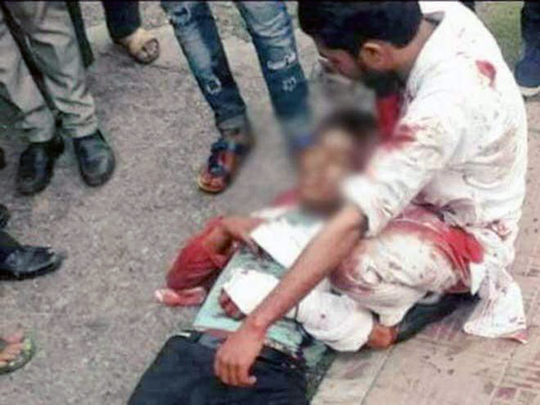
Junaid was stabbed to death while his brothers, Hashim and Sakir--were injured by a mob which also allegedly hurled slurs against them onboard the Delhi-Mathura passenger train between Ballabgarh and Mathura stations on Thursday night.

The arrested accused, before being remanded to police custody by a court in Faridabad district earlier, had told reporters that he was in an inebriated state at the time of the incident and attacked the teenager on being allegedly instigated by fellow passengers.

Also Read: Communal hate crime: Family in shock after 16-yr-old Hafiz-ul-Quran murdered on train

Comments

Mohammed Imran
 - 
Monday, 26 Jun 2017

Now time has came to unite and fight against such goons till our last breath. Will sacrifice for humanity, not be tolerate.

Unseen Baig
 - 
Tuesday, 27 Jun 2017

Suspect state sponsored actions to consolidate Hindu votes. Wondering if all Hindus accept this and throw alliance. Steadfastness and fear of Allah shall prevail against all these pseudo nationalist plans.

Ranjan shetty
 - 
Tuesday, 27 Jun 2017

what is so shocking in this ? it was a street brawl . they taunted and might have hurt hindu sentiments or eve teased Hindu women as it is in their blood .

Ahmed K.C.
 - 
Tuesday, 27 Jun 2017

Mohammed Imran, Udupi,
As soon as you start fighting against such goons, they will label you as 'Terrorist" and you know what happens after that?
According to them:-
One wearing skull cap is a Terrorist
One goes to Madrasa is a Terrorist
One reads Qur'an is a Terrorist
One with Islamic beard is a Terrorist
One who transports a cattle is a Terrorist

All come under one umbrella called "RADICAL ISLAMIC TERRORISM"

Add new comment

  • Coastaldigest.com reserves the right to delete or block any comments.
  • Coastaldigset.com is not responsible for its readers’ comments.
  • Comments that are abusive, incendiary or irrelevant are strictly prohibited.
  • Please use a genuine email ID and provide your name to avoid reject.
News Network
January 16,2020

Bengaluru, Jan 16: Senior Congress leader K J George on Thursday appeared before the Enforcement Directorate officials here in connection with a FEMA case.

The former minister is being investigated by the ED for probable violation of provisions of the Foreign Exchange Management Act.

The ED had recently issued summons to George.

Speaking to reporters after appearing before the ED, George said he has answered to the officials' queries and will cooperate further also.

"ED had issued me summons, as a law abiding citizen, I have answered and gave documents to whatever they asked.

Further also if they call me...I will cooperate and provide necessary documents," he said, without divulging any details.

George clarified that no summons has been issued by the ED to members of his family.

"If required they (ED officials) will call me again, and I'm ready to cooperate," the congress leader added.

Last year, the president of the Karnataka Rashtra Samithi Ravi Krishna Reddy had complained to the ED seeking a probe into the alleged money laundering and properties held by George and his family members in the United States.

Responding to a question about a defamation case filed by him against those who have levelled the allegations, George said "Just because ED has called me for questioning, I'm not proved guilty."

"Anyone can complain to agencies like the Income Tax or ED or Lokayukta, but my only objection is with going to the press to project someone as guilty," he said.

"...going to the press with an intention to do a propaganda against me..someone who is in public life-- to project me as guilty is wrong, so I have filed defamation case stating the allegations are false," he added.

George is the third senior Congress leader from Karnataka to face an ED probe after D K Shivakumar and B Z Zameer Ahmed Khan.

Shivakumar was arrested by the agency in a money laundering case and was kept in Tihar Jail, until he got bail in October, while Khan was summoned in connection with the multi-crore IMA group Ponzi scam case.

Comments

Add new comment

  • Coastaldigest.com reserves the right to delete or block any comments.
  • Coastaldigset.com is not responsible for its readers’ comments.
  • Comments that are abusive, incendiary or irrelevant are strictly prohibited.
  • Please use a genuine email ID and provide your name to avoid reject.
Agencies
June 30,2020

Washington, Jun 30: Researchers in China have discovered a new type of swine flu that is capable of triggering a pandemic, according to a study published Monday in the US science journal PNAS.

Named G4, it is genetically descended from the H1N1 strain that caused a pandemic in 2009.

It possesses "all the essential hallmarks of being highly adapted to infect humans," say the authors, scientists at Chinese universities and China's Center for Disease Control and Prevention.

The researchers then carried out various experiments including on ferrets, which are widely used in flu studies because they experience similar symptoms to humans -- principally fever, coughing and sneezing. 

G4 was observed to be highly infectious, replicating in human cells and causing more serious symptoms in ferrets than other viruses.

Tests also showed that any immunity humans gain from exposure to seasonal flu does not provide protection from G4.

According to blood tests which showed up antibodies created by exposure to the virus, 10.4 percent of swine workers had already been infected.

The tests showed that as many as 4.4 percent of the general population also appeared to have been exposed.

The virus has therefore already passed from animals to humans but there is no evidence yet that it can be passed from human to human -- the scientists' main worry.

"It is of concern that human infection of G4 virus will further human adaptation and increase the risk of a human pandemic," the researchers wrote.

The authors called for urgent measures to monitor people working with pigs.

"The work comes as a salutary reminder that we are constantly at risk of new emergence of zoonotic pathogens and that farmed animals, with which humans have greater contact than with wildlife, may act as the source for important pandemic viruses," said James Wood, head of the department of veterinary medicine at Cambridge University.

A zoonotic infection is caused by a pathogen that has jumped from a non-human animal into a human.

Comments

Add new comment

  • Coastaldigest.com reserves the right to delete or block any comments.
  • Coastaldigset.com is not responsible for its readers’ comments.
  • Comments that are abusive, incendiary or irrelevant are strictly prohibited.
  • Please use a genuine email ID and provide your name to avoid reject.
News Network
March 26,2020

Hubballi, Mar 25: The people living in rural areas of North-Karnataka region have become more aware about deadly Corona virus as they are leaving no stone unturned to prevent people of Bengaluru and other metropolitan cities from entering into their villages. People have put thorny plants on all roads at the outskirts connecting their villages and deployed youths to conduct patrolling round the clock till next 21 days.

Their motto is to prevent their own villagers getting infected from the outsiders especially from cities like Bengaluru and other two-tier cities where positive virus cases are on the rise. They have also take precautionary measures in the wake of Chief Minister B S Yediyurappa's call to the people to return to their native places.

Several people have also dug up the roads leading to their villages to block the entry of outside vehicles. They have put a condition to the outsiders to enter into their villages only after proper health check-up to confirm that they are not infected with Corona positive.

"We don't have access to the proper medical care if Corona virus is entered into our village. The Primary Health Centres are not functioning properly and these centers are facing lack of adequate staff and medical equipments unlike in big cities.Therefore, those who have deserted our village to employ in various jobs in Bengaluru and other cities should confirm that they are tested negative for the virus", said Mallikarjun Patil of Kudal village in Hangal taluk of Haveri district. The village has totally banned the outsiders into their village and warned their fellow villagers to return immediately if they have visited to their relatives' homes in neighboring villages to observe 21-day lockdown.

Hundreds of youths in Itanal village of Chikkodi taluk of Belagavi have also resorted to similar tactics and patrolling in all roads at the outskirts by holding sticks to prevent outsiders from entering into their village until April 14.

People of Hunagunti village in Ron taluk and Kotamuchagi village in Gadag taluk have also adopted similar plan by parking tractors at th outskirts to prohibit the entry of outsiders. They have also created awareness in their villages by beating drums urging the people not to venture outside village for next three weeks.

The police officials have resorted to lati-charge at various places in urban areas when people gathered in large numbers to buy essential commodities.

Comments

Add new comment

  • Coastaldigest.com reserves the right to delete or block any comments.
  • Coastaldigset.com is not responsible for its readers’ comments.
  • Comments that are abusive, incendiary or irrelevant are strictly prohibited.
  • Please use a genuine email ID and provide your name to avoid reject.