Khandwali mourns Junaid, wears black bands during Eid namaz

Agencies
June 26, 2017

Khandawali, Jun 26: As villagers today wore black bands to protest the killing of a Muslim youth onboard a Mathura-bound train, his elder brother, Hashim, struggled to come to terms with the reality that he would be celebrating this Eid without his sibling.
band

Despair hung like a shroud over Khandawali village, lying on the outskirts of the national capital, as the family and other locals remained in a state of shock over the brutal killing of their 17-year-old "son" Junaid.

The Muslim residents, who wore black bands during the special morning namaz today, said Eid has lost all its meaning and wondered if "the spate of lynchings" would ever end.

Junaid's father Jallaludin (55) told reporters that Eid would never be the same for the family.

Though prayers were offered in the morning, no Eid celebrations were held here. The villagers gathered around Jallaludin and other family members, consoling them in their hour of grief.

Reports stated that people also wore black bands at some other places, including Mewat, as a mark of protest against the horrific killing.

Junaid's cousin, Sanovar Khan, said they had posted about the protest on social media.

Hashim (20) broke down several times as he recalled the fateful Thursday evening when he along with his other siblings boarded the train from Delhi's Sadar Bazaar after finishing Eid shopping.

"They killed him in cold blood. All of a sudden, a group of 20-25 persons who had boarded the train from Okhla station pushed my brother Junaid and he fell down," he recalled, his voice choking with emotion.

"When Junaid and I asked why they were pushing, they pointed to the skull cap on my head. They said we are Muslims, anti-nationals, Pakistanis, that we eat beef. Then they pulled my cap, threw it down and they also tried to pull my beard," he said.

Jallaludin, while trying to console Hashim, dismissed the police's claim that Junaid was killed because of a dispute over the sharing of a seat.

"Junaid had, in fact, vacated a seat for an elderly person. The seat theory is being cooked up as an excuse. The incident is purely communal in nature and my son was targeted because of his religious identity," he said.

"We offered namaaz but we won't celebrate the festival. We want those responsible for our son's death to be punished," he said when asked about the 'black Eid' in the village.

Jallaludin, when asked if anyone from the Haryana government had met family yet, said, "Not even a lower rank official of the state government has visited us, what to say about the chief minister. We have not even heard anybody from the government condemning the incident."

The also villagers who sat in protest with the grieving family.

Shakeel, a resident of Khandawli in Ballabgarh near Delhi, told reporters, "We could not have celebrated Eid with the usual sense of joy considering how Junaid was killed. So we decided to mark our protest by wearing black bands around our arms."

"When will this stop? After every such incident, the government offers some compensation and people move on. But the question is, will it ever stop?" asked a villager in his 20s.

He also questioned the efficacy of the administration in acting against the accused, wondering why only one arrest had been made in four days.

The police had yesterday announced a reward of Rs one lakh for credible information leading to the arrest of other accused in the case.

The family was yesterday given a cheque for Rs 5 lakh by the District Red Cross while Wakf Board chairman announced another Rs 5 lakh and a job to one of Jallaludin's sons.

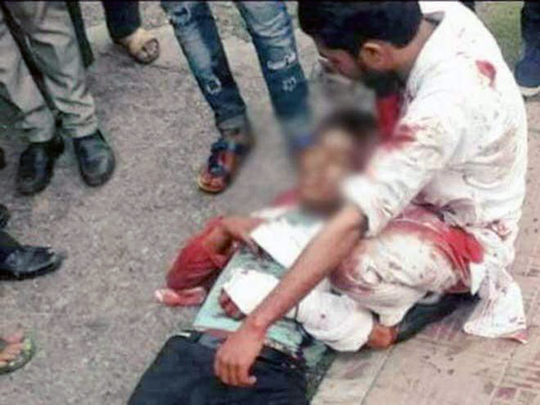
Junaid was stabbed to death while his brothers, Hashim and Sakir--were injured by a mob which also allegedly hurled slurs against them onboard the Delhi-Mathura passenger train between Ballabgarh and Mathura stations on Thursday night.

The arrested accused, before being remanded to police custody by a court in Faridabad district earlier, had told reporters that he was in an inebriated state at the time of the incident and attacked the teenager on being allegedly instigated by fellow passengers.

Also Read: Communal hate crime: Family in shock after 16-yr-old Hafiz-ul-Quran murdered on train

Comments

Mohammed Imran
 - 
Monday, 26 Jun 2017

Now time has came to unite and fight against such goons till our last breath. Will sacrifice for humanity, not be tolerate.

Unseen Baig
 - 
Tuesday, 27 Jun 2017

Suspect state sponsored actions to consolidate Hindu votes. Wondering if all Hindus accept this and throw alliance. Steadfastness and fear of Allah shall prevail against all these pseudo nationalist plans.

Ranjan shetty
 - 
Tuesday, 27 Jun 2017

what is so shocking in this ? it was a street brawl . they taunted and might have hurt hindu sentiments or eve teased Hindu women as it is in their blood .

Ahmed K.C.
 - 
Tuesday, 27 Jun 2017

Mohammed Imran, Udupi,
As soon as you start fighting against such goons, they will label you as 'Terrorist" and you know what happens after that?
According to them:-
One wearing skull cap is a Terrorist
One goes to Madrasa is a Terrorist
One reads Qur'an is a Terrorist
One with Islamic beard is a Terrorist
One who transports a cattle is a Terrorist

All come under one umbrella called "RADICAL ISLAMIC TERRORISM"

Add new comment

  • Coastaldigest.com reserves the right to delete or block any comments.
  • Coastaldigset.com is not responsible for its readers’ comments.
  • Comments that are abusive, incendiary or irrelevant are strictly prohibited.
  • Please use a genuine email ID and provide your name to avoid reject.
News Network
August 4,2020

Bengaluru, Aug 4: Janata Dal (Secular) leader and MLA Satyanarayana passed away today due to multiple organ failure. He was 67.

Satyanarayana was representing Tumakuru’s Sira constituency in the Karnataka Legislative Assembly. He is survived by five daughters and one son.

It is learnt that he was suffering from multiple organ ailments from the past few days and was recently admitted to Manipal Hospital in the city. He breathed his last at 12:20 p.m.

He contested from JDS and worked three times as MLA and 2 times as MP. He was the chairman of KSRTC during the coalition government led by HD Kumaraswamy.

Former Prime Minister HD Devegowda mourned his death and said, “It is a shock to hear the demise of former minister and my close friend. We are friends from the past 3 decades and I cannot recall the days without him.”

Karnataka Pradesh Congress Committee President DK Shivakumar said, “Satyanarayana was concerned for the farmers and he was a gentleman. Hearing the news hurts me and this is an irreparable loss to the political field.”

Comments

Add new comment

  • Coastaldigest.com reserves the right to delete or block any comments.
  • Coastaldigset.com is not responsible for its readers’ comments.
  • Comments that are abusive, incendiary or irrelevant are strictly prohibited.
  • Please use a genuine email ID and provide your name to avoid reject.
News Network
March 15,2020

While it makes perfect sense for IT employees to work from remote locations via video conferencing and collaboration tools seamlessly - especially in the case of tech giants like Google or Microsoft -- workers from the non-IT companies and small and medium enterprises (SMBs) are the worst-hit in India as most of them have little or no clue about how these messaging and collaboration tools work amid the coronavirus pandemic.

Small companies -- from corporate to education verticals -- are scrambling to get their act together as new coronavirus threat has reached their premises, prompting them to send employees home who have age-old laptops, poor network and connectivity with no UPS backups and little knowledge about how to handle group chat and collaboration software like Zoom, Google Hangouts Meet, Microsoft Teams and Flock etc.

Instead of halting operations, however, businesses can choose to shift towards remote working methods with teaching non-IT staff on how to use the latest digital software to connect and work, say industry experts.

The training will take some time and may hamper productivity in the short run but is a win-win situation for the non-tech companies in the long run, in case any such global emergency arises in the future.

According to a latest report by Gartner, 54 per cent of HR leaders have cited that poor technology and/or infrastructure for remote working is the biggest barrier to effective remote working.

Sandy Shen, Senior Director Analyst, Gartner, says that with COVID-19 disrupting the business landscape, CIOs should relook at the digital fulfillment of market demand.

"The value of digital channels, products and operations is immediately obvious to companies everywhere right now. This is a wake-up call for organisations that have placed too much focus on daily operational needs at the expense of investing in digital business and long-term resilience," warned Shen.

Businesses that can shift technology capacity and investments to digital platforms will mitigate the impact of the outbreak and keep their companies running smoothly now, and over the long term.

"Videoconferencing, messaging, collaboration tools and document sharing are just a few examples of technologies that facilitate remote work. Additional bandwidth and network capacity may also be needed, given the increasing number of users and volume of communications," informed Shen.

The IT industry's apex body Nasscom has asked the government to relax norms for a month to allow work-from-home for technology and back-office employees as a measure to deal with the spread of Covid-19 in India.

Networking giant Cisco said that it has seen "significant growth" in the usage of its web conferencing and video-conferencing service Webex in India.

According to Muneer Ahmad, Business Head, ViewSonic India, due to COVID-19 pandemic, the corporate and educational sector is severely getting affected in the country.

"ViewSonic IFP has a cloud-based software which help teachers and corporates to connect through video conferencing to multiple people at the same time and can split the screen into six screens. It can also connect with various tools like Skype, Cisco WebEx, Zoom, Google Hangouts and GoToMeeting," Ahmad told IANS.

Co-working sector has also taken a hit and the industry is looking at several measures to tackle it -- from ensuring supply of juices rich in Vitamin C to supply of disinfectants and giving work from home facilities.

"The scheduled visits of the clients at our co-working offices have been postponed. Few of our clients have cancelled their outstation meetings and have now started audio/video conferencing for virtual meetings," said Nakul Mathur, MD, Avanta India.

According to reports, India has approximately 1,000 co-working locations (as of September 2019) and is the second-largest market for the co-working industry after China.

As India's first licensed B2B Virtual Network Operator, CloudConnect Communications offers a collaborative platform that allows companies to overcome the COVID-19 threat while maintaining seamless business continuity and optimum employee productivity.

"We offer a secure, robust, reliable, scalable and trackable mobile-first unified communication infrastructure that aids remote teleworking so that businesses can continue operating even under any unforeseen circumstances," said Gokul Tandon, Executive Chairman, CloudConnect Communications.

Comments

Add new comment

  • Coastaldigest.com reserves the right to delete or block any comments.
  • Coastaldigset.com is not responsible for its readers’ comments.
  • Comments that are abusive, incendiary or irrelevant are strictly prohibited.
  • Please use a genuine email ID and provide your name to avoid reject.
News Network
June 8,2020

Bengaluru, Jun 8: Facing a shortage of labour, some top builders in the city have initiated efforts to bring back the migrant workers, who have returned to their native places following the COVID-19 lockdown, and are holding parleys with Railway authorities for operation of special trains to ferry them.

After the lockdown was announced, many construction projects came to a halt and accordingly the labourers were rendered jobless. These migrant workers preferred to go back to their home state as they were not paid when the projects were stopped and were caught in the big financial mess. Many of these migrants even chose to cover thousands of kilometres by foot when even trains, buses or any motor vehicles were not operating.

Keeping their woes in view, the Centre decided to run the Shramik Special trains to ferry them to their native places. But, after they were gone, the builders found themselves in a lurch. An executive of a builder told PTI "Yes, our builder and a few others are in talks with the Railways to run the special train to bring back the labourers." She said nothing has been materialised as of now.

According to her, the builders took the contact numbers of the workers when they left the city to their home states and are now contacting them one by one. The South Western Railway has so far sent 3.11 lakh migrant workers in 216 Shramik Special trains starting from May 3 to June 6.

Comments

Add new comment

  • Coastaldigest.com reserves the right to delete or block any comments.
  • Coastaldigset.com is not responsible for its readers’ comments.
  • Comments that are abusive, incendiary or irrelevant are strictly prohibited.
  • Please use a genuine email ID and provide your name to avoid reject.