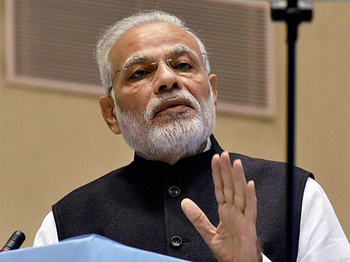
'Killing in the name of cow worship is not acceptable,' says PM Modi

News Network
June 29, 2017

New Delhi, Jun 29: Prime Minister Narendra Modi finally broke his silence on recent incidents of cow protection-related lynchings and violence, saying on Thursday he was "sad" they happened and that "killing in the name of cow worship is not acceptable".modi copy

"No person in this nation has the right to take the law in his or her own hands in this country," Modi said.

Modi said that protecting cows "should be done" and that "no one spoke about protecting cows more than Mahatma Gandhi and Acharya".

He added though that Gandhi wouldn't approve of killing people to protect cows.

"Killing people in the name of Gau Bhakti is not acceptable. This is not something Mahatma Gandhi would approve of," the PM said in an address in Ahmedabad.

Killing people in the name of Gau Bhakti is not acceptable. This is not something Mahatma Gandhi would approve: PM @narendramodi

— PMO India (@PMOIndia) June 29, 2017

Referring to cow vigilantism, Modi said violence won't solve any problems.

"We are a land of non violence. We are the land of Mahatma Gandhi. Why do we forget that...As a society, there is no place for violence. Violence never has and never will solve any problem:," Modi said.

He called for creating a country of "Mahatma Gandhi's dreams".

"Let's all work together. Let's create the India of Mahatma Gandhi's dreams. Let's create an India our freedom fighters would be proud of," he added.

Comments

Wonder Kotian
 - 
Wednesday, 5 Jul 2017

Really it is condemnable, our smartest police forces keeping very closely the real Criminals, do not think \every dogs has its own day\"
master Buffoon which part of the al ain you are leaving???
that's the Head quarters to that, looks fishy in that Criminals all are involved.
Jai Hoo Siddaramanna."

PAR
 - 
Wednesday, 5 Jul 2017

Ranjan Shetty:

Dont make bow bow without fact... It was stabbed by your own hindu brother who was drunken and came to collect his belongings ... When he did not get the item or damaged ... Stupid drunken militant hit him with the knife.

Cheddi color will not work here to destabilize the society... Please stop this evil of your masters here and in mangalore.

Add new comment

  • Coastaldigest.com reserves the right to delete or block any comments.
  • Coastaldigset.com is not responsible for its readers’ comments.
  • Comments that are abusive, incendiary or irrelevant are strictly prohibited.
  • Please use a genuine email ID and provide your name to avoid reject.
News Network
March 18,2020

Bengaluru, Mar 18: Karnataka Chief Minister B S Yeddyurappa on Wednesday said that the lockdown in the state will continue till March 31st. However restaurants and hotels will remain open.

Speaking to reporters here, Yediyurappa had said, "...we need to take more stringent measures, when the US President has recommended avoiding gatherings ofmore than 10 people in his country. We will discuss in the cabinet and take all necessary measures."

Two more coronavirus cases have been registered in Bengaluru on Wednesday, 18 March, taking the total infected cases to 13, ANI reported quoting state Health Minister B Sriramulu.

Meanwhile, Dental clinics in Bengaluru have shut shop after order from Indian Dental Association and Karnataka State Denta Council. The doctors have been advised to treat the patients only if there is an emergency.

In Udupit distrcit, Section 144(3) have been imposed across the district by DC G Jagadish.

No religious events allowed, devotees should not enter temples, churches or Masjid's in groups. Tourist locations closed. Students in PGs and Hostels asked to return home.

While, schools and colleges remained shut, IT professionals and other professionals working in air- conditioned places were advised to work from home. Till Tuesday evening, 13 COVID-19 positive cases have been reported in Karnataka, including one death.

The State government had on March 13 leapt into action announcing lock-down of malls, cinema theatres, pubs and night clubs for a week.

Instructions were also given to stop all kinds of exhibitions, summer camps, conferences, fairs, marriages, sports and engagement events and birthday parties state-wide for a week from Saturday.

While, schools and colleges remained shut, IT professionals and other professionals working in air- conditioned places were advised to work from home. Till Tuesday evening, 11 COVID-19 positive cases have been reported in Karnataka, including one death.

The Ministry of External Affairs confirmed that there are 276 coronavirus infected Indians abroad - 255 in Iran, 12 in UAE, five in Italy, one each in Sri Lanka, Hong Kong SAR, Kuwait, and Rwanda.

Earlier in the day, the total number of confirmed COVID-19 cases in India neared 150, according to the Health Ministry data.

Comments

Add new comment

  • Coastaldigest.com reserves the right to delete or block any comments.
  • Coastaldigset.com is not responsible for its readers’ comments.
  • Comments that are abusive, incendiary or irrelevant are strictly prohibited.
  • Please use a genuine email ID and provide your name to avoid reject.
News Network
January 17,2020

Bengaluru, Jan 17: Chief minister BS Yediyurappa is likely to induct new ministers into his cabinet only after he returns from Davos, Switzerland, on January 25.

Yediyurappa will leave for Davos on January 19 to participate in the World Economic Forum’s 50th annual meet.

Sources say Yediyurappa is keen on expanding his cabinet before he leaves for Davos and is still trying to secure the green signal from BJP national president Amit Shah. However, Shah has cold-shouldered Yediyurappa’s several requests for a meeting to discuss the issue.

Shah is scheduled to visit Karnataka on January 18 to participate in a pro-Citizenship (Amendment) Act rally in Hubballi and the CM plans to corner him there. But, given the time constraint, Yediyurappa is likely to put off the exercise till he returns from Davos even if Shah extends approval.

“Even if Shah gives the green signal, Yediyurappa will have less than 24 hours to expand his cabinet,” a source said. “It is highly unlikely he will rush through the process of inducting ministers. Also, his presence is required to douse disgruntlement which is bound to arise once the new ministers are sworn in.”

The CM and the party high command are on different pages as far as cabinet expansion is concerned. While Yediyurappa is hell-bent on keeping his promise of inducting all the newly elected MLAs, who switched from Congress and JD(S) to the BJP, Shah is keen on sharing vacant berths equally between loyal MLAs and the new entrants. There are 16 cabinet berths vacant.

Shah, sources said, is of the opinion that giving 12 berths to the turncoats will lead to heartburn among loyalists and it will impact the party’s prospects in the next election. “Moreover, he is of the opinion that none of the turncoats have mass appeal, nor do they have any administrative experience. This, he thinks, will impact governance,” said a source.

This has resulted in a deadlock and the issue has dragged on for a month now.

Comments

Add new comment

  • Coastaldigest.com reserves the right to delete or block any comments.
  • Coastaldigset.com is not responsible for its readers’ comments.
  • Comments that are abusive, incendiary or irrelevant are strictly prohibited.
  • Please use a genuine email ID and provide your name to avoid reject.
Ram Puniyani
February 10,2020

Noam Chomsky is one of the leading peace workers in the world. In the wake of America’s attack on Vietnam, he brought out his classic formulation, ‘manufacturing consent’. The phrase explains the state manipulating public opinion to have the public approve of it policies—in this case, the attack of the American state on Vietnam, which was then struggling to free itself from French colonial rule.

In India, we are witness to manufactured hate against religious minorities. This hatred serves to enhance polarisation in society, which undermines India’s democracy and Constitution and promotes support for a Hindu nation. Hate is being manufactured through multiple mechanisms. For example, it manifests in violence against religious minorities. Some recent ghastly expressions of this manufactured hate was the massive communal violence witnessed in Mumbai (1992-93), Gujarat (2002), Kandhamal (2008) and Muzaffarnagar (2013). Its other manifestation was in the form of lynching of those accused of having killed a cow or consumed beef. A parallel phenomenon is the brutal flogging, often to death, of Dalits who deal with animal carcasses or leather.

Yet another form of this was seen when Shambhulal Regar, indoctrinated by the propaganda of Hindu nationalists, burned alive Afrazul Khan and shot the video of the heinous act. For his brutality, he was praised by many. Regar was incited into the act by the propaganda around love jihad. Lately, we have the same phenomenon of manufactured hate taking on even more dastardly proportions as youth related to Hindu nationalist organisations have been caught using pistols, while police authorities look on.

Anurag Thakur, a BJP minster in the central government recently incited a crowd in Delhi to complete his chant of what should happen to ‘traitors of the country...” with a “they should be shot”. Just two days later, a youth brought a pistol to the site of a protest at Jamia Millia Islamia university and shouted “take Azaadi!” and fired it. One bullet hit a student of Jamia. This happened on 30 January, the day Nathuram Godse had shot Mahatma Gandhi in 1948. A few days later, another youth fired near the site of protests against the CAA and NRC at Shaheen Bagh. Soon after, he said that in India, “only Hindus will rule”.

What is very obvious is that the shootings by those associated with Hindu nationalist organisations are the culmination of a long campaign of spreading hate against religious minorities in India in general and against Muslims in particular. The present phase is the outcome of a long and sustained hate campaign, the beginning of which lies in nationalism in the name of religion; Muslim nationalism and Hindu nationalism. This sectarian nationalism picked up the communal view of history and the communal historiography which the British introduced in order to pursue their ‘divide and rule’ policy.

In India what became part of “social common sense” was that Muslim kings had destroyed Hindu temples, that Islam was spread by force, and that it is a foreign religion, and so on. Campaigns, such as the one for a temple dedicated to the Hindu god Rama to be built at the site where the Babri masjid once stood, further deepened the idea of a Muslim as a “temple-destroyer”. Aurangzeb, Tipu Sultan and other Muslim kings were tarnished as the ones who spread Islam by force in the subcontinent. The tragic Partition, which was primarily due to British policies, and was well-supported by communal streams also, was entirely attributed to Muslims. The Kashmir conflict, which is the outcome of regional, ethnic and other historical issues, coupled with the American policy of supporting Pakistan’s ambitions of regional hegemony, (which also fostered the birth of Al-Qaeda), was also attributed to the Muslims.

With recurring incidents of communal violence, these falsehoods went on going deeper into the social thinking. Violence itself led to ghettoisation of Muslims and further broke inter-community social bonds. On the one hand, a ghettoised community is cut off from others and on the other hand the victims come to be presented as culprits. The percolation of this hate through word-of-mouth propaganda, media and re-writing of school curricula, had a strong impact on social attitudes towards the minorities.

In the last couple of decades, the process of manufacturing hate has been intensified by the social media platforms which are being cleverly used by the communal forces. Swati Chaturvedi’s book, I Am a Troll: Inside the Secret World of the BJP’s Digital Army, tells us how the BJP used social media to spread hate. Whatapp University became the source of understanding for large sections of society and hate for the ‘Other’, went up by leaps and bounds. To add on to this process, the phenomenon of fake news was shrewdly deployed to intensify divisiveness.

Currently, the Shaheen Bagh movement is a big uniting force for the country; but it is being demonised as a gathering of ‘anti-nationals’. Another BJP leader has said that these protesters will indulge in crimes like rape. This has intensified the prevalent hate.

While there is a general dominance of hate, the likes of Shambhulal Regar and the Jamia shooter do get taken in by the incitement and act out the violence that is constantly hinted at. The deeper issue involved is the prevalence of hate, misconceptions and biases, which have become the part of social thinking.

These misconceptions are undoing the amity between different religious communities which was built during the freedom movement. They are undoing the fraternity which emerged with the process of India as a nation in the making. The processes which brought these communities together broadly drew from Gandhi, Bhagat Singh and Ambedkar. It is these values which need to be rooted again in the society. The communal forces have resorted to false propaganda against the minorities, and that needs to be undone with sincerity.

Combating those foundational misconceptions which create hatred is a massive task which needs to be taken up by the social organisations and political parties which have faith in the Indian Constitution and values of freedom movement. It needs to be done right away as a priority issue in with a focus on cultivating Indian fraternity yet again.


Comments

Add new comment

  • Coastaldigest.com reserves the right to delete or block any comments.
  • Coastaldigset.com is not responsible for its readers’ comments.
  • Comments that are abusive, incendiary or irrelevant are strictly prohibited.
  • Please use a genuine email ID and provide your name to avoid reject.