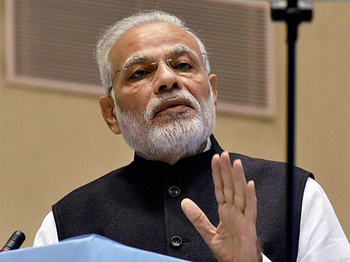
'Killing in the name of cow worship is not acceptable,' says PM Modi

News Network
June 29, 2017

New Delhi, Jun 29: Prime Minister Narendra Modi finally broke his silence on recent incidents of cow protection-related lynchings and violence, saying on Thursday he was "sad" they happened and that "killing in the name of cow worship is not acceptable".modi copy

"No person in this nation has the right to take the law in his or her own hands in this country," Modi said.

Modi said that protecting cows "should be done" and that "no one spoke about protecting cows more than Mahatma Gandhi and Acharya".

He added though that Gandhi wouldn't approve of killing people to protect cows.

"Killing people in the name of Gau Bhakti is not acceptable. This is not something Mahatma Gandhi would approve of," the PM said in an address in Ahmedabad.

Killing people in the name of Gau Bhakti is not acceptable. This is not something Mahatma Gandhi would approve: PM @narendramodi

— PMO India (@PMOIndia) June 29, 2017

Referring to cow vigilantism, Modi said violence won't solve any problems.

"We are a land of non violence. We are the land of Mahatma Gandhi. Why do we forget that...As a society, there is no place for violence. Violence never has and never will solve any problem:," Modi said.

He called for creating a country of "Mahatma Gandhi's dreams".

"Let's all work together. Let's create the India of Mahatma Gandhi's dreams. Let's create an India our freedom fighters would be proud of," he added.

Comments

Wonder Kotian
 - 
Wednesday, 5 Jul 2017

Really it is condemnable, our smartest police forces keeping very closely the real Criminals, do not think \every dogs has its own day\"
master Buffoon which part of the al ain you are leaving???
that's the Head quarters to that, looks fishy in that Criminals all are involved.
Jai Hoo Siddaramanna."

PAR
 - 
Wednesday, 5 Jul 2017

Ranjan Shetty:

Dont make bow bow without fact... It was stabbed by your own hindu brother who was drunken and came to collect his belongings ... When he did not get the item or damaged ... Stupid drunken militant hit him with the knife.

Cheddi color will not work here to destabilize the society... Please stop this evil of your masters here and in mangalore.

Add new comment

  • Coastaldigest.com reserves the right to delete or block any comments.
  • Coastaldigset.com is not responsible for its readers’ comments.
  • Comments that are abusive, incendiary or irrelevant are strictly prohibited.
  • Please use a genuine email ID and provide your name to avoid reject.
Agencies
February 6,2020

Even more than three years after demonetisation and all-out efforts to make most transactions through electronic, cash is still king, as it thrives in a digital India, said fintech start-up Paytm founder Vijay Sekhar Sharma.

"While cashless economy is not possible in India, less cash economy will be in the future. Less cash is the only solution, not the elimination of cash," Sharma told IANS in an interview after unveiling an all-in-one payment gateway on Tuesday.

Asserting that it would take 5-10 years for India to make the transition to digital payments from the traditional mode of cash, Sharma, 41, said the e-payment industry benefitted more from the November 8, 2016 note ban and withdrawal of old Rs 1,000 and Rs 500 denominations.

"I think it (demonetisation) helped the industry despite lack of specific help. But the world has changed since then. It is about the scale of distribution of merchants that is what is propelling digital payments," said Sharma.

Most of the cash not only came back into circulation, but also remains as the mode of payment for the majority due to its convenience for the people used to such transactions.

Expounding Paytm's zero service charge, Sharma said the strategy is sustainable as it leads to acquiring more customers and merchants, enabling newer business opportunities.

Paytm also does not levy a service charge to small merchants for its payments services, unlike organised players like Uber.

"Though there is a monetisation model, the merchants who are small shopkeepers, become our financial services customers as they open a bank account, which is profitable."

Paytm secured a Payments Bank license from the Reserve Bank of India to offer a savings bank account, Rupay debit card and money transfer services.

"We are banking on payment services acquiring customers and merchants who avail banking, lending, insurance, wealth and software services like billing software and business ledger software services eventually," Sharma noted.

The mobile first bank services include zero balance and zero digital transaction charge accounts.

"Basically, payments, cloud, commerce and financial services are a cohort we follow. So, payments is our customer as well as merchant acquisition. If it breaks even, we are happy because other line items make more money, he affirmed.

Noting that in a market like India, one cannot price services at a premium unlike in a developed country like the US, the billionaire businessman said a consumer in a developing country would not be able to afford such a hefty charge.

Forbes ranked Sharma as India's youngest billionaire in 2017, with a net worth of $2.1 billion.

While several countries operate on the model of higher service charges, Sharma said newer business models have to be discovered in India, as customer lifecycle value is accounted for more stages than in other nations.

Asked about an upscale retailer like Zara not giving a wallet payment option during its recent end of season sale in Bengaluru, Sharma said Paytm was addressing such hiccups with its all-in-one payment solutions.

"It's an opportunity, because if the retailer has our all-in-one point of sale machine, where in they enter the amount, it shows both the Quick Response code (QR) and card payment options," he observed.

Sharma compared older swiping payment machine to feature phones and modern ones to feature-rich smartphones.

"If you notice, they look like feature phones and the modern day card machine is more a smartphone like. You can add the smatphone components, which can add the features," reiterated Sharma.

Though Paytm's all-in-one QR point of sale machine integrates the billing system, its chief executive said it was not ideal to have an independent QR feature.

Paytm has 16 million strong merchant user base, which Sharma aims to raise to 26 million base in the next one year.

Sharma has launched in this tech city an all-in-one payment gateway and Paytm Business Payments solution, which enable digital payments through multiple methods for small and medium enterprises (SMEs) and an Android point of sale machine.

With the new gateway solution, collecting digital payments through multiple methods can be achieved seamlessly while Paytm Business Payments solution enables automated vendor payments, including employee salaries and customer refunds among others.

The One97 Communications-owned Paytm aims to help SMEs streamline and digitise their business activities using its new solutions, which enhance the overall efficiency of both accepting and making payments.

Paytm has a data bank of over 200 million saved cards and bank accounts, a feature which enables partner apps to shorten transaction times and propel faster conversions while using the all-in-one payment gateway.

Complementing the two solutions, Sharma also launched an all-in-one Android point of sale machine, which can accept payments through all forms such as cards, wallets, UPI apps and even cash.

The device has a QR code that supports all contact and contactless payments, coming with integrated billing software customized solutions for different sectors such as catering, ticketing, parking and others.

The handheld Android device is equipped with an in-built printer, scanner and can also generate bills.

Valued at $16 billion, Paytm is not alone in the fiercely competitive Indian fintech space where a dozen players like PhonePe, MobiKwik, Kotak 811 and deep pocketed international giants Google Pay and Amazon Pay are in the fray.


Comments

Add new comment

  • Coastaldigest.com reserves the right to delete or block any comments.
  • Coastaldigset.com is not responsible for its readers’ comments.
  • Comments that are abusive, incendiary or irrelevant are strictly prohibited.
  • Please use a genuine email ID and provide your name to avoid reject.
coastaldigest.com news network
February 23,2020

Mangalore University has been participating in the campus bird count a sub-event of ‘Great backyard bird count’ (GBBC) organized by Bird Count India for the past 5 years. This year, CBC was held from 14th to 17th February of 2020 across various campuses in India.

This year the four days event was successfully ended up with the sightings of 103 species of birds from various locations across the campus spread on 300 acres. In this Black Drongo, Black Kite, Brahminy Kite, Common Iora, Green Wabler, Purple-rumed Sunbird, Red-whiskered Bulbul, White-cheeked Barbet, Jungle Babbler and Plum headed parakeets were the common birds, and also observed House Crow with nest and nestlings, Indian Robin nest with eggs, Bronzed Drongo constructing the nest and Shikra mating and carrying nesting materials.  Whereas Yellow-billed Babbler is rare in the campus, Ashy Drongo, Barn Swallow, Booted Eagle, Grey Wagtail, Indian Pitta etc. were migratory birds, Grey-headed Bulbul (Near Threatened bird), Rufous Babbler and Grey-headed Bulbul were Western Ghats Endemics  and Brown Wood Owl, Barn Owl, Spotted Owlet, Nightjars (Savanna, Indian and Jerdon’s) and Sri Lanka Frogmouth were nocturnal birds. Blue-eared Kingfisher Grey-bellied Cuckoo which was very rare and new additions to avian list of the campus.

In the first year (2016) of Mangalore University’s CBC recorded 77 species, in 2017 recorded 95 species, in 2018 recorded 110 species and in 2019 recorded 107 species of birds. However some of the common species like Rose ringed parakeets, Blue tailed bee-eater, Nilgiri Flowerpecker and Indian roller etc., sighted last year were not seen this year. But with 2 new additions from this CBC, the checklist of Mangalore University Campus has been updated with a total of 141 species.

This event was coordinated by Vivek Hasyagar from the Department of Applied Zoology and Maxim Rodrigues from the Department of Marine Geology. Survey trails were led by more than 60 students and research scholars from various Departments of Mangalore University includes Applied Zoology, Biosciences, Microbiology, Botany, Physics, Chemistry and Material Science.  In addition, some enthusiastic participants from St. Aloysius College had involved in identifying the birds around the campus.

Quote:

Wild/planned fire affects negatively on the existing ecologically sensitive areas in and around the campus especially in lateritic grasslands. Because many insectivorous birds are dependent on these lateritic grassland habitats for their food and breeding grounds for many ground dwelling birds like Yellow wattled lapwing, Red wattled lapwing, Indian Robin and Barred buttonquails. Conserving these habitats will be helpful in protecting these birds.

Quotes from the participants: “The Campus Bird Count 2020 at Mangalore University was an experience of its own kind. Observing birds in their natural habitat gave me new perspective of viewing them not only as another living being, but as equals, or even of higher intelligence. The Campus Bird Count is an important step towards documenting bird life year after year, and creating awareness amongst youngsters, so that proper conservation steps can be taken to protect them from human interference”.

-Jyotsna Dessai ( 1 M.Sc Zoology)

Comments

Add new comment

  • Coastaldigest.com reserves the right to delete or block any comments.
  • Coastaldigset.com is not responsible for its readers’ comments.
  • Comments that are abusive, incendiary or irrelevant are strictly prohibited.
  • Please use a genuine email ID and provide your name to avoid reject.
coastaldigest.com news network
May 12,2020

Manama: Kannada Sangha Bahrain President Mr. Pradeep Shetty and Vice President of Bahrain's prestigious KHK HEROES Foundation Mohammed Mansoor on Monday, May 11, met The Second Secretary (Consular & CW) of the Embassy of India, Bahrain Mr. P. K. Chowdhury in the Indian Embassy. 

The situation, problems and relief of Indians and Kannadigas residing in Bahrain during the COVID 19 Pandemic was discussed in detail. The distribution of food (dry ration) kits, as well as those seeking repatriation, was also discussed in the meeting.

When asked about the repatriation of distressed Kannadigas, the Second Secretary said that though the number of Kannadigas who wish to return home is not much compared to the rest of the states, still Embassy is compiling all the information and will do the needful soon. 

Mr. Shetty and Mr. Mansoor told the Second Secretary that those who are in problem can contact them and they are ready to do their best.

Comments

Add new comment

  • Coastaldigest.com reserves the right to delete or block any comments.
  • Coastaldigset.com is not responsible for its readers’ comments.
  • Comments that are abusive, incendiary or irrelevant are strictly prohibited.
  • Please use a genuine email ID and provide your name to avoid reject.