


King Salman’s team takes charge in Saudi Arabia

February 2, 2015

Jeddah, Feb 2: Saudi Arabia is all set for a new era under Custodian of the Two Holy Mosques King Salman as the newly appointed ministers and regional governors took oath of office in front of the king at Al-Yamamah Palace on Sunday.
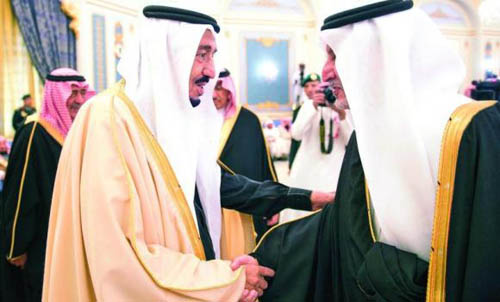
team

King Salman urged the new governors and ministers to give top priority for the welfare and prosperity of citizens. “May Allah help us all to serve our religion, nation and people,” the king said in a brief speech.

He expressed his confidence in the new governors and ministers who took oath of office on Sunday, describing them as “the roots of this country founded by King Abdul Aziz.”

He highlighted Saudi Arabia’s position as the heart of the Muslim world and the cradle of Islam.

King Salman called upon Saudis to strengthen their unity and solidarity to bolster the Kingdom’s security and stability. He noted the great contributions made by previous kings.

“King Abdullah always advised me to give top priority for our citizens and our religion,” the king said.

Makkah Gov. Prince Khaled Al-Faisal, Riyadh Gov. Prince Faisal bin Bandar, State Minister Prince Mansour bin Miteb, National Guard Minister Prince Miteb bin Abdullah, Defense Minister Prince Mohammed bin Salman, and Islamic Affairs Minister Saleh Al-Asheikh, Education Minister Azzam Al-Dakhil and Culture and Information Minister Adel Al-Toraifi were sworn in during the ceremony. They swore separately: “In the name of Allah, the most gracious, the most merciful, I swear by Allah Almighty to be loyal to my religion, king and country, and not to divulge the state secrets, to maintain its interests and regulations, and to perform my duties sincerely, honestly and faithfully.”

Other ministers who took oath were: Justice Minister Walid Al-Samaani, State Minister Matlab Al-Nafeesa, State Minister Musaed Al-Aiban, Petroleum and Mineral Resources Minister Ali Al-Naimi, Finance Minister Ibrahim Al-Assaf, Water and Electricity Minister Abdullah Al-Hussayen and Labor Minister Adel Fakeih.

Housing Minister Shuwaish Al-Dhuwaihi; Haj Minister Bandar Hajjar; Economy and Planning Minister Mohammed Al-Jasser, Minister of Commerce and Industry Tawfiq Al-Rabiah, Minister of State for Shoura Affairs Mohammed Abusaq, Minister of State Essam bin Saeed; Minister of Transport Abdullah Al-Muqbil, Minister of Communications and Information Technology Mohammed Al-Suwaiyel; Minister of Social Affairs Majed Al-Qassabi, Minister of State Saad Al-Jabri, Minister of State Mohammed Al-Asheikh; Minister of Municipal and Rural Affairs Abdul Latif Al-Asheikh; Minister of Health Dr. Ahmed Al-Khateeb; Minister of Civil Service Khaled Al-Araj, Minister of Agriculture Abdul Rahman Al-Fadli, and Assistant Shoura President Yahya Al-Samaan.

In a statement after taking oath, Al-Toraifi thanked King Salman for the appointment. “I thank the king for the trust bestowed on me. I value this trust and I am proud of it. I hope that I will live up to the expectations.”

Abdul Rahman Al-Zamil, president of the Council of Saudi Chambers, said he expected a new era of cooperation between the public and private sectors during King Salman’s era.

“There has been high optimism in business circles after King Salman ascended the throne,” he said.

Al-Zamil commended King Salman’s open-door policy that gave an opportunity for citizens to present their complaints to government departments. “We know King Salman for the last 50 years as governor of Riyadh,” he said while praising his efforts to make Riyadh a world-class city.

Samira Al-Suwayegh, chairperson of the Executive Council for Businesswomen at Asharqia Chamber, said the new decisions issued by the king would help achieve sustainable development. “It will also open new horizons of progress in the economic sector and open the door for women to participate in economic and investment ventures inside and outside the Kingdom,” she said.

Rima Al-Shahrani, a businesswoman, said King Salman’s programs would have a positive impact on the national economy and create more job opportunities for Saudi men and women. “It will also improve the living condition of citizens across the country,” she added.

Comments

MURUGAN RAMASAMY
 - 
Wednesday, 24 Feb 2016

Dear king of Saudi..

I am murugan Ramasamy from tamilnadu in India. Now I am very difficult situation so please help me in my features.. Now money is world. So life us big war .. We are victory of our sosaity . please donated some money. I will Expectations yous help. Thank you.

Add new comment

  • Coastaldigest.com reserves the right to delete or block any comments.
  • Coastaldigset.com is not responsible for its readers’ comments.
  • Comments that are abusive, incendiary or irrelevant are strictly prohibited.
  • Please use a genuine email ID and provide your name to avoid reject.
News Network
June 12,2020

Beirut, Jun 12: Angry Lebanese protesters blocked roads across the country with burning tyres, debris and their vehicles, incensed over the local currency's depreciation by more than 25 percent in just two days.

The demonstrations from northern Akkar and Tripoli to central Zouk, the eastern Bekaa Valley, Beirut and southern Tyre and Nabatieh on Thursday were some of the most widespread in months of upheaval over a calamitous economic and financial crisis.

Protesters set ablaze a branch of the Central Bank, vandalised several private banks and clashed with security forces in several areas. At least 41 people were injured in Tripoli alone, according to the Lebanese Red Cross.

"I'm really pissed off, that's all. If politicians think they can burn our hearts like this the fire is going to reach them too," unemployed computer engineer Ali Qassem, 26, told Al Jazeera after pouring fuel onto smouldering tyres on a main Beirut thoroughfare.

Tens of thousands of Lebanese have lost jobs in the past six months and hundreds of businesses have shuttered as a dollar shortage led the Lebanese pound to slide from 1,500 to $1 last summer - where it was pegged for 23 years - to roughly 4,000 for each US dollar last month.

But the slide turned into a freefall between Wednesday and Thursday when the pound plummeted to roughly 5,000 to $1 on black markets, which have become a main source of hard currency. There was widespread speculation the rate hit 6,000 or even 7,000 pounds to the dollar, though most markets stopped trading.

Protesters began amassing on streets across the country before sunset and increased into the thousands across the country as the night fell.

Prime Minister Hassan Diab cancelled all meetings scheduled for Friday to hold an emergency cabinet session at 9:30am and another at 3pm at the presidential palace to be headed by President Michel Aoun.

The pound's collapse is the perhaps the biggest challenge yet for Diab's young cabinet, which gained confidence in February after former prime minister Saad Hariri's government was toppled by an unprecedented October uprising that had the country's economic crisis at its core.

Economy Minister Raoul Nehme told Al Jazeera that there was "disinformation" being circulated about the exchange rate on social media and said he was investigating possible currency manipulation.

"I don't understand how the exchange rate increased by so much in two days," he said.

Many protesters have pitted blame on Central Bank governor Riad Salameh, nominally in charge of  keeping the currency stable. But they have also called on the government to resign.

"If people want reform between dawn and dusk, that's not going to work, and if someone thinks they can do a better job then please come forward," Nehme said.

"But what we can't have is a power vacuum - then the exchange rate won't be 5000, it'll be a catastrophe."

'Everyone paying the price'

When protesters set a large fire in Beirut's Riad al-Solh Square, which lies at the foot of a grand Ottoman-era building that serves as the seat of government, firefighters did not intervene to extinguish it.

It later became clear why: Civil Defence told local news channel LBCI they had run out of diesel to fuel their firetrucks.

Basic imports such as fuel have been hit hard by the currency crisis, making already-weak state services increasingly feeble.

A half-dozen or so police officers with Lebanon's Internal Security Forces observed the scene unfolding in front of them in the square.

"Why do you destroy shops and things and attack us security forces - do you think we're happy? Go and f****** break that wall or go to the politicians' houses," one police officer told Al Jazeera, referring to a large concrete barrier separating protesters from the seat of government.

"In the end we are with you and we want the country to change. Don't you dare think we're happy. My salary is now worth $130," the officer said.

The currency's spectacular fall seems to have pushed many Lebanese to put common interests above their differences.

Large convoys of men on motorbikes from Shia-majority areas of southern Beirut joined the demonstrations on Thursday, though they have clashed with protesters many times before - including at a protest on Saturday.

Some chanted sectarian insults, leading to brief clashes in areas that were formerly front lines during the country's devastating 15-year civil war.

Instead, the motorbike-riding demonstrators on Thursday chanted: "Shia, Sunni, F*ck sectarianism."

"We are Shia, and Sunnis and Christian are our brothers," Hisham Houri, 39, told Al Jazeera, perched on a moped with his fiancee behind him just a few metres from a pile of burning tyres.

The blaze sent thick black smoke into the sky towards an iconic blue-domed mosque and church in downtown Beirut.

"Politicians play on these sectarian issues and sometimes succeed, but in the end, they'll fail because all the people have been hurt," he said. "The dollar isn't just worth 6,000 for Shias or for Sunnis, everyone is paying that price."

Comments

Add new comment

  • Coastaldigest.com reserves the right to delete or block any comments.
  • Coastaldigset.com is not responsible for its readers’ comments.
  • Comments that are abusive, incendiary or irrelevant are strictly prohibited.
  • Please use a genuine email ID and provide your name to avoid reject.
KT
June 30,2020

Dubai, Jun 30: The UAE Embassy in India on Tuesday urged expats stranded in India to procure travel approvals from the Federal Authority for Identity and Citizenship (ICA) in the UAE ahead of their travel to the UAE.

It has also assured UAE residence visa holders that a no-objection letter to travel would be issued on a humanitarian basis, as long as the resident meets all conditions set by the government of UAE.

The UAE Embassy in New Delhi tweeted Tuesday morning, "The @UAEembassyIndia would like to draw the attention of the valid UAE residence permit holders currently present in India, to the necessity of obtaining necessary approval from the @ICAUAE while ensuring that all conditions set by the UAE competent authorities are observed."

It added, "Please note that UAE will issue no objection letter to travel in some humanitarian cases only that meet all conditions and requirements."

The embassy also affirmed its commitment to the decisions of the Indian authorities regarding the continued closure of airports in India, and implementation of some restrictions that do not allow foreign airlines to carry passengers.

"We express our thank for your cooperation and your understanding of the current global situation, and in case there is any developments in this regard, we will publish it on the official platforms of embassy (sic)," the Embassy tweeted.

Comments

Add new comment

  • Coastaldigest.com reserves the right to delete or block any comments.
  • Coastaldigset.com is not responsible for its readers’ comments.
  • Comments that are abusive, incendiary or irrelevant are strictly prohibited.
  • Please use a genuine email ID and provide your name to avoid reject.
News Network
January 12,2020

Dubai, Jan 12: Saudi Arabian oil giant Aramco announced Sunday that its initial public offering raised a record $29.4 billion, a figure higher than previously announced, after the company used a so-called "greenshoe option" to sell millions more shares to meet investor demand.

The company said that the sale of an additional 450 million shares took place during the initial public offering process.

The oil and gas company, which is majority owned by the state, began publicly trading on the local Saudi Tadawul exchange on December 11. It hit hit upwards of $10 a share on the second day of trading. This gave Aramco a market capitalization of $2 trillion, making it comfortably the world's most valuable company.

Aramco's additional sales mean the company has publicly floated 1.7% of its shares. It's IPO, even before the added sales, was the world's largest ever.

The shares sold in the over-allotment option "had been allocated to investors during the book-building process and therefore, no additional shares are being offered into the market today," Aramco said.

Company shares traded down on Sunday, dipping to around 34.7 riyals, or $9.25 a share, amid heightened tensions in the Persian Gulf between Iran and the United States. Aramco was a target of rising tensions over the summer when a missile and drone attack, which Saudi Arabia and the US blame on Iran, temporarily halved its production.

Sunday's trading figures value Aramco at $1.85 trillion, still well ahead of Apple, the second largest company in the world after Aramco, but below the $2 trillion mark sought by Crown Prince Mohammed bin Salman.

Comments

Add new comment

  • Coastaldigest.com reserves the right to delete or block any comments.
  • Coastaldigset.com is not responsible for its readers’ comments.
  • Comments that are abusive, incendiary or irrelevant are strictly prohibited.
  • Please use a genuine email ID and provide your name to avoid reject.