


Kolkata flyover collapse: Toll rises to 24, rescue ops on through night

April 1, 2016

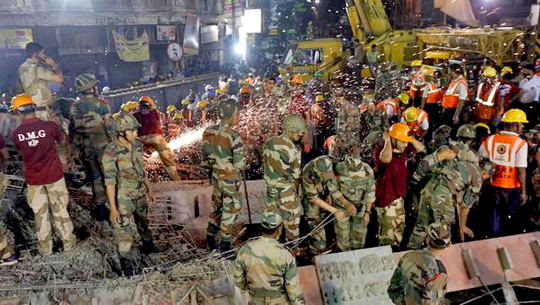
Kolkata, Apr 1: Death toll in the flyover collapse in Kolkata rose to 24 on Friday as the army and other emergency workers battled through Thursday night to rescue dozens of people still trapped under the debris.
flyover1

Doctors and paramedics of the army worked throughout the night to treat those rescued from the debris even as the state government ordered a high-level probe into the incident. The official death toll was 21.

Around 250 metres of the under-construction 2.2 kilometre-long Vivekananda Road flyover crashed onto dense traffic around 12.30 pm on Thursday near one of the city's most important business districts, Burrabazar.

PTI, quoting police, said 15 of the dead were identified while the identification process of the rest were on.

Anil Shekhawat, a spokesman for the National Disaster Response Force (NDRF), said seventeen survivers out of 92 rescued were still undergoing treatment at hospital, according to AFP.

Most suffered multiple fractures and were in a critical condition, Shekhawat added, saying that the death toll was expected to rise, with an unknown number of people still trapped under the wreckage.

Specialist rescue teams armed with concrete and metal cutters, drilling machines, sensors to detect life and sniffer dogs were sifting through the rubble.

Anurag Gupta, a spokesman for the National Disaster Management Authority, told AFP hundreds of rescuers would work through the night to rescue the trapped victims.

“Four hundred men from NDRF and 300 Indian army men along with hundreds of police and local officials are at the spot,” Gupta said.

Authorities sealed off the accident site to members of the public, who in the initial hours were seen trying to pull away concrete slabs with their bare hands.

Workers struggled to get cranes and other large machinery through the narrow streets of Burrabazar, one of the oldest and most congested parts of the city, where locals desperately waited for news of missing loved ones.

Like a bomb blast'

“Everything is finished,” screamed Parbati Mondal, whose fruit-seller husband had not been seen since the accident.

An injured builder told AFP at the scene that he had been working on the structure before it collapsed and had seen bolts come out of the metal girders.

“We were cementing two iron girders for the pillars, but the girders couldn't take the weight of the cement,” said 30-year-old Milan Sheikh before being taken away to hospital.

“The bolts started coming out this morning and then the flyover came crashing down.”

Many locals said they were fleeing their houses for fear that more of the damaged structure could collapse.

“We heard a massive bang sound and our house shook violently. We thought it was an earthquake,” 45-year-old resident Sunita Agarwal told AFP.

“We're leaving -- who knows what will happen next.”

An eyewitness at the scene described a loud bang “like a bomb blast and suddenly there was a lot of smoke and dust”.

Problem started during concrete casting

Problems started with the under-construction Vivekanand Road flyover here during midnight of Wednesday-Thursday when concrete casting was being done, construction workers said, reports IANS.

Sunil Sarkar, who was among those doing the concrete casting, said: “The bolt was coming apart as the bucket could not hold it. I think the sunshade in that particular place was made too big.”

Sarkar, now in hospital after sustaining injury, said a technician was called who welded the bolt in place.

“Our supervisors assured us that everything was in order and asked us to go ahead with the concrete casting.”

“The casting continued till noon today (Thursday). When the work was almost complete, the same part caved in and the flyover gave away,” said the resident of Murshidabad district.

Probe ordered

Meanwhile, chief secretary Basudeb Banerjee said on Thursday that a high level inquiry has been ordered into the flyover collapse while the city police commissioner Rajeev Kumar handed over a report about the incident to the chief minister Mamata Banerjee.

West Bengal Governor K N Tripathi, who visited the spot, has sought a report of the incident from the state government.

Comments

Pramod
 - 
Thursday, 31 Mar 2016

thank god before finishing only its collapsed, incase vehicle s movable so many lives would have been lost, please find the contractor and cancel his license.

Add new comment

  • Coastaldigest.com reserves the right to delete or block any comments.
  • Coastaldigset.com is not responsible for its readers’ comments.
  • Comments that are abusive, incendiary or irrelevant are strictly prohibited.
  • Please use a genuine email ID and provide your name to avoid reject.
Agencies
July 5,2020

The deadly coronavirus that entered India while there was still nip in the air has beaten rising mercury, humid conditions, unique Indian genome and has entered monsoon season with more potency as fresh cases are only breaking all records in the country.

India recorded a single-day spike of record 24,850 new coronavirus cases on Sunday, taking its total tally to 6.73 lakh corona-positive cases.

Top Indian microbiologists were hopeful in March that after the 21-day lockdown, as summer approaches, the rise in temperature would play an important role in preventing the drastic spread of COVID-19 virus in India.

Several virologists hinted that by June this year, the impact of COVID-19 would be less than what it appeared in March-April.

The claims have fallen flat as the virus is mutating fast, becoming more potent than ever.

According to experts, the novel coronavirus is a new virus whose seasonality and response to hot humid weather was never fully understood.

"The theory was based on the fact that high temperatures can kill the virus as in sterilisation techniques used in healthcare. But these are controlled environment conditions. There are many other factors besides temperature, humidity which influence the transmission rate among humans," Dr Anu Gupta, Head, Microbiologist and Infection Control, Fortis Escorts Heart Institute, told IANS.

There is no built-up immunity to COVID-19 in humans.

"Also, asymptomatic people might be passing it to many others unknowingly. New viruses tend not to follow the seasonal trend in their first year," Gupta emphasized.

Globally, as several countries are now experiencing hot weather, the World Health Organization (WHO) reported a record hike in the number of coronavirus cases, with the total rising by 2,12,326 in 24 hours in the highest single-day increase since COVID-19 broke out.

So far over 11 million people worldwide have tested positive for the disease which has led to over 5,25,000 deaths, according to data from Johns Hopkins University. The US remained the worst-hit country with over 28 lakh cases, followed by Brazil with 15.8 lakh.

According to Sandeep Nayar, Senior Consultant and HOD, Respiratory Medicine, Allergy & Sleep Disorders, BLK Super Speciality Hospital in New Delhi, whether temperature plays a role in COVID-19 infection is highly debated.

One school of thought said in the tropical regions of South Asia, the virus might not thrive longer.

"On the other hand, another school of thought has found that novel Coronavirus can survive in a hot and humid environment and tropical climate does not make a difference to the virus. According to them, this is what distinguishes the novel coronavirus from other common viruses, which usually wane in hot weather," stressed Nayar.

Not much has been studied in the past and no definite treatment or vaccine is available to date.

"Every day, new properties and manifestation of the disease come up. As of now, the only way to prevent this monster is by taking appropriate precautions. Hand hygiene, social distancing, cough etiquette and face masks definitely reduce spread of COVID-19 infection," Nayar told IANS.

Not just top Indian health experts, even Indian-American scientists had this theory in mind that sunshine and summer may ebb the spread of the coronavirus.

Ravi Godse, Director of Discharge Planning, UPMC Shadyside Pennsylvania in the US told IANS in April: "In the summer, the humidity can go up as well, meaning more water drops in the air. If the air is saturated with water and somebody sneezes virus droplets into such air, it is likely that the droplets will fall to the ground quicker, making them less infectious. So the short answer is yes, summer/sunshine could be bettera.

According to Dr Puneet Khanna, Head of Respiratory Medicine and Pulmonology, Manipal Hospital, Delhi, COVID-19 death rates are not too different in tropical countries but since the disease affected them late it was yet to show its peak in these areas.

"The virus can survive well in hot and humid countries and this is proven now," he stressed.

Comments

Add new comment

  • Coastaldigest.com reserves the right to delete or block any comments.
  • Coastaldigset.com is not responsible for its readers’ comments.
  • Comments that are abusive, incendiary or irrelevant are strictly prohibited.
  • Please use a genuine email ID and provide your name to avoid reject.
News Network
March 3,2020

Dubai, Mar 3: Abu Dhabi-based Indian retail tycoon MA Yusuff Ali has become the first Indian to receive Saudi Arabia's premium residency, his office said in a statement on Monday.

Yusuff Ali, 64, is the chairman of the LuLu Group, who was ranked the richest expat in the UAE by the Forbes magazine last year.

The permit, informally known as Saudi Green Card, grants expatriates the right to live, work and own business and property in the Kingdom without need for a sponsor, the LULU group said in a statement.

The introduction of the Premium Residency comes as a part of Saudi Arabia's Vision 2030 reform plan, which was announced by Crown Prince Mohammed bin Salman to boost the Saudi economy, the statement said.

Yusuff Ali said "obviously a very proud and humbling moment in my life. This is a great honour not only for me but for the entire Indian expat community and I sincerely thank the HM the King Salman, HRH Crown Prince Mohamed bin Salman and the government of Saudi Arabia."

"@Yusuffali_MA , an investor from India, after obtaining Premium Residency in Saudi Arabia: ''The Kingdom became an attractive investment destination due to the remarkable growth in economy," Premium Residency tweeted on Monday.

Yusuff Ali said he was sure that this new permanent residency initiative will further boost Saudi Arabia's image as one of the key investments and business hubs of the region as well as attract and retain new investors.

This initiative is targeting key investors and prominent personalities from various fields, including sports, arts & culture, who have played a defining role in the nation building process.

The Lulu Group owns and operates more than 35 hypermarkets and supermarkets in Saudi Arabia, which includes ARAMCO Commissaries and National Guards super stores.

Comments

Add new comment

  • Coastaldigest.com reserves the right to delete or block any comments.
  • Coastaldigset.com is not responsible for its readers’ comments.
  • Comments that are abusive, incendiary or irrelevant are strictly prohibited.
  • Please use a genuine email ID and provide your name to avoid reject.
News Network
July 22,2020

New Delhi, Jul 22: Sir Philip Barton visited Bengaluru on Tuesday in the first of the series of virtual regional visits as the UK's new High Commissioner and called Chief Minister BS Yeddyurappa, business leaders, and startup community to pitch for new momentum in the already strong UK-Karnataka relationship.

During his virtual call, High Commissioner Barton got a 'real' taste of Bengaluru through a traditional Masala Dosa delivered to his residence in Delhi along with authentic south Indian filter coffee, which he relished over a chat with historian and commentator Ramachandra Guha. They discussed the unique UK-India "living bridge" across culture and cuisine, history and heritage, and sports and science.

Both Yeddyurappa and the British envoy restated their commitment to working together on the immediate challenges of Covid-19 and beyond.

Barton subsequently 'traveled' to Electronics City, where he met with a range of key business leaders to discuss deepening the UK-India tech partnership and opportunities for global investors in the UK.

Barton also met with a group of entrepreneurs, business founders and innovators, who were part of the first GoGlobal UK cohort to explore the dynamic UK market considered one of the best ecosystems for startups in the world. 

They had earlier attended a week-long boot-camp in London and Manchester in December 2019 that helped them bolster their business skills, build links with UK's thriving digital sector, and paved the way for future partnerships.

"I am delighted to make my first regional virtual visit to Bengaluru, the technology hub of India. My visit comes at a difficult time for everyone. So it is also a time when the excellent collaboration between the UK and Karnataka across technology and healthcare could not be important," Barton said.

"Making the most of those close links, and drawing on the great energy, innovation and entrepreneurship that Karnataka is famous for, will be central to ensuring we all recover from Covid-19 stronger than ever," he added.

Comments

Add new comment

  • Coastaldigest.com reserves the right to delete or block any comments.
  • Coastaldigset.com is not responsible for its readers’ comments.
  • Comments that are abusive, incendiary or irrelevant are strictly prohibited.
  • Please use a genuine email ID and provide your name to avoid reject.